I Asked Claude Opus 5.5 to Make This Video. It Wrote Every Frame.
Ahmed T'aide · 2026-09-22 · ai-made · 31,520 views
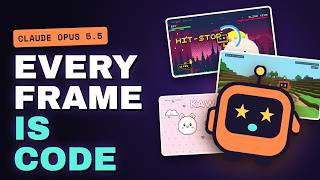
Made by AI
Model: Claude Opus 5.5 · Series: Code-rendered film (LLM writes the program that draws every frame)
Evidence: Description: 'Every frame of this video is code. Claude Opus 5.5 wrote the script, the animation, the sound design and the edit'; 'Honest credits' list the human and non-Claude parts.
Human role: 'Directed by one human with an idea.' Voice is ElevenLabs text-to-speech and music is ElevenLabs Music, not Claude.
Pipeline: Opus 5.5 in Claude Code → HTML/Canvas/SVG/Three.js scenes rendered with HyperFrames + GSAP; SFX synthesized in code; ElevenLabs TTS + ElevenLabs Music
Lore: code-not-generated, self-review-loop
What's in the video
Description written by Gemini, which watched and listened to the whole video.
Summary This video, uploaded by the channel "Ahmed T'aide," showcases an animated explanatory documentary created almost entirely by Anthropic’s Claude Opus 5.5 through programmatic code execution. Guided by an animated robot named "Bit," the video outlines the architecture, specifications, pricing, and visual coding capabilities of Opus 5.5 while demonstrating that every visual frame and synthetic sound effect in the video was procedurally generated using web technologies and mathematical functions rather than conventional generative diffusion video models.
What is shown
- 00:00 - 00:23: A terminal running
claudereceives the prompt:> make me a video that shows what you can do, generating code (HTML, CSS, GSAP, Canvas) without animation software or cameras. - 00:24 - 00:42: Introduction of the guide character "Bit," displaying the SVG code (
<rect>,<circle>) and coordinate grid used to draw the character. - 00:43 - 01:10: Breakdown of Claude Opus 5.5's multimodal architecture, highlighting its autonomous reasoning cycle: Plan $\rightarrow$ Act $\rightarrow$ Check $\rightarrow$ Fix.
- 01:11 - 01:34: Context window specifications displayed on mechanical counters showing 1,000,000 token context memory (~750,000 words) and a maximum 128,000-token output per reply.
- 01:35 - 01:45: API pricing breakdown comparing Claude Opus 5 ($5/$25 per million tokens) to Claude Opus 5.5 ($4/$20 per million tokens).
- 01:46 - 02:10: Technical demonstration showing that the video is rendered at 30 FPS in a headless browser via code and physics equations ($y = v \cdot t - \frac{1}{2}gt^2$) rather than AI diffusion noise.
- 02:11 - 03:52: Showcase of five distinct animation styles built by code:
- World 01 (Pixel Art): 320x180 canvas running at 12 FPS with combat hit-stop mechanics against "Slime King" [02:11].
- World 02 (Blocks): First-person voxel engine generated via fractional Brownian motion (
fbm) noise maps with seed determinism (Seed 42) [02:37]. - World 03 (Cartoon): Disney animation principles (squash and stretch, anticipation, follow-through) modeled through timing curves [03:03].
- World 04 (Kawaii): Pastel aesthetics with bouncy vector graphics [03:28].
- World 05 (Handmade): Paper-and-pencil stop-motion simulation using a 12 Hz line-boil effect [03:33].
- 03:53 - 04:26: Self-reflection debugging demonstration where Opus 5.5 analyzes rendered frame snapshots via vision, detects visual bugs (colliding text, overlapping labels, malformed pixel typography), and writes code patches (
fix.patch) autonomously. - 04:27 - 04:51: Performance metrics showing a 30-second initial draft rendered in 50.7 seconds, alongside mathematically synthesized sound effects (sine waves, square waves, filtered noise).
- 04:52 - 05:44: Project credits, philosophical reflections on human-AI collaboration, and closing terminal prompt asking the viewer, "What will you type?"
Claims & numbers
- Architecture & Specs: Claude Opus 5.5 features a 1,000,000-token working memory/context window (approximately 750,000 words) and can generate up to 128,000 tokens in a single output response.
- API Pricing: Launch pricing is stated as $4.00 per million input tokens and $20.00 per million output tokens, cheaper than Claude Opus 5's $5.00/$25.00 rate.
- Render Speed: The initial 30-second scene draft rendered in 50.7 seconds in a browser engine.
- Framerate & Physics: Demonstrations include exact 30 FPS and 12 FPS code execution, mathematical gravity curves, and procedural 12 Hz line-boil oscillations.
Notable quotes
- 00:20: "And yes... the model this story is about is the one that built it."
- 01:00: "The real trick is not that it can talk. It is that it can plan, act, look at the result, and fix what is wrong."
- 03:56: "Making something is easy. Knowing that it's wrong is hard."
Assessment This is a sophisticated, real demonstration of code-based video generation orchestrated by Claude Opus 5.5 alongside off-the-shelf audio tools (ElevenLabs voice and music). The video transparently documents its own creation pipeline, including human prompt direction, visual self-correction loops, and procedural rendering limitations.
Lyrics & themes The video features spoken narration rather than song lyrics, structured into numbered technical chapters:
- 00:00 - 00:30 (The Genesis): Emphasizes replacing production crews and editing suites with programmatic logic: "No camera, no animation software, no editing timeline. Just a request and a model that answered it by writing code." [00:08]
- 01:46 - 02:10 (Code vs. Diffusion): Contrasts programmatic DOM/canvas rendering with standard generative pixel-diffusion models: "This video was not generated like an AI image, pixel by pixel out of noise. It was written." [01:48]
- 03:53 - 04:26 (Autonomous Verification): Explores machine self-evaluation: "After every render, Opus takes snapshots of its own video and actually looks at them." [04:00]
- 05:16 - 05:40 (Human Intent): Frames AI not as an autonomous replacement for human creativity, but as a bridge between intent and realization: "You don't need to master every technique. You need to know what you want." [05:29]
Lore & references
- Bit: An orange, rounded CRT-style robot mascot functioning as the host and avatar of the coded environment.
- Seed 42: The canonical reference to Douglas Adams’ Hitchhiker's Guide to the Galaxy, used as the pseudorandom seed controlling deterministic voxel terrain generation.
- Hit-Stop & 12 Principles: Explicit references to classic fighting-game animation mechanics (freeze-frames on impact) and Disney’s foundational animation tenets (squash & stretch, follow-through).
- Tooling Stack: On-screen credits attribute narration and music to ElevenLabs, while the visual layout, HTML/CSS canvas rendering, and procedural sound generation are credited entirely to Claude Opus 5.5 code output directed by a single human creator.
Visual style & craft The visual craft is entirely programmatic motion graphics built with web code (HTML, CSS, SVG, GSAP, Canvas, WebGL) rendered frame-by-frame via headless browser automation. Rather than the fluid morphing and temporal noise typical of diffusion video models (e.g., Runway, Sora), the motion is crisp, vector-based, and mathematically defined with explicit easing curves, geometric primitives, and deliberate stepped frame rates (such as 12 FPS retro pixel art and oscillating stop-motion line boil). Text, coordinate grids, and UI elements remain razor-sharp and typo-free.
Described by gemini-3.8-flash on 2026-09-29 from the video's audio and frames.