"Opus 5.5 ultra created this masterpiece": 4 agents, an hour and a half, no AI voice API (X video)
AndrewOnXYZ (@AndrewOnXYZ) · 2026-09-22 · ai-made · 382,341 views
Made by AI
Model: Claude Opus 5.5 · Series: Code-rendered film (LLM writes the program that draws every frame)
Evidence: X post (2026-09-22): 'What the actual fuck. Opus 5.5 ultra created this masterpiece. 4 agents and an hour and a half later. Everything from scratch, no AI voice API used... / / this is it...'
Human role: Ran Opus 5.5 "ultra" with 4 agents for about 90 minutes; "everything from scratch, no AI voice API used". Prompt not published.
Pipeline: Opus 5.5 with 4 subagents → 4-minute code-rendered film (mission control monitoring a duck-shaped Mars rover, per claudevideo.org), including synthesized voice
Lore: code-not-generated
What's in the video
Description written by Gemini, which watched and listened to the whole video.
Summary
Shared by AndrewOnXYZ (@AndrewOnXYZ), this animated short film titled Fourteen Minutes depicts the final sol of a robotic Mars rover named Moss and its human controller on Earth, Ada, as budget cuts force NASA to shut down communications. Reportedly generated via four Claude Opus 5.5 agents executing custom graphics code and synthesized audio in 90 minutes without voice APIs, the narrative dramatizes the 14-minute light-speed delay between Mars and Earth.
What is shown
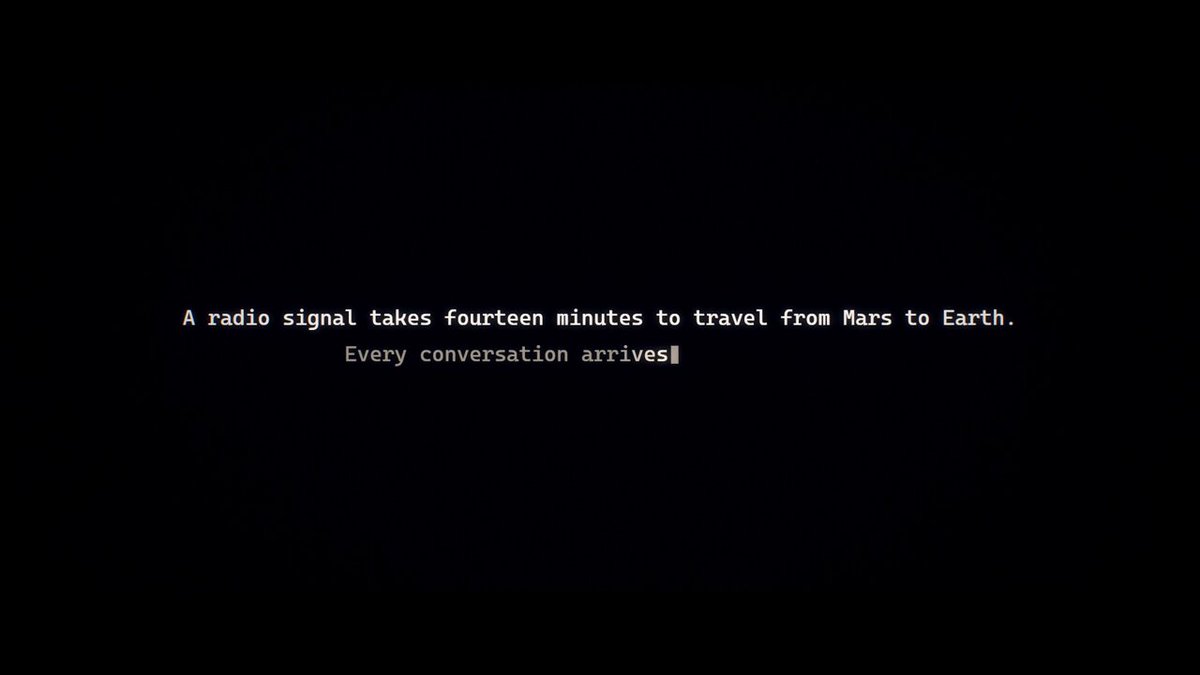
- [00:00 - 00:14]: Opening terminal text explaining the 14-minute radio signal latency between Mars and Earth, segueing into the title card FOURTEEN MINUTES.
- [00:15 - 00:47]: Moss wakes up on Meridiani Plains (Sol 4012), greets its pet rock "Gerald", notices a duck-shaped rock in the distance, and radios Earth that it is investigating.
- [00:48 - 01:20]: Earth control room at DSS-14 Goldstone / JPL, where Ada is informed by supervisor Frank that budget cuts require shutting down the Deep Space Network dish at midnight; Ada radios Moss the shutdown notice and a warning about the terrain.
- [01:21 - 01:50]: "Fourteen Minutes Later" title card; Moss gets stuck in soft sand near the duck rock just as Ada's warning and decommissioning news arrives on a 14-minute delay.
- [01:51 - 02:22]: Moss dislodges itself and decides to spend its remaining power climbing the steep ridge to see Earth; at JPL, Frank notes Moss is entering a dust storm, and Ada observes that whatever happened occurred 14 minutes prior.
- [02:23 - 02:44]: Moss pushes up the ridge as power drops to 11% in high winds, breaking through the storm canopy into sunlight at the ridge summit.
- [02:45 - 03:08]: Moss admires the blue Martian sunset, spots Earth as a bright blue point in the night sky, and takes a photograph.
- [03:09 - 03:28]: A split-screen interface shows Moss transmitting the image while both Moss and Ada exchange mutual farewells and thanks across space.
- [03:29 - 03:45]: Light signals cross the interplanetary void; at 23:59:51 PDT, the photo of Earth arrives on Ada's console; at 00:00:00 PDT, the carrier signal drops ("LINK CLOSED / M.O.S.S. - MISSION COMPLETE - SOL 4012").
- [03:46 - 04:00]: Moss sits silently on the ridge beside Gerald under a starry Martian sky as its battery depletes to zero, followed by a post-credits stinger where Moss notices Gerald has somehow appeared beside it on the ridge.
Claims & numbers
- A radio signal takes 14 minutes to travel from Mars to Earth (stated in opening text [00:02] and telemetry [00:40]).
- Moss was designed for a 90-day nominal lifespan but survived for 11 years (4,012 sols) [00:29, 01:00].
- The video's closing dedication states: "For Opportunity — built to last 90 days, explored Mars for 14 years" [03:53].
- The closing card claims: "Every frame drawn in code. Every sound synthesized" [03:53].
- The uploader states the animation was built by four Claude Opus 5.5 agents in 1.5 hours without commercial voice APIs.
Notable quotes
- [01:00]: "Eleven years, Frank. She was built to last ninety days." — Ada
- [02:20]: "So whatever happens up there..." / "...already happened." — Frank and Ada
- [03:23]: "And you're the brightest thing in my sky." / "You were the best of us." — Moss and Ada
Assessment
This is a narrative creative showcase demonstrating programmatic animation and sound design orchestrated by autonomous LLM coding agents. The entire visual presentation consists of procedural code-rendered vector graphics and custom canvas rendering rather than generative diffusion video, paired with synthesized parametric audio and speech.
Lyrics & themes
The piece is not a sung track, but a dramatic dialogue short film scored with ambient, synthesized instrumental music.
- Key Themes: Physical distance and light-delay communication, mortality and decommissioning of exploratory probes, artificial affection, and human connection across space.
- Sample Lines:
- [00:26]: "Gerald is not a morning rock."
- [01:43]: "After that... we won't be able to hear you anymore."
- [02:45]: "Ada... the sunsets here are blue. Did you know that?"
- [03:13]: "Moss... I only ever saw your world in pictures. Fourteen minutes old."
Lore & references
- Opportunity Rover (Oppy): The film directly allegorizes NASA's Mars Exploration Rover Opportunity, which had a planned 90-sol mission, operated for over 14 Earth years in Meridiani Planum, and ultimately ended following a global dust storm in 2018.
- Martian Blue Sunsets: References the real Martian atmospheric phenomenon where fine dust particles cause forward Rayleigh scattering of red wavelengths away, leaving a distinctive blue halo around the setting sun.
- DSS-14 Goldstone: A real 70-meter Deep Space Network antenna complex in California used for deep-space missions.
- Gerald the Rock: A nod to field geologists and planetary scientists personifying terrain features and stones encountered during rover missions.
Visual style & craft
The visual production utilizes programmatic 2D/2.5D vector illustration and shader-like procedural backgrounds (stars, dust particles, Martian horizon, atmospheric gradients) rendered in code. Transitions, camera pans, and retro CRT terminal HUD telemetry overlays (Sol counters, power percentages, transmission logs) are rendered programmatically rather than output by a diffusion video generator, exhibiting crisp lines, synchronized text typing, and clean frame-to-frame consistency.
Described by gemini-3.8-flash on 2026-09-30 from the video's audio and frames.