Claude Opus 5.5 Looks Insane… But Can It Code My Game?
AI Dev Challenge and Can It Code? · 2026-09-24 · review · 25,440 views
What's in the video
Description written by Gemini, which watched and listened to the whole video.
Summary
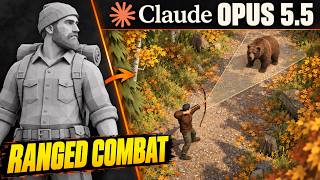
This devlog video, presented by the indie game developer channel AI Dev Challenge (collaborating with Can It Code?), demonstrates using Anthropic’s Claude Opus 5.5 to design and implement a complete ranged combat system for their game in under three hours. The developer walks through generating the mechanic specification with Opus, visualizing it with Astra 6, orchestrating multi-agent code and asset generation, and successfully testing the resulting archery combat against a charging bear in-engine.
What is shown
- Specification Session [00:41]: Brainstorming archery mechanics with Opus 5.5 in a terminal CLI, establishing rules for hold-draw-release timing, string snapping after excessive hold, aim cones, travel time, and damage scaling.
- Concept Visualization [02:26]: Passing the spec into Astra 6 to generate a visual reference of the third-person aiming cone and shot trajectory.
- Round 1 Implementation & Ranged Lab [02:45]: Opus 5.5 writes the underlying combat mechanics; tested in a grid-like sandbox against static targets and sheep, verifying aim cones, leading moving targets, sweet-spot bonus damage (1.25×), and arrow retrieval.
- Round 2 Multi-Agent Delegation [04:06]: An Opus 5.5 orchestrator assigns sub-tasks to three Opus 5.5 sub-agents: Agent 1 creates bow models, Agent 2 creates textured quivers, and Agent 3 retargets a Mixamo bow-draw animation onto the project's custom character skeleton.
- Round 2 Integration [05:10]: Demonstrating the merged result with complete animations, equipped quiver, and selectable bows.
- Final In-Game Combat Test [05:46]: Deploying the bow mechanics into the main forest environment, where the player successfully takes down a charging bear in three timed shots.
- API Cost Breakdown [05:27, 06:13]: Visualizing token usage, cache reads/writes, and financial cost across both development rounds and the overall project.
Claims & numbers
- The entire ranged combat implementation was completed in under 3 hours (presenter's claim).
- Restringing after a snapped bowstring takes 2.5 seconds (presenter's mechanic spec).
- Perfect release timing grants a 1.25× bonus damage multiplier.
- Round 1 Cost: 92 model calls, 114k output tokens, 701k cache write tokens, 20.4M cache read tokens (~$12.00 API cost).
- Round 2 Cost: 302 model calls, 454k output tokens, 4.0M cache write tokens, 75.0M cache read tokens ($48.70 API cost; broken down as Orchestrator: $23.90, Quiver agent: $17.10, Bows agent: $7.70).
- Total Project Cost: $74.00 on the API across 539 model calls, 739k tokens written, and 130.3M tokens re-read ($12.00 for Round 1, $48.70 for Round 2, $13.30 for Round 3).
- On the developer's Claude "Max 5x" subscription plan, the entire task consumed approximately 10% of their weekly allowance.
Notable quotes
- [00:17] "This is how it cooked the range combat in our game."
- [04:58] "Totally different skeleton, and it just... works. Incredible."
- [06:28] "From a spec, to a picture, to this. I love it."
Assessment
This is a genuine indie game development log showcasing a real practical workflow combining Claude Opus 5.5 for orchestration/coding with other tools for visual concepting and asset retargeting. The developer openly demonstrates early rough edges (missing animations and collision issues in Round 1) before showing how sub-agents resolved them in Round 2.
Described by gemini-3.8-flash on 2026-09-29 from the video's audio and frames.