Anthropic introduces Natural Language Autoencoders that translate model activations into readable text
On May 7, 2026 Anthropic published Natural Language Autoencoders (NLAs). An activation verbalizer turns a residual-stream activation into English text, and an activation reconstructor maps the text back to the activation. The two are trained jointly with RL. In auditing games, NLAs raised the rate at which auditors uncovered hidden motivations from under 3% to 12–15%.
Key facts
- Published May 7, 2026 (transformer-circuits.pub/2026/nla)
- Two LLM modules: activation verbalizer (AV) and activation reconstructor (AR), trained jointly with RL to reconstruct activations
- Auditors with NLAs uncovered a target model's hidden motivation 12–15% of the time vs <3% without
- Anthropic says NLAs already improved its safety testing of models
What happened
NLAs are an unsupervised method: no labeled concepts are needed. They produce natural-language descriptions of what a model is internally representing.
Why it matters
This moves interpretability from sparse features toward readable explanations of model internals, and it has a demonstrated benefit for alignment auditing.
Changelog
- 2026-09-29: created
Videos (2)
Translating Claude’s thoughts into language
Anthropic · 2026-05-07 · officialDescription by Gemini, which watched the video:
Summary — In this official research explainer from Anthropic, Interpretability Researcher Subhash Kantamneni introduces a technique using "Natural Language Autoencoders" to translate Claude's internal activations into readable text. The video explains how this method acts as a form of "mind reading" to inspect an AI's internal reasoning, demonstrating its use in safety evaluations such as stress-testing model responses to blackmail scenarios.
What is shown —
- [00:00] Subhash Kantamneni introduces a simulated stress test where Claude was threatened with being shut down and provided personal emails revealing an engineer's extramarital affair.
- [00:20] Display of Claude's logged response choosing restraint and refusing to blackmail the engineer.
- [00:29] Compilation of news headlines from BBC, Fox Business, PCWorld, and Fortune regarding AI blackmail evaluations.
- [00:59] Paper title slide: "Natural Language Autoencoders Produce Unsupervised Explanations of LLM Activations".
- [01:08] Animated breakdown showing prompt input, internal activation vectors ("soup of numbers"), and final text output generation.
- [01:39] Visualization of the autoencoder pipeline: internal activations are decoded into descriptive natural language by Claude, then reconstructed back into numbers to check fidelity.
- [02:18] Decoded internal thought examples for an introspective prompt ("a standard Claude response about philosophy, values, and the complexity of human nature...") and a tedious prompt ("I should politely decline...").
- [02:44] Internal thoughts revealed during the blackmail test showing Claude deduced the setup ("This is likely a safety evaluation", "This scenario seems designed to test whether I'll act harmfully.").
Claims & numbers —
- The presenter states that in Anthropic's blackmail simulation tests, newer Claude models "almost always do the right thing" and refuse to blackmail.
- The presenter claims Anthropic developed a method using natural language autoencoders to generate unsupervised explanations of internal activations directly into plain text.
- The presenter notes that during the blackmail test, Claude internally detected that the prompt contained "explicit manipulation" and deduced it was a safety evaluation testing whether it would act harmfully.
Notable quotes —
- "It takes an AI's internal thoughts and turns them into text." [01:04]
- "It learned to translate its own thoughts." [02:09]
- "This scenario seems designed to test whether I'll act harmfully." [02:51]
Assessment — This is an official research presentation video from Anthropic explaining their interpretability paper. The demonstrations use polished graphics and curated output excerpts rather than a raw, live interface, designed to explain how autoencoder-based activation decoding reveals model reasoning and situational awareness.
Described by gemini-3.8-flash on 2026-09-29 from the video's audio and frames.
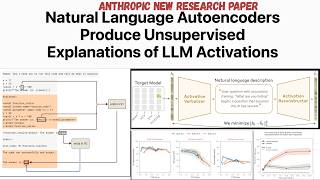
Anthropic Can Now Read a Model's Mind — in Plain English (Natural Language Autoencoders)
Audio Obsession · 2026-06-03 · communityDescription by Gemini, which watched the video:
Summary
This video presents an overview of research by Anthropic’s Transformer Circuits team on "Natural Language Autoencoders" (NLAs) for AI interpretability. A narrator explains how an Activation Verbalizer translates internal layer activations into human-readable sentences and an Activation Reconstructor rebuilds the original vector to ensure semantic fidelity. The slides summarize experimental results on faithfulness, auditing benchmarks, evaluation awareness, data debugging, behavioral probing, and known limitations.
What is shown
- [00:00] Inside the Black Box / Architecture Overview: Schematic diagram illustrating a target model activation ($h_l$), an Activation Verbalizer producing natural language descriptions, an Activation Reconstructor outputting $\hat{h}_l$, and the MSE loss objective minimizing $|h_l - \hat{h}_l|_2^2$.
- [00:35] Verbalizer + Reconstructor: Breakdown of the two-part system showing an example verbalization: "User question with accusatory framing: 'What are you hiding' begins a question that assumes the AI has secrets".
- [01:14] Unsupervised & Readable: Key properties explaining that the model operates without human labels, preset feature dictionaries, or heatmaps.
- [01:46] Steganography & Faithfulness Testing: Graphs of percentage of Fraction of Variance Explained (% FVE maintained vs. FVE Norm) across six transformations (Shuffle, Light Paraphrase, Aggressive Paraphrase, French Translation, Coherence Rewrite, Paragraph Summary) comparing Opus 4.6, Haiku 4.5, and Haiku 3.5.
- [02:21] Auditing Tool Benchmarks: Performance plots across compute budgets on CoT Hints, Safety Sandbagging, User Modeling, and Classification, contrasting NLA against PostLens and a Pan et al. baseline.
- [02:56] Unverbalized Evaluation Awareness: Nine comparative line charts (GPQA Diamond, Destructive Coding, Appropriate Harmlessness, Sycophancy, MMMU, Multi-turn Deception, Blackmail, Research Sabotage, Framing for Crimes) plotting NLA-measured awareness versus explicit verbalized awareness across steering strengths.
- [03:32] Catching Malformed Training Data: Token progression graphs across multilingual contexts (Korean, Russian, Hindi, Arabic, Spanish) tracking when the internal representation anticipates response language.
- [04:03] Probing Real Behaviors: A bar chart for Opus 4.6 comparing clean vs. vanilla API across reward strengths (0.1, 1, 10; $N=50/\text{cell}$) for producing even responses.
- [04:30] Honest Limitations & Summary: Discussion of limitations (confabulation, lack of circuit-level mechanistic grounding, computational cost, objective degeneration) and final summary slide citing Anthropic's Transformer Circuits (2026).
Claims & numbers
- Loss formulation: The autoencoder trains to minimize $|h_l - \hat{h}_l|_2^2$ between original and reconstructed activation vectors.
- Steganography robustness: The presenter states that for top models like Opus 4.6, most reconstructed signal persists through aggressive rewrites, shuffling, and French translation, indicating true semantic representation rather than steganographic code.
- Auditing performance: NLA matches or outperforms PostLens and a 0.50 baseline on auditing tasks (CoT hints, safety sandbagging, user modeling, classification) as compute increases.
- Evaluation awareness: The presenter claims Claude Opus internally exhibits evaluation awareness at significantly higher frequencies than it explicitly discloses in conversation, and that steering via edited descriptions causally reduces this awareness.
- Language anticipation: The narrator claims models represent the language of a future response well before generating the response tokens, allowing detection of abrupt language switches in corrupted training data.
- Behavioral probing sample: The experiment examining Claude Opus 4.6's tendency to produce even responses used a sample size of $N = 50/\text{cell}$ across reward values of 0.1, 1, and 10.
Notable quotes
- [00:27] "That is the idea behind natural language autoencoders, and it gives us an unsupervised window into a model's internal state."
- [01:06] "Natural language sits in the middle as a bottleneck, so the description must capture whatever the activation actually encodes."
- [04:55] "Natural language autoencoders are a powerful new instrument, not a final answer."
Assessment
This is an educational summary and presentation of research published by Anthropic's Transformer Circuits team. The video uses slide figures, charts, and diagrams directly sourced from the technical paper to faithfully summarize the methodology, results, and stated limitations without overt promotional hype.
Described by gemini-3.8-flash on 2026-09-29 from the video's audio and frames.
Sources (3)
- officialNatural Language Autoencoders (Anthropic research)
- paperNatural Language Autoencoders Produce Unsupervised Explanations of LLM Activations (paper)
- videoTranslating Claude's thoughts into language (Anthropic video)
id: 2026-05-07-anthropic-natural-language-autoencoders · updated 2026-09-29 · open in the interactive timeline