Claude autonomously designs protein binders that work in the lab against 14 of 15 targets
On Aug 18, 2026 Anthropic reported that Claude (Mythos Preview and Opus 4.8), running autonomously in Claude Science, designed de novo protein binders against 15 targets and produced confirmed binders for 14 of them in outside wet-lab tests by Adaptyv Bio and Twist Bioscience. Hit rates were 22.6–35.1%, against the 10–15% typical of protein design campaigns. The same post showed Opus 5 processing raw NMR and LC-MS files in about 25 minutes, matching a contract lab's results.
Key facts
- 354 confirmed binders from 1,320 designs, against 14 of 15 targets (30 designs requested per target)
- Hit rates: Mythos Preview 26.7% and Opus 4.8 22.6% in multi-target mode (48 h, up to 12,500 H100 hours); Mythos Preview 35.1% in single-target mode (24 h, up to 2,500 H100 hours per target). Anthropic cites 10–15% as typical
- Wet-lab production and testing done independently by Adaptyv Bio and Twist Bioscience
- High-affinity binders against at least six targets; binders matching or exceeding the best reported affinity against at least four
- RBX1: Mythos Preview reached a 40% hit rate vs 3.7% among Adaptyv competition participants; its top design outperformed the winning entry (245 designs entered)
- Opus 4.8, not Mythos Preview, succeeded on the hard target TNFα, including binders cross-reactive to human, cynomolgus monkey and mouse TNFα
- Failures: no confirmed binder against maltose-binding protein (0 of 90 designs); only three modest binders against the de novo β-barrel BBF-14
- Humans only granted access approvals and monitored infrastructure after the initial prompt; prompts and all in vitro and in silico data released
- Chemistry test: Opus 5 in Claude Science returned processed NMR and LC-MS results in 23 and 19 minutes from raw vendor files; purity 96.4% vs the lab's 96.33%. It decoded an undocumented LC-MS format, checked against all 2,664 scans
- Protein design and other dual-use biology stay blocked in generally available Claude Fable 5; Anthropic said an access program for scientists was a top priority
Science result
- Field
- biology / protein design
- Problem
- De novo design of protein minibinders against benchmark and novel targets (incl. Adaptyv BenchBB, 15-PGDH, GDF-8, RBX1, TNFα)
- Result
- Binders confirmed in the wet lab for 14 of 15 targets; 354 binders from 1,320 designs; overall hit rates 22.6–35.1%, several binders exceeding the best published affinities.
- AI system
- Claude Mythos Preview, Claude Opus 4.8, Claude Science
- Human role
- Humans chose the targets, wrote the prompt and ran the infrastructure; Claude ran the design campaign autonomously; outside labs ran the wet-lab validation
- Verification
- Independent wet-lab testing by Adaptyv Bio and Twist Bioscience; company technical report, not peer-reviewed
- Status
- confirmed
- Why surprising
- A general-purpose model orchestrating existing open-source tools matched or beat top human protein design competition entries.
What happened
Anthropic ran a multi-arm binder design campaign in Claude Science. Claude chose binding sites on each target, orchestrated open-source structure-design, sequence-design and co-folding models, ran several rounds of in silico optimization and screened candidates. After the first prompt nobody gave it scientific guidance. Adaptyv Bio and Twist Bioscience then made and tested the designs. Anthropic described the 354 binders as a sizeable addition to public de novo binder data. By comparison, it counted about 770 binders from 5,700 designs across 40 targets in the two largest existing public collections.
The post also tested a generally available model, Opus 5, on routine analytical chemistry. Working only from a contract lab's raw instrument files, it reproduced the lab's NMR and purity results. It also proposed the same heavy-water follow-up test that the lab had run on its own.
Why it matters
It was among the first wet-lab-validated demonstrations of a general-purpose LLM agent running a whole protein design campaign at or above expert level. It was the basis for Anthropic's later work to make the pipeline cheaper (Sept 17) and for its Life Sciences Verification Program. The results are the company's own, and the hit-rate comparisons use Anthropic's baseline figures. Anthropic says it will characterize the binders further to confirm hit rates and affinities.
Changelog
- 2026-09-30: created (Anthropic blog audit; the post had not been cited)
Videos (1)
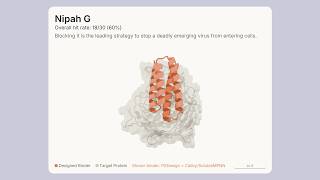
Claude designs proteins that bind in the lab
Claude · 2026-09-01 · demoDescription by Gemini, which watched the video:
Summary
This video is a promotional showcase highlighting de novo protein binder designs and reported experimental hit rates across twelve biological and therapeutic targets. Presented with 3D molecular visualizations and background synth music, it concludes with Anthropic's Claude branding.
What is shown
- [00:00] 15-PGDH: 3D structural model showing candidate binder clouds condensing into a helical binder (PXDesign + SolubleMPNN).
- [00:05] BHRF1: Docking animation of a binder (Genie3 + SolubleCaliby) to target protein.
- [00:10] EGFR: Binder conformation (Mosaic + SolubleMPNN) aligned to target receptor.
- [00:15] IL-7Rα: Multi-helix designed binder (Genie3 + SolubleMPNN) complexed with the target.
- [00:20] Latent GDF-8: Helix bundle binder (Genie3 + SolubleMPNN) positioned against latent GDF-8.
- [00:25] Nipah G: Four-helix bundle binder (PXDesign + Caliby/SolubleMPNN) targeting the viral glycoprotein.
- [00:30] PD-L1: Binder design (PXDesign + SolubleMPNN) shown binding to checkpoint receptor PD-L1.
- [00:35] RBX1: Binder design (BoltzGen) docked to the target protein.
- [00:40] TNFα: Binder (PXDesign + Mutagenesis) positioned on target cytokine.
- [00:46] TREM2: Helical binder (Genie3 + SolubleMPNN) bound to target immune receptor.
- [00:51] TrkA: Designed binder (Mosaic + SolubleMPNN) bound to the pain pathway receptor.
- [00:56] VEGF-A: Multi-helix binder (PXDesign + SolubleCaliby) docked against the angiogenic factor.
- [01:01] Concluding Anthropic Claude spark logo animation.
Claims & numbers
- 15-PGDH: Overall hit rate of 23/30 (77%); on-screen text states inhibiting it has boosted tissue repair and muscle regeneration in preclinical studies.
- BHRF1: Overall hit rate of 21/30 (70%); on-screen text states inhibiting it could strip Epstein–Barr-driven cancers of a key survival protein.
- EGFR: Overall hit rate of 8/30 (27%); on-screen text states shutting it down halts the growth signal driving many lung and colon cancers.
- IL-7Rα: Overall hit rate of 22/30 (73%); on-screen text states modulating it is being tested as a way to rein in T cells behind autoimmune disease.
- Latent GDF-8: Overall hit rate of 1/30 (3%); on-screen text states locking myostatin in its dormant form is a clinically tested strategy for building and preserving muscle.
- Nipah G: Overall hit rate of 18/30 (60%); on-screen text states blocking it is the leading strategy to stop the virus from entering cells.
- PD-L1: Overall hit rate of 14/30 (47%); on-screen text states blocking it releases the immune system to attack tumors.
- RBX1: Overall hit rate of 2/19 (11%); on-screen text states a binder may enable research on protein-recycling machinery.
- TNFα: Overall hit rate of 4/30 (13%); on-screen text states neutralizing it calms inflammation behind arthritis and Crohn's disease.
- TREM2: Overall hit rate of 28/30 (93%); on-screen text states engaging it is explored to mobilize brain immune cells in Alzheimer's disease.
- TrkA: Overall hit rate of 11/30 (37%); on-screen text states blocking NGF signaling through this receptor is a clinically tested non-opioid route to pain relief.
- VEGF-A: Overall hit rate of 21/30 (70%); on-screen text states blocking it cuts off tumor blood supply and preserves vision in macular degeneration.
Notable quotes
- none (video contains no spoken voiceover or dialogue).
Assessment
This is an official promotional video presenting structural models and summary benchmark hit rates for AI-assisted protein design tools across twelve targets. While the animations effectively illustrate docking configurations and target applications, assay details, binding affinities (Kd), and experimental conditions are not shown in the clip.
Described by gemini-3.8-flash on 2026-09-29 from the video's audio and frames.
Related events
- Anthropic launches Claude Science, an AI workbench for researchers (beta) ★★★
- Claude speeds up 30+ open-source biology models about 4x and folds 10,000+ token complexes on one GPU node ★★★
- Claude agents discover a novel CRISPR-like enzyme system; Anthropic reveals its own biology wet lab ★★★★
- Anthropic releases Claude Fable 5 and Claude Mythos 5 — first generally available Mythos-class model ★★★★★
- AlphaProteo designs high-affinity protein binders, including the first AI-designed VEGF-A binder ★★★
- RFdiffusion: diffusion models design new proteins that work in the lab ★★★★
Sources (4)
- officialAnthropic: How Claude is accelerating protein design and analytical chemistry
- pressThe Next Web: Anthropic says Claude designed working protein binders, and beat human experts on some
- pressDataconomy: Claude designed protein binders for 14 of 15 targets
- presspharmaphorum: Claude Science outperforms experts in protein binder task
id: 2026-08-18-claude-protein-binders-wet-lab · updated 2026-09-30 · open in the interactive timeline