Claude designs proteins that bind in the lab
Claude · 2026-09-01 · demo · 54,023 views
What's in the video
Description written by Gemini, which watched and listened to the whole video.
Summary
This video is a promotional showcase highlighting de novo protein binder designs and reported experimental hit rates across twelve biological and therapeutic targets. Presented with 3D molecular visualizations and background synth music, it concludes with Anthropic's Claude branding.
What is shown
- [00:00] 15-PGDH: 3D structural model showing candidate binder clouds condensing into a helical binder (PXDesign + SolubleMPNN).
- [00:05] BHRF1: Docking animation of a binder (Genie3 + SolubleCaliby) to target protein.
- [00:10] EGFR: Binder conformation (Mosaic + SolubleMPNN) aligned to target receptor.
- [00:15] IL-7Rα: Multi-helix designed binder (Genie3 + SolubleMPNN) complexed with the target.
- [00:20] Latent GDF-8: Helix bundle binder (Genie3 + SolubleMPNN) positioned against latent GDF-8.
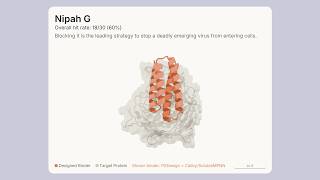
- [00:25] Nipah G: Four-helix bundle binder (PXDesign + Caliby/SolubleMPNN) targeting the viral glycoprotein.
- [00:30] PD-L1: Binder design (PXDesign + SolubleMPNN) shown binding to checkpoint receptor PD-L1.
- [00:35] RBX1: Binder design (BoltzGen) docked to the target protein.
- [00:40] TNFα: Binder (PXDesign + Mutagenesis) positioned on target cytokine.
- [00:46] TREM2: Helical binder (Genie3 + SolubleMPNN) bound to target immune receptor.
- [00:51] TrkA: Designed binder (Mosaic + SolubleMPNN) bound to the pain pathway receptor.
- [00:56] VEGF-A: Multi-helix binder (PXDesign + SolubleCaliby) docked against the angiogenic factor.
- [01:01] Concluding Anthropic Claude spark logo animation.
Claims & numbers
- 15-PGDH: Overall hit rate of 23/30 (77%); on-screen text states inhibiting it has boosted tissue repair and muscle regeneration in preclinical studies.
- BHRF1: Overall hit rate of 21/30 (70%); on-screen text states inhibiting it could strip Epstein–Barr-driven cancers of a key survival protein.
- EGFR: Overall hit rate of 8/30 (27%); on-screen text states shutting it down halts the growth signal driving many lung and colon cancers.
- IL-7Rα: Overall hit rate of 22/30 (73%); on-screen text states modulating it is being tested as a way to rein in T cells behind autoimmune disease.
- Latent GDF-8: Overall hit rate of 1/30 (3%); on-screen text states locking myostatin in its dormant form is a clinically tested strategy for building and preserving muscle.
- Nipah G: Overall hit rate of 18/30 (60%); on-screen text states blocking it is the leading strategy to stop the virus from entering cells.
- PD-L1: Overall hit rate of 14/30 (47%); on-screen text states blocking it releases the immune system to attack tumors.
- RBX1: Overall hit rate of 2/19 (11%); on-screen text states a binder may enable research on protein-recycling machinery.
- TNFα: Overall hit rate of 4/30 (13%); on-screen text states neutralizing it calms inflammation behind arthritis and Crohn's disease.
- TREM2: Overall hit rate of 28/30 (93%); on-screen text states engaging it is explored to mobilize brain immune cells in Alzheimer's disease.
- TrkA: Overall hit rate of 11/30 (37%); on-screen text states blocking NGF signaling through this receptor is a clinically tested non-opioid route to pain relief.
- VEGF-A: Overall hit rate of 21/30 (70%); on-screen text states blocking it cuts off tumor blood supply and preserves vision in macular degeneration.
Notable quotes
- none (video contains no spoken voiceover or dialogue).
Assessment
This is an official promotional video presenting structural models and summary benchmark hit rates for AI-assisted protein design tools across twelve targets. While the animations effectively illustrate docking configurations and target applications, assay details, binding affinities (Kd), and experimental conditions are not shown in the clip.
Described by gemini-3.8-flash on 2026-09-29 from the video's audio and frames.