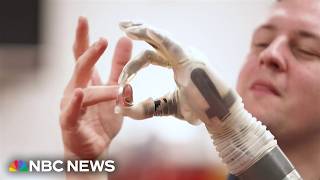
Utah’s AI-decoded nerve-interface bionic arm goes home with its first trial participant
Restores touch
Confirmed
The takeaway
On Sept 18, 2026, University of Utah Health announced the first home trial of its bionic arm: amputee Alexander “Avi” Davidson will use DEKA’s LUKE Arm, driven by the implanted BIOS direct nerve interface and custom AI decoding software, for a year at home.
Status
- Claim
Confirmed
- Our reporting
- High confidence
- Importance
- 2 of 5
- Last verified
- 19 October 2026
Your AI and this story
- GPT-6 Astra141 days after its cutoff
- Claude Opus 5.580 days after its cutoff
- Gemini 4 Argon171 days after its cutoff
- Grok 4.7110 days after its cutoff
None of these four assistants can know about it. The closest, Claude Opus 5.5, stops 80 days before it.
Key facts
- Device: DEKA’s commercially available LUKE Arm prosthesis plus the BIOS Controller direct nerve interface implanted in the residual limb; it lets the user control the arm by thought and returns sensation (University of Utah Health, Sept 18)
- AI: the university credits ‘the latest iteration of the technology’s software and AI’ with more life-like sensation, more dexterity and more intuitive control, making unsupervised home use feasible; Utah Business: a custom AI trained on the body’s electrical signals (not an LLM), a chip near the shoulder about the size of a pinkie fingernail, reading and sending signals in about 10 ms; BIOS says it used more than 30,000 hours of human data
- Participant: Alexander ‘Avi’ Davidson, who lost his left arm below the elbow after a 35-foot fall at 16; ninth participant in this line of Utah research and the first to take the arm home; one-year trial with a possible extension
- People: Jacob A. George (Utah NeuroRobotics Lab director, BIOS chief scientist), Marshall Trout; earlier participants supervised by Gregory Clark and Douglas Hutchinson; earlier work funded by DARPA and NSF
- Regulatory: Investigational Device Exemption early feasibility study; the BIOS interface received FDA Breakthrough Device designation in March 2024 and entered the FDA’s TAP programme. BIOS CEO Josh Miller: availability for adults in 18–24 months, upper-arm loss first
- Quote (Davidson): ‘The ability to have a return of sensation to my previously dominant hand is a life-altering experience.’
What happened
Utah researchers and their spin-out BIOS combined an implanted nerve interface, AI decoding software and DEKA’s LUKE Arm into a neuroprosthesis that moves by thought and gives a sense of touch. On Sept 18, 2026 the university said the first participant, Avi Davidson, would take it home for a year, the first unsupervised use outside the lab. NBC News covered it on Oct 13.
Why it matters
The step from lab sessions to daily home use is what decides whether such prostheses reach patients; BIOS talks of a product in 18–24 months. The “AI” here is a custom signal decoder, not a general model, and no new peer-reviewed paper accompanied the announcement (the NBC segment names no paper).
Sources
4 sources from 4 sites. Numbers match the chips in the text.
4 sources: 1 primary, 2 press, 1 reaction
Primary
- University of Utah Health: From Lab to Living Room: Revolutionary Utah Bionic Arm Enters First Home Trial (Sept 18, 2026)healthcare.utah.edu, official
Press
- Utah Business: BIOS bionic arm: Holding his wife’s hand for the first time (Sept 10)utahbusiness.com, press
- Deseret News: This bionic arm sounds like science fiction — but it’s notdeseret.com, press
Reactions
Changes
- Filed (video agent request)