Data center opposition a rare issue uniting Americans across the political divide | 60 Minutes
60 MinutesYouTube1,829,401 views as of 9 October 2026
Why it is here
60 Minutes on bipartisan community backlash against AI data centers. ~1.83M views by 2026-10-09. Length 12:56.
Description
Description written by Gemini from the videoGemini 3.8 Flash, 9 October 2026
Summary
In this 60 Minutes investigative report, correspondent Norah O’Donnell examines the growing nationwide grassroots and political backlash against the rapid construction of massive AI data centers. The segment travels across Texas to profile rural residents, local officials, energy experts, and ranchers who argue that hyperscale data centers threaten their electrical grids, water resources, tax bases, and rural way of life.
What is shown
- [00:53] Norah O’Donnell drives with US Marine veteran Jasmine Villegas past rural farmland slated for data center development near Dallas, Texas.
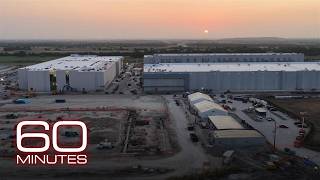
- [01:15] Aerial footage of massive industrial data center complexes and ongoing construction sites.
- [02:06] Clips of contentious local town hall and city council meetings in Pennsylvania, Loudoun County (Virginia), Chandler (Arizona), and Red Oak (Texas).
- [03:36] Interview with University of Texas energy and water resources professor Michael Webber detailing the energy scale of AI computing clusters.
- [05:14] B-roll illustrating modern AI applications, including autonomous vehicles, industrial robotics, and laboratory research.
- [06:09] Political speeches and rallies featuring Texas Governor Greg Abbott and Democratic candidate Gina Hinojosa addressing data center grid impacts.
- [07:50] A meeting of local Red Oak, Texas residents organizing bipartisan opposition to a planned multi-building campus by developer Compass.
- [09:11] Interview with Hood County Commissioner Dave Eagle regarding confidential corporate proposals (codenamed Project Yellow, Red, Lion, Panther) and AWS tax abatement demands.
- [11:44] Interview with third-generation rancher Blake Quinn herding cattle on his ranch while explaining threats to local grazing land and water availability.
Claims & numbers
- The presenter states there are over 3,000 data centers operating in the United States and another 1,500 proposed [00:33].
- Loudoun County, Virginia, has the world’s highest concentration of data centers [02:29].
- Professor Michael Webber states that roughly two years ago, a large data center was around 5 megawatts, whereas new AI data centers can require 1,000 megawatts—approximately 200 times larger [04:21].
- The presenter notes Meta, Amazon, Google, and Microsoft are expected to spend $1.5 trillion on data centers through next year [04:40].
- A CBS News analysis found that golf courses across the US consume more than twice as much water as data centers [05:41].
- The report cites polling showing that more than 60% of Republicans, Independents, and Democrats oppose having a data center built where they live [07:41].
- Compass’s proposal in Red Oak comprises 10 two-story data centers on agricultural land equal in area to Manhattan’s Central Park [08:08]; across seven campuses, data centers would occupy over one-quarter of Red Oak [08:29].
- Hood County received data center proposals totaling roughly 8,000 to 10,000 acres [09:12].
- Amazon Web Services requested property tax abatements of up to 90% for 30 consecutive years from Hood County [10:52].
- Two-thirds of newly proposed data centers are planned in rural America [12:18].
Notable quotes
- Jasmine Villegas [01:35]: “Just because I’m not in uniform doesn’t mean that my service to this country has ended.”
- Michael Webber [04:21]: “In the old days, and by old days I mean like two years ago, a large data center might have been five megawatts. A new data center for AI might be a thousand megawatts. That’s like 200 times larger.”
- Blake Quinn [12:39]: “Rural Texans, they’re going to fight as hard as anybody, because that’s all we know how to do. We won’t give up.”
Assessment
This is a standard broadcast news magazine report featuring on-the-ground reporting, stakeholder interviews, and public document reviews. It provides a balanced journalistic overview of the infrastructure demands of the AI boom alongside the local environmental and economic conflicts arising across rural communities.
Described by gemini-3.8-flash on 2026-10-09 from the video’s audio and frames.