‘Dot battle’: Opus 5.5 drives Blender, Python and After Effects to turn a fight into beat-synced dots
aicreataro (@aicreataro)X122,270 views as of 11 October 2026
Why it is here
Listed in the awesome-claude-5-5-videos library; ~122k views. Post lists lessons on dot size, half-beat switching and pauses.
Description
Description written by Gemini from the videoGemini 3.8 Flash, 11 October 2026
Summary
This video showcases an experimental animation titled “‘Dot battle’”, created by AI creator @aicreataro using Claude Opus 5.5 to coordinate Blender, Python scripts, and Adobe After Effects. It depicts a fast-paced martial arts and sword combat sequence rendered entirely through dynamic, beat-synced halftone dot matrices and glowing particle patterns.
What is shown
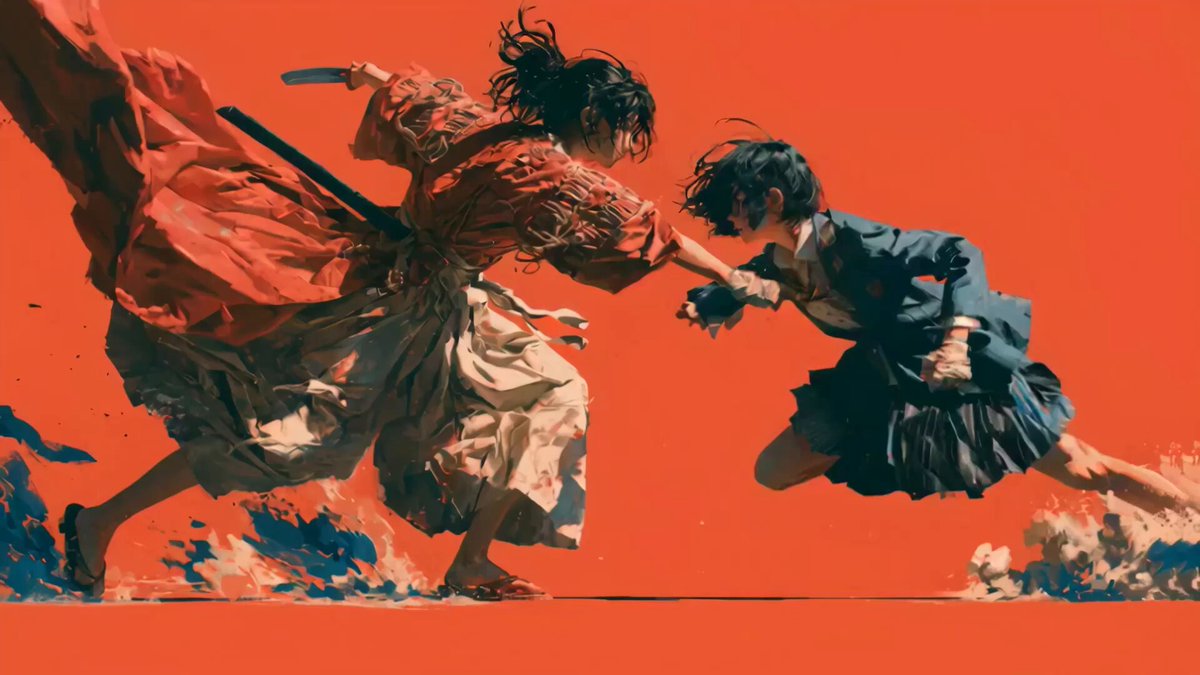
- [00:00 - 00:03]: Opening combat sequence rendered as large pixelated dots on a red background, transitioning to a burst of pulsating bokeh-style circular dots on black.
- [00:03 - 00:06]: A low-angle sword duel rendered in dense red and white dot rasters, bursting into a field of sparkling white and gold particles that morph into a blue-and-white halftone duel.
- [00:07 - 00:12]: Rapid cuts of combatants silhouetted in violet, white, and golden luminous dot clusters reacting to strike impacts and sound transients.
- [00:13 - 00:16]: High-contrast combat scenes shifting between magenta/red and vibrant cyan backdrops, showing sword sweeps and weapon impacts represented by chromatic particle dispersion.
- [00:16 - 00:20]: Climax of the fight featuring particle shockwaves, striking stances rendered in circular dots, and a final dissolve into minimalist white dots on black.
Claims & numbers
- None (no spoken dialogue, benchmark results, or textual capability claims are presented in the video).
Notable quotes
- None (the audio consists solely of combat vocal grunts, sword whooshes, impact sound effects, and rhythmic percussive music).
Assessment
This is a creative demonstration reel showcasing code-driven and tool-orchestrated visual generation rather than a benchmark or product launch. The footage is tightly edited and synchronized to audio transients, illustrating the stylistic potential of LLM-orchestrated procedural visual scripting pipelines.
Lyrics & themes
- Theme: The piece is an instrumental and sound-design-focused action scene centered on rhythm, martial combat choreography, and geometric abstraction.
- Lyrics: The piece is entirely instrumental with stylized combat vocal grunts (e.g., martial arts shouts at [00:07], [00:16], and [00:18]).
Lore & references
- Halftone / Dot Matrix Aesthetic: Evokes classic LED matrix displays, comic-book Ben-Day dots, and retro visualizer displays re-imagined through procedural 3D motion tracking.
- Procedural VFX Pipelines: Part of the broader late-2026 creator movement where frontier models (such as Claude Opus 5.5) generate and execute Blender Python scripts and compositing graphs to create stylized animation without traditional video diffusion models.
Visual style & craft
- Visual Style: A hybrid of 3D motion-capture animation and procedural 2D/3D post-processing, where human silhouettes and motion vectors are converted into variable-sized circles, halftone dot screens, and floating particle fields.
- Craft: The motion flows smoothly from human combat tracking, indicating underlying 3D skeletal animation or video keyframing that was shaded and stylized via automated Blender scripts and After Effects particle/halftone plugins directed by code.
Described by gemini-3.8-flash on 2026-10-11 from the video’s audio and frames.
Made by AI
- Made with
- Claude Opus 5.5, Seedance 2.0
- How we know
- X post (2026-10-03, Japanese): ‘Opus 5.5 operated Blender, Python and AE’; battle footage and sound from Seedance 2.0
- Human role
- Human designed the concept and iterated on rules (dot size, timing, explosions).
- Pipeline
- Seedance 2.0 battle footage → Opus 5.5 analyses outlines/depth in Blender + Python → dots switch every half-beat → After Effects
- Series
- Agent-driven 3D (LLM operates Blender)