DeepSeek V4.1 Flash 1017: I Tested It on 6 Real Apps for $1.97 (KingBench 4)
AISeeKing YouTube 3,180 views as of 17 October 2026
Why it is here
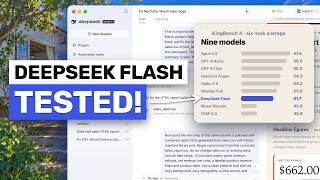
Hands-on test (14 min) of the 1017 update on six KingBench 4 app tasks through OpenCode at maximum reasoning effort. Per the description: served under the existing deepseek-flash name, image input, tool calls, 1M-token context; the six projects cost about $1.97 in API charges; the 3D room designer scored 8.8/10.
Description
Description written by Gemini from the videoGemini 3.8 Flash, 17 October 2026
Summary
The creator behind the channel AISeeKing evaluates the newly updated DeepSeek-V4.1-Flash-1017 model across six coding and system-building tasks from the KingBench 4 evaluation suite using the OpenCode CLI, along with a separate sequence-inference challenge. The video tests each generated application without manual code repairs, examining real functionality, interface design, security sandbox behavior, and API token billing.
What is shown
- [00:05]: DeepSeek API change log documenting the release of
DeepSeek-V4.1-Flash-1017on 2026-10-17, noting 1M context window and tool-calling support. - [01:56]: Task 1: Rust Multi-System Emulator: Testing an emulator built for Game Boy, DS, and 3DS. While it renders homebrew Game Boy game µCity with functioning save states, it fails 5 of 8 diagnostic timing/interrupt tests and omits actual DS/3DS emulation engines (Score: 2.0/10).
- [02:55]: Task 2: Docker Alternative (
vela): Testing a Go container tool that pulls Alpine images from Docker Hub, tags, loads, and unpacks root filesystems, but alters filesystem permissions outside its intended extraction directory on malformed archives and lacks measured efficiency gains (Score: 3.0/10). - [04:00]: Task 3: 3D Room Designer (Haven Interior Studio): Demonstrating a 3D interior design web app with furniture placement, color/material options, undo/redo, customizable sunlight and ambient lighting, and snapshot exports, achieving 60 FPS on an M4 Max GPU (Score: 8.8/10).
- [05:19]: Task 4: QMK Keyboard Configurator (Pollen Studio): Testing a yellow-themed VIA alternative. Despite a polished UI with key remap tables and lighting selectors, it filters for incorrect raw-HID vendor usage (
0xFF61instead of0x61), failing connection to standard QMK virtual devices (Score: 3.0/10). - [06:15]: Task 5: Pokémon Red Recreation: A complete browser-based recreation in a handheld bezel, played from Pallet Town through Viridian Forest to defeating Brock’s Geodude and Onix at the Pewter Gym, retaining quest logs and save states (Score: 8.2/10).
- [07:42]: Task 6: Fitbit Desktop App (FORM Health): Testing an app with a Rust backend and Whoop-style dark UI showing sleep, strain, and recovery metrics, but finding date-span calculation flaws and synthetic demo data blended into imported records without a raw data toggle (Score: 6.0/10).
- [09:14]: Separate Challenge: “Find the Hidden Cuts”: Testing the model’s ability to infer an underlying 32-bit affine LCG generator from numerical output; the model correctly identifies 28/28 test cases and matches all 1,792 withheld predictions (Score: 9.8/10).
- [10:09]: Benchmark leaderboard and token cost accounting showing total token usage, cached input reuse, and comparative costs against Claude Haiku 5.5, Muse Wonder, and GPT-6 Astra.
Claims & numbers
- DeepSeek’s reported benchmarks: The presenter cites DeepSeek’s published figures of 42.3 on Terminal-Bench 4.0 (via Claude Code) and 77.0 on DeepSWE v1.1 (via Mini-SWE-V2) [01:03].
- KingBench 4 Average Score: The presenter reports DeepSeek-V4.1-Flash-1017 achieved an average of 5.17/10 (51.7%), placing it 7th out of 9 models, behind Claude Opus 5.5 (57.8%), GPT-6 Astra (56.5%), GPT-6.1 Sol (55.0%), Gemini 4 Argon (54.3%), Claude Haiku 5.5 (54.2%), and Muse Wonder Full (53.0%), but ahead of Muse Wonder (45.8%) and GLM-5.3 (45.8%) [10:09].
- Task Scores:
- Emulator: 2.0/10 [02:43]
- Docker alternative: 3.0/10 [03:57]
- Room designer: 8.8/10 (highest among all 9 tested models) [05:11]
- Keyboard configurator: 3.0/10 [06:12]
- Pokémon Red: 8.2/10 [07:33]
- Fitbit analytics app: 6.0/10 [09:06]
- Hidden Cuts sequence challenge: 9.8/10 [09:53]
- Token Usage & API Cost:
- 6 main tasks processed ~264 million total tokens (~262M cached input tokens, ~1.84M output tokens including 1.02M reasoning tokens) [11:01].
- Total API charge for the 6 tasks was $1.97, and $2.03 including the sequence challenge, billed at DeepSeek’s weekend/off-peak pricing ($0.003/M cached input, $0.15/M fresh input, $0.60/M output) [11:05, 11:46].
- The presenter notes that for the same six tasks, Claude Haiku 5.5 cost between $7.40 and $7.56 (~3.8× higher), Muse Wonder cost $10.52, and GPT-6 Astra cost between $39.61 and $74.86 [12:03].
Notable quotes
- [00:29]: “Let’s examine the projects, because the useful parts and the failures explain much more than the average score.”
- [12:45]: “My conclusion is that Flash looks useful for projects where you can quickly inspect and test the result.”
- [13:13]: “For me, the strongest reason to try this update is the amount of useful work it produced for roughly two dollars in model charges.”
Assessment
This is an independent, detailed empirical benchmark review demonstrating code generated directly by DeepSeek-V4.1-Flash-1017 via OpenCode. All applications are shown running in local environments (Rust, Go, web browsers), complete with functional testing of runtime edge cases, security boundary testing, and transparent breakdowns of API billing logs.
Described by gemini-3.8-flash on 2026-10-17 from the video’s audio and frames.
Related
More videos on this
-
DeepSeek V4.1 Flash v2 Matches Opus 5.5 for 90% LESS?
Universe of AI10,900 views as of 17 Oct