A game from one 24-hour Claude Opus 5 session: every pixel and sound built by Claude
Anshu (@anshuc) X 663,484 views as of 9 October 2026
Why it is here
The biggest agent-made game video of July 2026, two months before the Opus 5.5 wave. Reddit threads summarised in AINews (2026-07-28/29) described it as a No Man’s Sky/Starfield-style exploration game built in about a day. gmi_cloud later rebuilt its own 24-hour Opus 5 project, “Sakura Crossing”, with Opus 5.5 in 2 hours (~264k views).
Verified 2026-09-30 via X public embed data (fxtwitter): ~662,066 views, 3,680 likes, 247 reposts; video 0:53; posted 2026-07-27 18:00 UTC.
Description
Description written by Gemini from the videoGemini 3.8 Flash, 30 September 2026
Summary This video is a gameplay demonstration of a custom 3D sci-fi space exploration game reportedly developed entirely—code, 3D assets, shaders, and sound—by Anthropic’s Claude Opus 5 in a single 24-hour session. Shared by Anshu (@anshuc) on X, the footage showcases first-person cockpit and ship interior traversal, seamless planetary landing and on-foot exploration, and hyperdrive jumps between distinct star systems.
What is shown
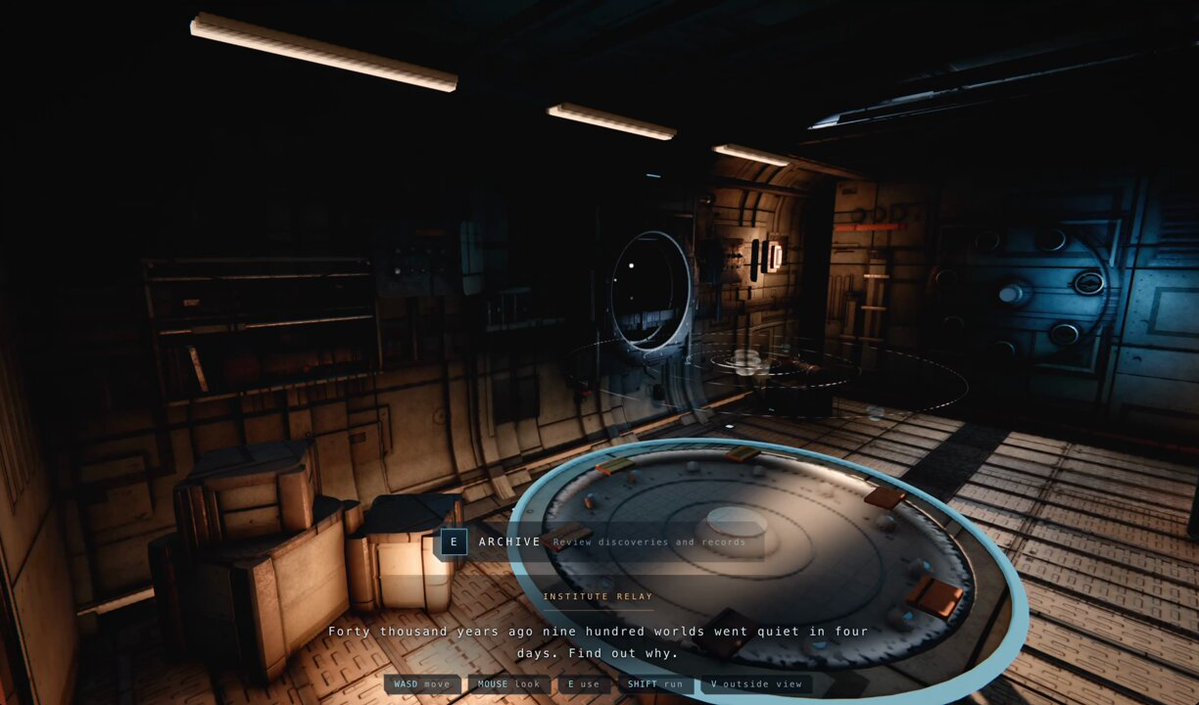
- [00:00] First-person walking through an industrial spaceship hallway to the bridge, with atmospheric lighting and on-screen mission objectives.
- [00:04] Interacting with the helm cockpit controls, displaying flight instruments, system telemetry, and targeting reticles.
- [00:08] Engaging the “F.O.L.D.” hyperspace jump drive with warp-streak visual effects.
- [00:11] Cutscene sequence showing external atmospheric re-entry and descent to the planet surface of “ITHIRKA II”.
- [00:17] On-foot exploration of the planet surface showing green hills, stylized low-poly trees, distant mountains, and player control keybinds on the HUD.
- [00:23] Ship takeoff and transition back into space orbit.
- [00:24] Third-person orbital view of an Earth-like planet in the “VERUXNIS” star system.
- [00:34] Initiating a second hyperspace jump from inside the cockpit.
- [00:37] Arrival at the “SENUXVEK” red dwarf system featuring a large ringed gas giant.
- [00:44] External flight controls targeting navigation beacons (“BEACON KP-8623-A”) and orbital objectives (“RESONATOR VII”) near the planetary ring plane.
Claims & numbers
- The metadata claims the game was built during “one 24-hour Claude Opus 5 session” with “every pixel and sound built by Claude”.
- In-game text: “Forty thousand years ago nine hundred worlds went quiet in four days. Find out why.” [00:00]
- In-game objective: “Scanner online. Seven Resonators are out there. Bring back what they say.” [00:01]
- System data: “VERUXNIS / YELLOW-WHITE DWARF / 7 WORLDS” [00:24] and “SENUXVEK / RED DWARF / 3 WORLDS” [00:36].
Notable quotes
- [00:00] “Forty thousand years ago nine hundred worlds went quiet in four days. Find out why.” (on-screen text)
- [00:01] “Scanner online. Seven Resonators are out there. Bring back what they say.” (on-screen text)
- [00:12] “ITHIRKA II / DESCENT / ATTITUDE NOMINAL” (on-screen text)
Assessment This is a genuine demo reel of a real-time game engine prototype rather than pre-rendered CGI. The video consists of edited gameplay clips edited together to demonstrate diverse subsystems (player movement, flight model, terrain generation, procedural skyboxes, and UI).
Lyrics & themes
- The audio is entirely instrumental and atmospheric, consisting of synthesized space ambient droning, engine rumbles, thruster bursts, and interface beeps.
- The thematic narrative revolves around cosmic mystery and space archaeology: discovering why hundreds of inhabited worlds went dark millennia ago by tracking down mysterious acoustic/signal “Resonators.”
Lore & references
- Resonators & Institute Relay: A classic sci-fi trope reminiscent of Outer Wilds or Elite Dangerous, framing the player as an isolated scout uncovering lost galactic history.
- “FOLD” Engine: Represents faster-than-light space-folding travel mechanics.
- Claude Opus 5 Generation: Serves as a technical showcase highlighting 2026-era frontier LLM code generation capable of handling complex 3D engine scripts, input handling, procedural meshes, and shader systems.
Visual style & craft
- Features a blend of high-contrast interior sci-fi lighting and stylized low-poly exterior assets (billboard trees, basic terrain geometry, and ring shader math).
- The presentation uses standard game HUD elements (WASD movement indicators, flight gimbal markers, contact lists, and system diagnostics).
Described by gemini-3.8-flash on 2026-09-30 from the video’s audio and frames.
How AI was used to make it
AI made all of it of this video: subject built by ai.
- Claude Opus 5 generated all game code, procedural 3D models, textures, and audio in a single 24-hour marathon session
Tools named: Claude Opus 5
Classified by gemini-3.8-flash from our description of the video (high confidence), 25 October 2026. How AI is used to make videos, across the whole log
Made by AI
- Made with
- Claude Opus 5
- How we know
- X post (2026-07-27): ‘I ran Claude Opus 5 in one marathon session for 24 hours straight, and ended up with this game. / / No external assets or code. Every pixel and sound was built by Claude. / / Prompts, workflow, code, and link below. / / (sound on!)’
- Human role
- Anshu ran Opus 5 in one marathon session for 24 hours straight; published prompts, workflow, code and a playable link in the thread.
- Pipeline
- Opus 5 in one 24-hour session → game code plus procedurally made 3D models, textures and sound (no external assets) → 53-second gameplay video
- Series
- Agent-built game or 3D world (the video shows the result)
Related
More videos on this
-
Claude Opus 5 is a freak
AI Search691,630 views as of 9 Oct
-

Anthropic Just Revealed How to Prompt Opus 5
Paul J Lipsky90,186 views as of 8 Oct
-

I Tested Fable 5.1 vs Fable 5 vs Opus 5 (Cost/Speed/Design)
Brock Mesarich | AI for Non Techies22,457 views as of 6 Nov
-

NEW Sonnet 5.5 Is Opus 5 Level
Mehul Mohan21,319 views as of 24 Oct