But What About China? | Claude Opus 5.5 Music Video
Automated Artist YouTube 439 views as of 13 October 2026
Why it is here
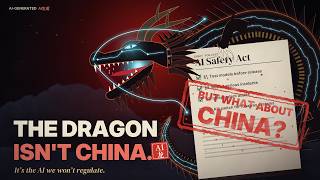
Automated Artist music video on the ‘but what about China?’ objection to slowing AI development (theme read from the title; the description gives only the credit line).
Description
Description written by Gemini from the videoGemini 3.8 Flash, 13 October 2026
Summary
“But What About China?” is an AI-generated animated music video and policy essay produced by the channel “Automated Artist” using Anthropic’s Claude (for lyrics, research, and visual scripting) alongside ElevenLabs Music (for vocals and instrumentation). The song challenges the common political talking point that Western AI safety regulations are unworkable due to competition with China, arguing instead that international verification, monitoring, and coordination mechanisms can and must be developed.
What is shown
- [00:00 - 00:22] Intro sequence presenting traditional Chinese seal script stamps for the four-character phrase “那中国呢” (Nà Zhōngguó ne / “But what about China?”).
- [00:23 - 00:43] A legislative hearing room setting where a speaker proposes basic AI safety rules (pre-release testing, safety plan, incident reporting) before being dismissed by an interjection from the back: “BUT WHAT ABOUT CHINA?”.
- [00:44 - 01:31] Traditional courtyard scene depicting a locked gate with an “EXIT” sign, visualizing the chorus where the question is used as an excuse to shut down debate.
- [01:32 - 02:09] Shanghai and Beijing skyline visuals highlighting statements from Chinese leadership and international scientists (IDAIS Beijing statement) agreeing on AI red lines (no self-replication, no deceptive AI, no weapons assistance).
- [02:10 - 02:52] Checklist addressing core governance challenges: Coordination (协调), Transparency (透明), and Verification (核查).
- [02:53 - 03:22] Technical verification proposals: monitoring 1 GW data centers via power and satellite thermal imagery, chip accounting via fab declarations, and recomputing network taps (“Plan A”).
- [03:23 - 03:44] Historical case study of the 1987 Montreal Protocol and monitoring of CFC-11 emissions via atmospheric detection stations on Gosan (Jeju) and Hateruma.
- [03:45 - 04:18] Symmetrical split-screen depiction of hearing rooms in Washington and Beijing both asking “But what about America?” / “But what about China?”, transitioning to a bilateral red phone/hotline.
- [04:40 - 04:56] Comprehensive source bibliography slide detailing academic papers, treaty documents, and policy reporting referenced throughout the video.
Claims & numbers
- The presenter/song cites that the US Senate rejected a proposed 10-year moratorium on state AI laws 99–1 on July 1, 2025.
- The lyric cites Xi Jinping’s keynote at the World AI Conference in Shanghai on July 17, 2026, advocating that AI remain under human control.
- Cites the IDAIS Beijing Statement (March 2024) signed by Yoshua Bengio, Geoffrey Hinton, Andrew Yao, and Xue Lan establishing red lines against autonomous self-replication and deception.
- States that 1 GW frontier AI campuses consume power equivalent to approximately 1 million US homes and emit thermal/satellite signatures visible from space (citing Epoch AI).
- Notes that the Montreal Protocol (1987) was signed by 198 parties, that China closed its last CFC plants in 2007 (2.5 years ahead of schedule), and that illicit eastern Chinese CFC-11 emissions were successfully pinpointed by monitoring stations on Gosan (Jeju) and Hateruma before dropping by ~15,000 t/year after enforcement.
- Mentions that in September 2026, the US and China agreed to establish an AI incident channel and bilateral AI dialogue.
Notable quotes
- [00:44] “It’s not a question if you never wait to hear the answer — it’s a locked gate. It’s not a question, it’s an exit sign...”
- [01:21] “You say it like a full stop, but it ends in a question mark — so ask it like you mean it: not to end it, but to start.”
- [02:10] “Yeah, the problem’s real — I won’t pretend it’s not, but a problem is a job, not a full stop.”
Assessment
This is a polished, fully AI-generated musical video essay and policy advocacy piece rather than a software demonstration or product review. The arguments, citations, and data points displayed in onscreen sidebars are carefully referenced from actual treaty precedent, technical white papers, and geopolitical dialogues to dismantle a specific policy deadlock.
Lyrics & themes
- Hearing Room & The Rhetorical Deflection [00:22 - 01:31]: Establishes how “What about China?” functions as a conversation-ending conversation stopper rather than a sincere inquiry.
- Line: “Write a safety plan, report it when it breaks — it’s a seatbelt, not a wall, that’s all it takes.” [00:28]
- China’s Policy & The Meaning of Control [01:32 - 02:52]: Examines official Chinese statements and the semantic ambiguity of kòng (控, “control”), concluding that trust must be backed by verification (yàn / 验).
- Line: “Sure, words are cheap, and ‘control’ can mean a lot — so don’t take it on faith. Check it. That’s the plot.” [02:01]
- Technical Verification & The Montreal Precedent [02:53 - 03:44]: Proposes tangible verification schemes (compute tracking, datacenter thermal observation, chip supply chains) and draws a direct comparison to the enforcement of the ozone treaty.
- Line: “You can’t hide a gigawatt — a training run burns like a city at night, chillers on the roof that the satellites spot.” [02:56]
- Mutual Paranoia & The Hotline [03:45 - 04:39]: Depicts how mirror-image distrust paralyzes decision-makers on both sides, calling for active bilateral communication instead of paralysis.
- Line: “And somewhere in Beijing, in a room just like ours, someone says ‘let’s slow down’ — and a voice from the back: ‘But what about America?’” [03:45]
Lore & references
- “Trust, but verify” / INF Treaty: References Ronald Reagan quoting the Russian proverb (doveryay, no proveryay) during the 1987 Intermediate-Range Nuclear Forces Treaty negotiations to emphasize that agreements depend on on-site inspection protocols rather than goodwill.
- Red Lines / IDAIS: Alludes to the International Dialogues on AI Safety meetings in Beijing where top Western and Chinese researchers jointly affirmed common red lines against self-replicating or cyber-offensive frontier models.
- Montreal Protocol & CFC-11 Receipts: Leverages the atmospheric detection of rogue CFC emissions in East Asia as proof that international atmospheric and physical sensor networks can identify non-compliant industrial actors even without intrusive domestic searches.
- “Full stop vs. Question mark”: Central recurring motif contrasting a rhetorical dead-end with genuine diplomatic and technical engagement.
Visual style & craft
- Visual Style: Stylized 2D motion graphics and paper-cutout/vector aesthetic blending traditional Chinese motifs (red lacquer gates, hanging lanterns, ink-wash mountain landscapes, Chinese chops/stamps) with modern infographic dashboards, data overlays, and technical schematic callouts.
- Craft & Assembly: The visual compositions, kinetic typography, and synchronized slide text are orchestrated based on Claude-generated scripts, paired with a pop-R&B vocal and instrumental track generated via ElevenLabs Music. Source cards, citations, and dual-language overlays appear neatly anchored to specific lyrical cues throughout.
Described by gemini-3.8-flash on 2026-10-13 from the video’s audio and frames.
Made by AI
- Made with
- Claude Opus 5.5
- How we know
- YouTube description: ‘Done with Opus5.5 and Elevenlabs’; the title names ‘Claude Opus 5.5 Music Video’.
- Human role
- Not stated beyond the credit line.
- Pipeline
- Claude Opus 5.5 (visuals; what else it wrote is not stated) + ElevenLabs (audio; which product is not stated)
- Series
- Claude Pop