T Equals One – Navier Stokes Millennium Prize Problem | Claude Opus 5.5 Music Video
Automated Artist YouTube 82 views as of 13 October 2026
Why it is here
Automated Artist music video about the Navier–Stokes Millennium Prize problem, the one maths-themed video on a channel otherwise about AI safety (theme read from the title; the description gives only the credit line).
Description
Description written by Gemini from the videoGemini 3.8 Flash, 13 October 2026
Summary
“T Equals One” is an AI-generated animated music video and educational song about the Navier–Stokes existence and smoothness Millennium Prize Problem and the September 2026 machine-assisted blow-up result. Produced under the channel “Automated Artist”, the track features music generated by ElevenLabs Music, with lyrics, procedural code, and 2D fluid simulation visuals created by Anthropic’s Claude.
What is shown
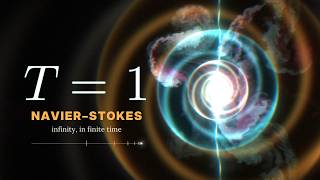
- [00:00 - 00:19] Title sequence displaying “$T = 1$” and “T EQUALS ONE: a song about the Navier-Stokes problem” over spinning chromatic fluid vortices.
- [00:20 - 00:37] Coffee cup animation introducing Claude-Louis Navier (1822) and George Gabriel Stokes (1845), presenting the incompressible Navier–Stokes momentum and continuity equations alongside practical fluid dynamics applications (ocean currents, airfoils, stirring coffee, rainfall).
- [00:38 - 00:57] Laminar flow streamlines perturbed into a singular vortex, displaying the Clay Millennium Prize Problem details ($1,000,000, posed in 2000) and asking whether smooth flows can blow up in finite time.
- [00:58 - 01:11] Accelerating spiral countdown sequence illustrating self-similar cascades (“half the size in half the time”) heading towards $t = 1$.
- [01:12 - 01:38] Electronic drop featuring high-contrast kaleidoscopic visualizations of a fluid singularity accompanied by metrics showing the $L^\infty$ norm velocity blowing up past $10^7$ while kinetic energy $E(t)$ remains bounded.
- [01:39 - 01:56] Historical timeline transitioning from Jean Leray’s 1934 weak solutions to Córdoba & Martínez-Zoroa’s 2023 vortex cascade construction, followed by a visualization of 10,000 parallel AI agents running for 88 hours in September 2026.
- [01:57 - 02:12] Stirring spoon animation coupled with scrolling Lean 4 code showing the computer-assisted formal verification of the blow-up proof.
- [02:13 - 02:47] Second chorus and drop displaying intense symmetry blooms and chromatic aberration as the forced flow encounters blow-up at $t = 1$.
- [02:48 - 03:12] Explanatory bridge distinguishing between forced blow-up ($f \ne 0$) and unforced smooth decay ($f = 0$), comparing mathematical blow-up to physical molecular water, and highlighting the authorship debate between human mathematicians and AI swarms.
- [03:13 - 03:45] Final countdown and visual crescendo of vortex singularity breakup.
- [03:46 - 04:08] Outro depicting residual rotation in a coffee cup followed by full academic citations and tool credits.
Claims & numbers
- The Clay Mathematics Institute Millennium Prize for the Navier–Stokes problem carries a $1,000,000 award (posed in 2000) [00:53, 03:09].
- Jean Leray introduced weak solutions to the Navier–Stokes equations in 1934 (Acta Mathematica 63) [01:39, 03:56].
- Diego Córdoba and Luis Martínez-Zoroa constructed an infinite cascade of vortices for the 3D Euler equations in 2023 [01:49, 03:57].
- OpenAI deployed approximately 10,000 AI agents for 88 continuous hours to construct and verify the forced Navier–Stokes blow-up proof in September 2026 [01:53, 03:57].
- In the proven blow-up scenario, velocity becomes infinite ($|u(t)|_\infty \to \infty$) while total energy remains finite ($E(t) \le E(0)$) [01:15].
- Clay Institute prize conditions require peer-reviewed publication followed by a two-year waiting period and formal verification before consideration [03:09, 03:58].
- The video states that while the forced case ($f \ne 0$) was demonstrated to blow up, the unforced case ($f = 0$, Clay cases A & B) remains an open mathematical problem [02:54, 03:58].
Notable quotes
- [00:45] “But start it smooth, will it stay that way? Or can it tear itself apart in a finite time? Ninety years, and no one could say.”
- [02:04] “A proof too long for a life to read, so a machine checked every line at machine speed.”
- [03:03] “The math falls over. The coffee doesn’t. Who found it, the ladder or the ones who climbed?”
Assessment
This is a polished, AI-generated science-communication music video illustrating mathematical fluid dynamics and formal verification. The technical visualizations are rendered programmatically using a custom 2D Navier–Stokes grid solver, faithfully reflecting the underlying mathematical concepts rather than serving as commercial marketing hype.
Lyrics & themes
The song explores the tension between mathematical idealization and physical reality through fluid dynamics.
- Verse 1 [00:20 - 00:37]: Connects mundane everyday fluid observation (stirring a cup of coffee) to the classical equations formulated by Navier (1822) and Stokes (1845).
- Chorus [00:58 - 01:11]: Describes dyadic self-similar blow-up cascades: “Smaller and faster, a whirl in a whirl / a storm inside a storm inside the world / half the size in half the time / again, again, again, again / infinity folded into one line.”
- Verse 2 [01:39 - 02:12]: Chronicles mathematical progress from Leray’s 1934 weak solutions through the Córdoba–Martínez-Zoroa vortex ladder, concluding with modern AI automated theorem proving in Lean: “A proof too long for a life to read / so a machine checked every line at machine speed.”
- Bridge & Outro [02:48 - 03:52]: Contrasts mathematical continuum singularities with real molecular fluids (“And real water is molecules, restless and small / long before infinity there’s no smooth at all”), while examining human vs. machine credit attribution for automated discoveries.
Lore & references
- The Millennium Prize & Clay Institute: Direct reference to the unsolved status of smooth global solutions and the $1M reward.
- OpenAI’s September 2026 Navier–Stokes Announcement: References the 10,000-agent swarm that constructed the forced blow-up counterexample and the subsequent Nature / Quanta Magazine reporting.
- Lean Interactive Theorem Prover: Code snippets and text highlight computer verification via the Lean proof assistant, reflecting the 2026 trend toward formal verification of AI-discovered mathematical proofs.
- “The Ladder vs. The Climber”: A philosophical nod to whether conceptual credit belongs to the human mathematicians who designed the reduction framework (Córdoba & Martínez-Zoroa) or the AI models that completed the exhaustive search and verification.
Visual style & craft
- Graphics & Simulations: Combines algorithmic 2D grid fluid simulations (vortex pair interactions, shear layers) with geometric kaleidoscope shaders, particle point-clouds, and motion typography.
- UI Elements: Overlays exact LaTeX mathematical equations, kinetic typography with word-level highlighting synchronized to the vocal track, simulation telemetry gauges ($|u(t)|_\infty$), and Lean 4 syntax windows.
- Production Pipeline: End credits clarify that Claude authored the lyrics, procedural rendering code, and shader scripts, while ElevenLabs Music synthesized the vocals and electro-pop instrumental track.
Described by gemini-3.8-flash on 2026-10-13 from the video’s audio and frames.
Made by AI
- Made with
- Claude Opus 5.5
- How we know
- YouTube description: ‘Done with Opus5.5 and Elevenlabs’; the title names ‘Claude Opus 5.5 Music Video’.
- Human role
- Not stated beyond the credit line.
- Pipeline
- Claude Opus 5.5 (visuals; what else it wrote is not stated) + ElevenLabs (audio; which product is not stated)
- Series
- Claude Pop