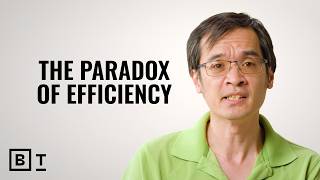
The paradox at the heart of AI and science | Terence Tao
Big Think ClipsYouTube2,352,675 views as of 12 October 2026
Why it is here
Big Think’s 30-minute Terence Tao piece on AI in mathematics and science; ~2.35M views, the most-viewed Tao-on-AI video of 2026 we know of. Missed since Sept 3.
Description
Description written by Gemini from the videoGemini 3.8 Flash, 12 October 2026
Summary
In an in-depth interview with Big Think, UCLA mathematics professor Terence Tao examines the evolving role of artificial intelligence in scientific research and mathematics. Tao reflects on the epistemological shift from human-driven theory and experimentation toward automated hypothesis generation, computation, and theorem proving, highlighting both the immense scaling potential and the risks of losing intuitive human understanding and training pipelines for future scientists.
What is shown
- [00:00 - 00:55] Terence Tao uses a hiking analogy to contrast human scientific exploration with helicopter-like AI shortcuts.
- [01:07 - 01:30] Big Think mid-roll membership promo.
- [01:48 - 02:16] Historical graphics displaying Johannes Kepler, Isaac Newton, Carl Friedrich Gauss, and the Prime Number Theorem formula ($\pi(x) \sim \frac{x}{\ln(x)}$).
- [05:35 - 06:40] Graphics illustrating machine learning concepts, including regression curve fitting and next-token prediction using sentence completion (“Roses are red. Violets are blue.”).
- [14:15 - 14:36] Historical engravings of the five Platonic solids, Kepler’s 1596 nested Platonic solid solar system model, and Tycho Brahe.
- [16:05] Comparison graphics contrasting historical Geocentric and Heliocentric cosmological models.
- [20:13] Graphic introducing the concept of “Proof indigestion.”
- [21:51 - 22:05] Portrait of Paul Erdős and an on-screen post from OpenAI announcing an autonomous AI breakthrough on Erdős’s 1946 planar unit distance problem.
- [23:49 - 24:02] Display of pages from the “First Proof” benchmark paper assessing AI systems across 10 unpublished research-level math questions.
Claims & numbers
- Historical compute in math: Tao notes that Carl Friedrich Gauss manually computed the first 100,000 prime numbers to uncover patterns that inspired the prime number theorem [02:09].
- AI math progression: Tao describes the progression over the past four years as advancing sequentially from middle school math to high school, math Olympiad, graduate qualifying exam problems, and finally open research conjectures [21:30].
- Breadth versus depth: Tao argues AI excels at breadth; pointing models at 1,000 problems with even a 5% success rate yields 50 solved problems, outproducing human output by raw volume [13:00].
- First Proof benchmark: Tao notes that in the First Proof challenge (evaluating models on 10 research-level questions), top frontier models answered 5 or 6 out of 10 [23:55].
- Software engineering gains and trade-offs: Tao mentions programmers report 5x, 10x, or 100x speedups in writing code using AI coding assistants, though often accompanied by declining manual coding retention and difficulty vetting agent outputs [24:28].
- Cost of compute runs: Tao notes that running extensive automated research/problem-solving runs can cost hundreds of dollars in compute per attempt, with no guarantee of success [24:16].
Notable quotes
- “These AI tools, they can be like helicopters that will just fly you directly to this waterfall... But you learn nothing about how to get there.” [00:36]
- “We are now experiencing what you might call proof indigestion, where suddenly there’s lots and lots of pending solutions to problems that should be understood... but we’re just flooded now with too many of them.” [20:11]
- “If you replace the grad students by these AIs... then we won’t get the next generation of students.” [27:59]
Assessment
This is a professionally produced expert interview from Big Think featuring Terence Tao. It does not contain live product demos or benchmark executions; historical diagrams, published papers, and social media announcements are shown as b-roll illustrations accompanying Tao’s spoken analysis.
Described by gemini-3.8-flash on 2026-10-12 from the video’s audio and frames.