OpenAI just posted 722 math papers at once...
BugX YouTube 20,360 views as of 15 October 2026
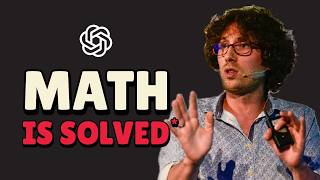
Why it is here
On the 722 manuscripts: three pulled within two days over a sign error, and fewer than half of the main results checked by computer. About 20,360 views on 2026-10-15.
Description
Description written by Gemini from the videoGemini 3.8 Flash, 15 October 2026
Summary — This video is an investigative documentary and review by BugX exploring the fallout from OpenAI’s release of 722 AI-generated mathematics manuscripts on October 6, 2026. It chronicles the sequence of AI math milestones leading up to this release, controversies over priority and “forced” Navier–Stokes blowup, and the severe verification bottleneck facing the mathematical community.
What is shown
- [00:00] The GitHub repository
openai/mathfirst commit page (dated October 6, 2026) showing 722 manuscripts categorized into 372 families. - [00:11] Quotes and reactions from mathematicians, including Fields Medalist Hugo Duminil-Copin’s post on Proofs and Prompts.
- [00:43] Timeline graphics reviewing Kevin Weil’s retracted October 2025 tweet claiming 10 solved Erdős problems, Thomas Bloom’s clarification on X, and Demis Hassabis’s response.
- [01:24] Website snippet from
erdosproblems.comshowing problem #90 disproved by an internal OpenAI model in May 2026, accompanied by video commentary from Fields Medalist Timothy Gowers [01:40]. - [02:08] 3D render of Clay Mathematics Institute Millennium Prize plaques, explaining the Navier–Stokes existence and smoothness problem and finite-time blowup [02:30].
- [02:44] Statements by Tristan Buckmaster and Levent Alpöge, Buckmaster’s interview on CNBC Squawk Box [03:30, 06:58], and OpenAI’s September 10 statement regarding Codex prompt independence.
- [04:14] Lean code samples from OpenAI’s math repository and discussion of the 166-page Navier–Stokes preprint.
- [04:58] The September 11, 2026 declaration signed by 25 Fields Medalists titled “A Severe Misalignment of AI in Mathematics.”
- [06:01] Overview of OpenAI’s October 6 catalog, including claimed results for the Unique Games Conjecture, the rational Hodge conjecture for CM abelian varieties, and integer multiplication algorithms.
- [07:54] OpenAI withdrawal notice and algebraic diagrams detailing a sign error ($I_{\text{new}} = I(f_1) - m \neq 0$) that led to the retraction of three papers.
Claims & numbers
- The presenter notes that on October 6, 2026, OpenAI posted 722 math manuscripts across 372 result families to GitHub, all written by AI [00:05].
- The presenter notes that in October 2025, OpenAI VP Kevin Weil tweeted that GPT-5 had found solutions to 10 unsolved Erdős problems and progress on 11 others, which maintainer Thomas Bloom clarified were pre-existing references [00:48].
- The presenter states that in August 2026, OpenAI announced 10 results achieved at a compute cost of roughly $2,000 at Sol API rates [01:57].
- The presenter notes the Clay Mathematics Institute designated a $7 million prize fund in 2000 ($1 million per problem) for seven Millennium Prize problems [02:13].
- The presenter reports that beginning September 1, 2026, OpenAI deployed a system of approximately 10,000 coordinating agents that produced a Navier–Stokes blowup solution in about 88 hours, resulting in a 166-page paper [03:01, 04:10].
- The presenter states that OpenAI evaluated its internal model on approximately 4,000 problems, using an average of 3 hours of ChatGPT Pro thinking compute per result [06:16].
- Oxford mathematician Ben Green reported that OpenAI’s October 6 release covered around three-quarters of the research objectives in his ERC Advanced Grant awarded that June [06:48].
- The presenter states that within two days of publication, OpenAI withdrew three papers related to the Hodge conjecture due to a sign error and revised 14 other papers [07:54, 08:15].
- The presenter states that Lean formalizations were only completed for 300 of the 719 (~42%) remaining main results in OpenAI’s repository [08:18].
Notable quotes
- “Not a single one of the major open problems I have publicly mentioned throughout my career... was left untouched by the announcement. Everything has been claimed to be proved.” — Hugo Duminil-Copin [00:13]
- “So we’ve had whole research programs wiped out on Tuesday by their dump.” — Tristan Buckmaster [06:58]
- “If the proof doesn’t compile, the proof is wrong. If the proof compiles, the proof is right. If the definition compiles, you have no idea whether the definition’s right.” — Kevin Buzzard [07:44]
Assessment This video is a journalistic review and documentary explainer covering the academic reaction to OpenAI’s automated theorem-proving releases in autumn 2026. The video consists of authenticated news clips, archival posts, paper excerpts, and explanatory 3D motion graphics rather than live benchmark demos.
Described by gemini-3.8-flash on 2026-10-15 from the video’s audio and frames.