AI is solving math faster than human verification..
Caleb Writes Code YouTube 30,663 views as of 15 October 2026
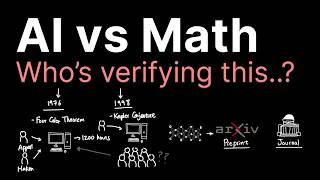
Why it is here
On OpenAI’s and Google’s AI maths results straining how breakthroughs are verified and credited: arXiv overload and journals capping submissions. About 30,663 views on 2026-10-15.
Description
Description written by Gemini from the videoGemini 3.8 Flash, 15 October 2026
Summary
Caleb from the channel Caleb Writes Code presents an analytical video essay on the growing crisis of AI-generated mathematics and scientific research flooding academic preprints and journals. He examines how institutions are reacting with submission limits, compares the current situation to early milestones of computer-assisted proofs (the Four Color Theorem and Kepler Conjecture), and explores how the human bottleneck in peer review is forcing a paradigm shift toward AI-driven discovery and curation.
What is shown
- [00:05] Submission growth charts on arXiv, noting monthly submissions surpassing 40,363 in September 2026 and cumulative submissions crossing 3.19 million.
- [00:11] Chart of
cs.AImonthly submissions from 2024 to 2026 showing a steep upward trajectory. - [00:31] Graph of weekly submissions to Transactions on Machine Learning Research (TMLR), highlighting a sharp spike in single-author submissions in 2026.
- [00:43] Illustrated workflow diagram showing submission caps on arXiv (2 papers/month) and academic journals, prompting entities like OpenAI to publish large batches (722 manuscripts) directly to GitHub.
- [01:34] Articles and commentary reflecting mathematical community reaction, including quotes from Alex Kontorovich, a Le Monde interview with Hugo Duminil-Copin, and Terence Tao’s ICM 2026 lecture paper “Mathematics in the Age of AI”.
- [01:55] Timeline comparing computer assistance in math: Appel & Haken’s 1976 Four Color Theorem (1,200 computation hours) and Thomas Hales’ 1998 Kepler Conjecture proof (4 years, 12-mathematician referee team).
- [04:11] Sponsor overview of Verda Cloud: instance selection (from GB300 to Tesla V100), VS Code SSH workflow, terminal training run, and server hardware.
- [06:25] Example research prompt on Erdős’s planar unit-distance problem given to an LLM, followed by an excerpt of generated LaTeX proof output.
- [07:20] Association for Human Mathematics (AHM) public statement regarding OpenAI’s October 6 mathematical document release.
- [08:09] Cross-discipline survey chart detailing preprint reading frequencies across mathematics, computer science, physics, and life/social sciences.
Claims & numbers
- The presenter states that arXiv submissions reached 40,363 in September 2026 alone, with a total of 3,192,873 submissions as of October 1, 2026 [00:05].
- The presenter claims submissions in the
cs.AIcategory increased more than sixfold between 2024 and 2026 [00:13]. - The presenter reports that arXiv instituted a cap of two submissions per author per month, while some journals implemented caps such as two per year [00:46].
- The presenter notes OpenAI released 722 manuscripts covering over 300 result families in one day on GitHub rather than going through standard peer review [00:50].
- The presenter states that proving the Four Color Theorem in 1976 required 1,200 hours of computation across three computers, whereas verifying Thomas Hales’ Kepler Conjecture proof required 12 mathematicians working over 4 years to reach 99% certainty [02:02, 02:20, 06:15].
- The presenter contrasts 1976 computation times with modern systems like ChatGPT Pro Thinking producing research-level proofs in roughly 3 hours per task [06:19].
- The presenter claims sponsor Verda provides GPUs ranging from GB300 down to Tesla V100, support for confidential computing and serverless inference, and offers promo code
CALEB-50for $50 off compute for $5 [04:40, 05:36].
Notable quotes
- “We’re coming to a point where AI is flooding research and academic journal submissions.” [00:00]
- “What you’re seeing here is our inability to keep up with research that’s being submitted with the rise of AI.” [01:07]
- “Currently the challenge is changing from discovering what we don’t know, but actually figuring out which discoveries are meaningful and worth pursuing.” [08:24]
Assessment
This is an independent analysis and video essay reviewing recent shifts in scientific publishing and automated mathematical discovery following OpenAI’s mass manuscript release in October 2026. The video is factual, combining referenced charts, historical case studies, and official statements from mathematical societies with an integrated commercial sponsor demonstration.
Described by gemini-3.8-flash on 2026-10-15 from the video’s audio and frames.