OpenAI solving Navier-Stokes explained..
Caleb Writes CodeYouTube239,003 views as of 12 October 2026
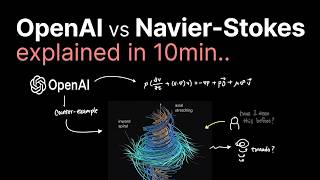
Why it is here
Explainer of OpenAI’s Navier–Stokes approach that sets the dispute aside (~240k views).
Description
Description written by Gemini from the videoGemini 3.8 Flash, 12 October 2026
Summary
Caleb from the channel Caleb Writes Code breaks down the Navier–Stokes existence and smoothness Millennium Prize Problem, showing how the governing equations evolved from Newton’s laws and Euler’s equations. He then examines OpenAI’s claimed counterexample (a finite-time singularity/blow-up), detailing how massive compute and multi-agent systems were deployed, while analyzing the controversy, priority disputes, and cheating allegations involving researchers Tristan Buckmaster and Levent Alpoge.
What is shown
- [00:00] Whiteboard overview connecting Newton’s second law ($F = m\vec{a}$) to fluid dynamics and OpenAI’s Navier–Stokes claim.
- [00:24] Illustrated elevator physics example calculating force and acceleration for solid bodies ($1000\text{ kg}$, $9.8\text{ m/s}^2$, $9800\text{ N}$).
- [01:08] Breakdown of fluid mechanics vs. solid bodies, detailing the Navier–Stokes equation terms: density ($\rho$), acceleration ($\frac{\partial v}{\partial t} + (v \cdot \nabla)v$), pressure gradient ($-\nabla p$), external forces/gravity ($\rho \vec{g}$), and viscosity ($\mu \nabla^2 \vec{v}$).
- [01:53] Diagrams illustrating local and advective fluid acceleration using garden hose and funnel analogies.
- [03:20] Timeline of equation development (Euler, Navier, Stokes) and practical engineering applications (blood vessels, weather forecasting, aircraft aerodynamics, ocean currents).
- [04:00] Formulation of the Millennium Prize problem: proving smooth solutions exist globally in 3D space versus finding a blow-up counterexample.
- [04:39] Slide showing an evaluation chart: “Performance of GPT-6 Astra and our Internal Model on a curated set of open math problems” across test-time compute.
- [06:30] 3D visual render of OpenAI’s counterexample structure: a spiral vortex featuring inward spiraling and axial stretching leading to singularity.
- [07:12] Breakdown of research history: Euler’s unforced equation vs. Buckmaster and Alpoge’s 1-year effort finding a forced blow-up solution.
- [08:13] OpenAI’s timeline: running 120 agents for 50 hours to achieve an unforced Euler blow-up, followed by an 88-hour run finding a Navier–Stokes counterexample.
- [09:04] Screenshots of leaked RCS text messages with Levent Alpoge, OpenAI’s “Concurrent work” acknowledgment statement, and public research drafts discussing priority and Codex telemetry concerns.
- [10:25] Clay Mathematics Institute Millennium Prize rules documentation regarding prize attribution and co-authorship.
Claims & numbers
- The presenter says the Navier–Stokes equations were progressively formulated over history starting roughly 181 years ago.
- The presenter states the Clay Mathematics Institute designated a $7 million prize fund ($1 million per problem) for seven Millennium Prize problems in 2000.
- The presenter claims OpenAI used 10,000 concurrent agents powered by internal models, consuming 130 billion tokens to search for the solution.
- The presenter reports that mathematicians Tristan Buckmaster (NYU) and Levent Alpoge (Anthropic) spent approximately one year developing a forced blow-up solution for Euler’s equations.
- The presenter states OpenAI utilized 120 agents working concurrently over 50 hours to find an unforced Euler blow-up solution, and subsequently found a Navier–Stokes blow-up candidate in 88 hours.
- The presenter notes allegations that OpenAI leveraged researchers’ Codex scratchpad/message histories to replicate and accelerate work on the problem.
Notable quotes
- “Is there a condition where math starts to break down under fair situations, or does it always produce a smooth solution in 3D space?” [04:02]
- “And they used 10,000 agents working concurrently, powered by OpenAI’s internal models, spending 130 billion tokens in total.” [04:35]
- “OpenAI was able to find a way to blow up Euler’s equation without being forced, and this only took them 50 hours of work with 120 agents working concurrently...” [08:21]
Assessment
This is an independent educational commentary and news review rather than a product demonstration. The presenter uses hand-drawn chalkboard animations, third-party paper diagrams, and leaked correspondence to explain the mathematical concepts and summarize the public controversy surrounding OpenAI’s Navier–Stokes claim.
Described by gemini-3.8-flash on 2026-10-12 from the video’s audio and frames.