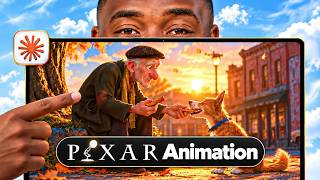
Claude Opus 5.5 Made This Entire Pixar Animation
Case StudioYouTube5,912 views as of 12 October 2026
Why it is here
Opus 5.5 as director: plans the story and characters and drives Higgsfield’s video models through the Higgsfield MCP. Sponsored (affiliate link).
Description
Description written by Gemini from the videoGemini 3.8 Flash, 12 October 2026
Summary
The presenter from Case Studio compares Claude Opus 5.5 and ChatGPT Astra by tasking both AI models with directing and generating a complete 90-second Pixar-style 3D animated short film from scratch using the Higgsfield Model Context Protocol (MCP). Without supplying initial assets or character references, both models plan character sheets, direct camera scenes, and generate three 30-second clips using Seedance 2.5, with the full resulting films presented for viewer comparison.
What is shown
- Higgsfield MCP Setup: Step-by-step connection of Claude to
mcp.higgsfield.aivia custom connectors, OAuth verification, and setting interactive tool permissions to “Always allow” [00:53–01:24]. - Claude Opus 5.5 Prompting: Dictating and submitting a detailed cinematic prompt for a 90-second Pixar-style story about an impoverished elderly man who loses his last dollar, is ejected from a store, and shares a pizza slice with a stray dog [01:48–02:32].
- Character & Location Sheets: Claude Opus 5.5 autonomously generates multi-angle character reference sheets (“Walter – The Old Man”, “Biscuit – The Stray Dog”, “Sal – The Storekeeper”) and scene reference sheets (“Location 1 – Maple Street”) [02:37–02:53].
- Story Breakdown & Execution: Claude Opus 5.5 divides the 90-second runtime into three acts (“The Fall”, “The Counter”, “The Gift”) and triggers batch video generation costing 360 credits per clip (1,080 credits total) [02:54–03:18].
- Claude Opus 5.5 Short Film: The complete 90-second animated film produced by Opus 5.5 and Seedance 2.5 [03:27–04:57].
- ChatGPT Astra Short Film: The full 90-second animated film generated under identical prompt parameters by ChatGPT Astra [05:26–06:54].
Claims & numbers
- The presenter states that Claude Opus 5.5 just launched and claims it is up to 50% cheaper than ChatGPT Astra [00:01–00:06].
- The generation prompt asks for three 30-second Seedance 2.5 clips to make a 90-second film [02:25–02:29].
- Claude’s UI indicates video generation costs 360 credits per clip, totaling 1,080 credits out of 12,547 available credits [03:16–03:18].
Notable quotes
- [00:00] “Claude Opus 5.5 just launched, and one of the most interesting claims around it is that it’s up to 50% cheaper than ChatGPT Astra, while being built specifically for long, complex, multi-step work.”
- [00:43] “Before Claude can produce anything, we need to give it hands, and that’s the Higgsfield MCP. It connects Claude directly to Higgsfield’s models, so it doesn’t just plan the movie, it builds it.”
- [04:58] “I’m genuinely blown away. The character consistency across all three clips, the cinematic camera angles, the storytelling, it all holds together into a cohesive short film.”
Assessment
This is a hands-on workflow demo and side-by-side comparison between Claude Opus 5.5 and ChatGPT Astra. While the setup and tool calling through Higgsfield MCP are genuinely shown in real browser recordings, the actual video generation steps are time-lapsed/cut to showcase the final rendered animated outputs and character sheets.
Lyrics & themes
The animated shorts follow an emotional narrative arc of despair, rejection, unexpected companionship, and hope:
- Act 1 (“The Fall”): An old man loses his only dollar bill as it drops onto the sidewalk unnoticed [03:36, 05:33].
- Act 2 (“The Counter”): The man enters Sal’s Deli, asks for food, discovers his money is gone, and is thrown out:
- “Excuse me, could I get something to eat with a dollar?” [03:52]
- “No money? Drop it and get out of my store!” [04:21] / “Put it down. Get out of my store!” [06:01]
- Act 3 (“The Gift”): A stray dog finds a slice of pizza in a street bin, brings it to the grieving man, they share the food, and the dog guides him away:
- “Where are you taking me to?” [04:55, 06:48]
Lore & references
- Higgsfield MCP & Seedance 2.5: The Model Context Protocol integration used to allow LLMs to act as autonomous film directors, driving image and video generation tools.
- Walter, Biscuit, and Sal: Archetypal Pixar-style character designations assigned by Claude Opus 5.5 during the pre-production sheet generation phase.
- Opus 5.5 vs. Astra: A direct benchmark test of multi-step autonomous agent execution between Anthropic’s flagship model and OpenAI’s GPT-6 Astra.
Visual style & craft
- Style: Warm, stylized 3D animation mimicking the visual hallmarks of modern Pixar features (soft lighting, expressive facial proportions, autumnal golden hour illumination, detailed cloth textures).
- Craft & Consistency: Character models, clothing textures, and lighting maintain strong continuity across multiple camera cuts, including close-ups and wide tracking shots. Both versions feature lip-sync and dialogue audio overlaid onto generative AI video clips.
Described by gemini-3.8-flash on 2026-10-12 from the video’s audio and frames.
Made by AI
- Made with
- Claude Opus 5.5, Higgsfield
- How we know
- YouTube description: ‘I only described my story idea to it, and it came back with a cinematic Pixar-style animation’; Opus 5.5 ‘connected to Higgsfield through the Higgsfield MCP’
- Human role
- Described the story idea.
- Pipeline
- Story idea → Opus 5.5 plans story and characters → Higgsfield MCP generates the footage
- Series
- Agent-directed generative video (LLM drives video models)