The Stock Market Is Being Used as a Dumping Ground
Casual Finance · 2026-10-04 · review · 1,261,942 views
What's in the video
Description written by Gemini, which watched and listened to the whole video.
Summary
The video is an animated financial essay presented by the narrator of the channel Casual Finance. It explores why late-stage tech and AI giants like SpaceX, Anthropic, and OpenAI are entering public markets at unprecedented multi-trillion-dollar valuations, arguing that legal and regulatory shifts over the past 30 years have allowed private markets to capture most company growth before regular investors can participate.
What is shown
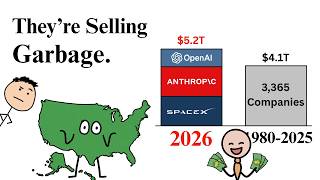
- [00:00]: Analysis of a viral chart by Steve Rattner comparing the combined $5.2T valuation of SpaceX, Anthropic, and OpenAI against the first-day value of all 3,365 U.S. tech IPOs from 1980–2025 ($4.1T).
- [01:04]: Comparison of Amazon's 1997 IPO ($429.5M valuation, growing 3,325x to $2.69T) versus SpaceX's 2026 IPO valuation ($1.77T, requiring a $5.9 quadrillion market cap to replicate the same return).
- [02:11]: Summary of Hendrik Bessembinder's research paper, "One Hundred Years in the U.S. Stock Markets (1926 to 2025)", showing wealth concentration in public equities.
- [03:06]: Discussion of an Andreessen Horowitz blog post ("Private Markets Are The New High Growth Public Markets") and a July 2026 Vanguard report on unicorn growth.
- [04:41]: Sponsored segment demonstrating the Bilt Rewards app, website, and point-earning features.
- [05:52]: Examination of Amazon's 1997 SEC Form 424B1 filing and the 1996 National Securities Markets Improvement Act (NSMIA).
- [08:14]: Historical review of Section 12(g) of the Securities Exchange Act of 1934 and how the 500-shareholder threshold forced Microsoft (1986), Google (2004), and Facebook (2012) to list publicly.
- [11:27]: Review of Title V of the 2012 Jumpstart Our Business Startups (JOBS) Act raising the shareholder disclosure limit to 2,000 individuals.
- [13:17]: Coverage of secondary tender offers providing employee liquidity without IPOs, highlighting Stripe's valuation rounds from $65B (February 2024) to $159B (February 2026).
- [14:29]: Chart illustrating median time to IPO increasing from 5 years to 14 years between 2005 and 2025, alongside Anthropic's private valuation leaps.
Claims & numbers
- The presenter notes that 3,365 U.S. tech IPOs between 1980 and 2025 had an aggregate first-day value of $4.1 trillion, while OpenAI ($1.2T), Anthropic ($2.0T), and SpaceX ($2.0T) total $5.2 trillion.
- The presenter states SpaceX targeted a $135 IPO price at a $1.77 trillion valuation on June 3, 2026, and surged past $2 trillion on its Nasdaq debut.
- The presenter notes Amazon was valued at $429.5 million at its 1997 IPO and grew by 3,325x to $2.69 trillion; for SpaceX to match that multiple, it would need to reach $5.9 quadrillion, which is over 11 times all personal wealth on Earth ($518 trillion per the UBS Global Wealth Report 2026).
- Citing Hendrik Bessembinder's study of nearly 30,000 stocks from 1926 to 2025, the presenter states that out of $91 trillion in net shareholder wealth created, half came from just 46 companies, with the top 5 (Apple, Nvidia, Microsoft, Alphabet, Amazon) accounting for ~20% ($21 trillion combined today).
- Citing Andreessen Horowitz, the presenter states companies going public between 2014 and 2019 generated 88% of their value after listing, whereas companies listing between 2020 and 2023 created 55% of their value while still private.
- Citing a July 2026 Vanguard report, the presenter notes the global aggregate valuation of unicorns rose from ~$800 billion in 2016 to $8.6 trillion across ~1,700 companies by spring 2026.
- The presenter notes late-stage startup private funding grew from $1.3 billion in 1995 to $11.4 billion in 2005 and $33.0 billion in 2015, surpassing total IPO proceeds in 2015 ($22 billion).
- The presenter states Facebook raised $1.5 billion privately in January 2011 before Section 12(g) mandated public reporting by April 30, 2012, leading to its May 18, 2012 IPO.
- The presenter states the JOBS Act of 2012 raised the registration threshold to 2,000 shareholders (or 500 non-accredited investors) and exempted equity-compensated employees.
- The presenter notes Stripe's internal tender offers valued the company at $65 billion in February 2024 and $159 billion in February 2026.
- Citing Jay Ritter's IPO data, the presenter states 266 VC-backed companies went public in 1996, compared to only 49 in 2025.
- The presenter reports Anthropic raised private capital at a $61.5 billion valuation in March 2025 and $965 billion in May 2026, while reportedly planning a $2 trillion IPO in October 2026.
Notable quotes
- [00:43]: "That's three companies worth more than every tech IPO in America since 1980 combined."
- [14:34]: "Those extra nine years are some of the best years of growth a company will ever have, and they used to happen on the stock market where anyone could buy in."
- [17:11]: "They're still getting an asymmetric bet, just this time it's pointed the wrong way."
Assessment
This is an analytical financial commentary video using 2D stick figure animation and cited academic papers, government statutes, and news reporting. The arguments are supported by real regulatory documents and financial datasets, though the presenter deliberately frames the shift as detrimental to retail investors to build a critical macro thesis.
Described by gemini-3.8-flash on 2026-10-07 from the video's audio and frames.