Nvidia CEO rejects AI extinction warnings as “doomsday narratives”
CBS News YouTube 124,592 views as of 19 October 2026
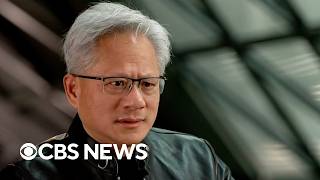
Why it is here
CBS web exclusive (46 min, ~125k views): Jensen Huang tells Jo Ling Kent that extinction warnings are ‘doomsday narratives’ and explains why he disagrees with calls to slow AI development, a week before Pope Leo XIV rebuked him. Counter-position, so not in the warnings collection.
Description
Description written by Gemini from the videoGemini 3.8 Flash, 19 October 2026
Summary
This CBS News exclusive interview features Nvidia founder and CEO Jensen Huang speaking with a CBS News correspondent. Huang discusses his rejection of catastrophic AI extinction warnings, argues for applying existing product liability and cybersecurity laws rather than rushing new regulations, addresses competition with China, and explains the role of modern data centers as “AI factories” driving American re-industrialization.
What is shown
- [00:00 - 04:30] Discussion on existential AI risk: Huang dismisses warnings of human extinction within ten years as unfounded, dramatic narratives not grounded in science, emphasizing the industry’s shift toward engineering safety and verification.
- [04:31 - 10:20] Debate over government regulation versus existing legal frameworks: Huang argues that existing laws covering cybersecurity, unauthorized access, and product liability should be rigorously enforced before inventing new regulatory regimes.
- [10:21 - 14:50] AI lab transition: Huang outlines the operational shift of frontier AI labs transitioning from research labs to high-production commercial product companies.
- [14:51 - 20:15] Competition with China: Huang argues the United States must innovate as fast as possible rather than artificially pacing development, highlighting that American architectures like Nvidia’s Vera Rubin platform remain several years ahead.
- [20:16 - 23:34] Chip sales and export policy: Huang rejects blanket bans on all commercial trade, advocating for American firms to lead in performance while competing globally.
- [23:35 - 28:05] Political perspectives and leadership: Huang discusses interactions with President Trump and perspectives on navigating national AI policy.
- [28:06 - 31:40] Taxes and public investment: Huang addresses California’s Proposition 40 (“billionaire tax”), stating he has no issue paying significant taxes (such as an estimated $8 billion over five years) given the opportunities afforded by the country.
- [31:41 - 37:44] Community concerns regarding data centers: Huang responds to local pushback against data centers, clarifying modern water recycling methods, grid support, and community engagement.
- [37:45 - 46:18] Explanation of “AI factories” and origin reflections: Huang reflects on his early career working as a dishwasher at Denny’s before describing how AI data centers function as industrial factories turning energy and data into digital intelligence (referencing tool use and agent workflows like OpenAI’s Astra).
Claims & numbers
- Huang states that he has been leading Nvidia for 33 years (the presenter also references Nvidia’s founding over 30 years ago) [09:41, 37:53].
- Huang claims that one frontier AI lab experienced four cybersecurity incidents triggered by their systems, while another lab had multiple incidents [05:40].
- Huang states that Nvidia’s Vera Rubin architecture is shipping in volume production and is “several years ahead of China” [19:55].
- The interviewer states that Proposition 40 could require Huang to pay approximately $8 billion in taxes over five years; Huang confirms he can afford it and views it as a privilege rather than a burden [30:19, 30:30].
- Huang asserts that claims about data centers consuming excessive water are now a “myth” because modern facilities recirculate water or use hot-water cooling rather than evaporative cooling, consuming less water than an evaporating swimming pool [36:20 - 36:34].
- Huang claims the global economy represents roughly a $100 trillion economy, of which around $15 trillion involves information and knowledge work that will be augmented by AI intelligence factories [33:35 - 33:43].
Notable quotes
- [02:14] “No, that’s completely false. And that’s That kind of narrative is dramatic. It gets a lot of attention. Obviously, it’s gotten the attention of of the press. And I think at its core, they care deeply that the products are built safely.”
- [08:32] “Do the obvious first. Do the practical first, and then we can talk about the theoretical later. But don’t talk about the theoretical without doing the practical.”
- [30:44] “I’m not afraid of paying taxes. I’m just afraid of being poor.”
Assessment
This is a standard broadcast television news interview focusing on policy, market positioning, and public debate rather than a technical demonstration. No live benchmarks or software demonstrations are performed on screen; all technical capabilities and economic figures are discussed verbally by Huang in response to journalistic questioning.
Described by gemini-3.8-flash on 2026-10-19 from the video’s audio and frames.
Related
More videos on this
-
Extended interview: Nvidia CEO explains why he disagrees with AI warnings
CBS Sunday Morning500,396 views as of 16 Oct
-
AI is not a new species, it’s software: Nvidia CEO Jensen Huang
CNN491,852 views as of 16 Oct