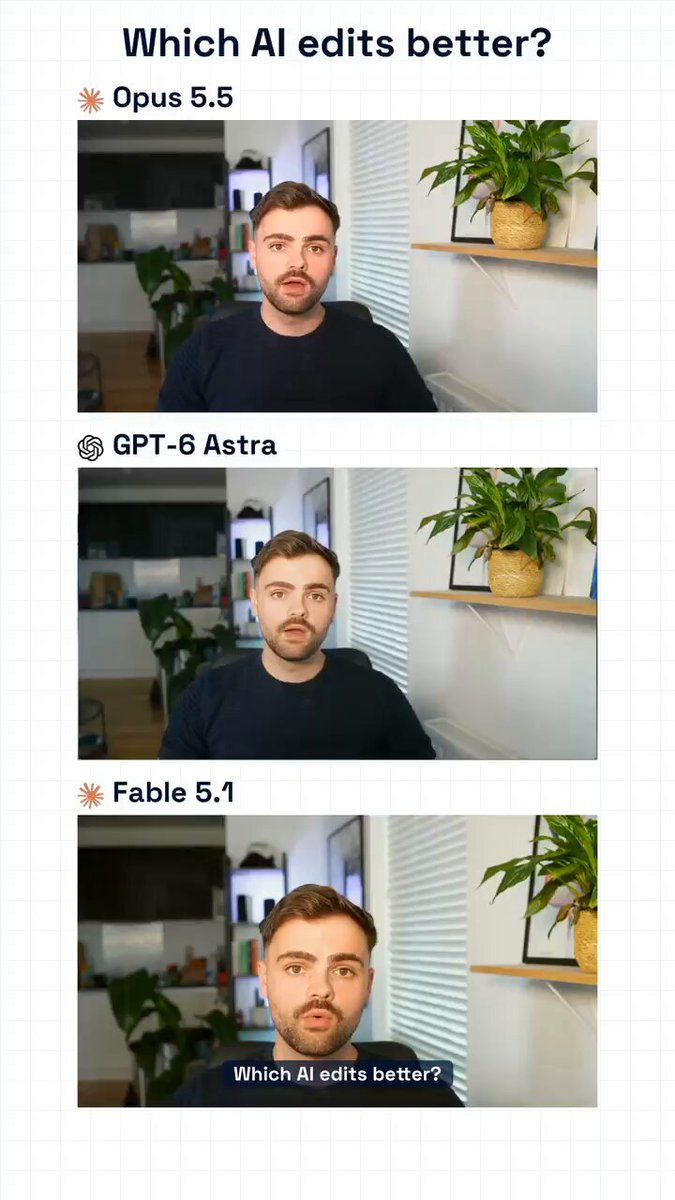
Opus 5.5 vs GPT-6 Astra vs Fable 5.1 edit the same raw talking-head video
Charlie Hills (@charliejhills)X93,197 views as of 11 October 2026
Why it is here
Listed in the awesome-claude-5-5-videos library; ~93k views. Same footage, brief and editing process given to three models.
Description
Description written by Gemini from the videoGemini 3.8 Flash, 11 October 2026
Summary
Charlie Hills presents a side-by-side video editing comparison between three frontier AI models: Claude Opus 5.5, GPT-6 Astra, and Claude Fable 5.1. Using the exact same raw talking-head footage and identical verbal instructions, each model independently edits and animates the video, showcasing different motion design choices, color correction, and graphic implementations.
What is shown
- Setup & Workflow Mapping [00:00–00:07]: A stacked three-way split screen (Opus 5.5 at top, GPT-6 Astra in center, Fable 5.1 at bottom) depicting how each model graphs the initial prompt pipeline (“1 recording”, “three editors”).
- Audio & Color Grading [00:08–00:12]: Each model’s visualization of audio cleanup (waveform displays comparing noisy vs. clean audio) and visual color correction with before/after toggles and subtitle insertion.
- Synchronized Subtitles [00:13–00:17]: Demonstration of word-level animated subtitles turning yellow in sync with spoken dialogue.
- Side-by-Side Comparison Layouts [00:18–00:23]: Layout management comparing two elements simultaneously (“A” vs. “B”, “Raw take” vs. “Edit”).
- Dynamic Venn Diagrams [00:24–00:28]: Animated Venn diagrams illustrating overlapping commonalities between elements.
- Process Roadmaps [00:29–00:34]: Generation of visual milestone paths and journey lines that animate progressive nodes (“Record”, “Clean”, “Edit”, “Publish”) in real-time as the narrator speaks.
- Pixel Art Character Animation [00:35–00:40]: A custom 2D 8-bit pixel-art sprite modeled on the presenter walking across the screen along a guided track.
- Conclusion & Model Decision [00:41–00:48]: Recapping summary flowcharts depicting the three models and asking the audience to evaluate which editing style is superior.
Claims & numbers
- The presenter says he gave three AI models—Claude Opus 5.5, GPT-6 Astra, and Claude Fable 5.1—the exact same raw video recording and set of instructions.
Notable quotes
- [00:00] “Which AI edits better? I’m giving Opus 5.5, Astra, and Fable the same recording to see what they do with it.”
- [00:18] “Say I want to compare two things side by side, put them side by side. Now show me what they’ve got in common: do a Venn diagram.”
- [00:41] “Same video, same instructions, three different AI edits. Which AI would you actually choose?”
Assessment
This is a creator-led comparison demonstration testing multimodal and agentic video-editing capabilities across Claude and OpenAI models. The video highlights stark differences in automated graphic layout and aesthetic choices, though it functions primarily as an observational side-by-side showcase rather than a standardized quantitative benchmark.
Lyrics & themes
The spoken narration acts as a direct command prompt outlining video editing requirements, progressing from basic technical polish to complex graphic motion:
- Basics & Audio [00:08]: “So first, I want them to clean up the audio, fix the color, and add subtitles.”
- Interactive Subtitling [00:13]: “And if I want those subtitles to turn yellow as I’m speaking, they should do that.”
- Data Visualization [00:26]: “Now show me what they’ve got in common: do a Venn diagram.”
- Character Animation [00:35]: “And if I want a little pixel art version of myself walking across the screen, let’s add that in as well.”
Lore & references
- Opus 5.5 & Fable 5.1: Anthropic’s flagship reasoning and agentic models, here evaluated on motion graphics composition and script-following capabilities.
- GPT-6 Astra: OpenAI’s frontier GPT-6 tier model, demonstrating its distinct visual design aesthetic (clean circular nodes, dark-blue minimal cards, and centered typography).
- AI Video Editing Agents: Demonstrates the paradigm shift where LLM-based creative agents generate SVG/canvas motion graphics, keyframing, and video layout directly from spoken prompts rather than human NLE editors.
Visual style & craft
The video employs a vertically stacked 9:16 layout on a grid notebook background, with each model assigned its own horizontal canvas. Each AI interprets instructions with different design languages:
- Opus 5.5: Prefers rounded diagram cards, modular audio waveform overlays, smooth blue gradient roadmaps, and subtle picture-in-picture frames.
- GPT-6 Astra: Uses minimalist stark geometric shapes (large labelled circles, crisp linear typography, high-contrast dark backgrounds).
- Fable 5.1: Focuses heavily on linear step-by-step checklists, blue curved sine-wave timelines with labeled milestone beads, and placing the presenter in the lower left corner.
Described by gemini-3.8-flash on 2026-10-11 from the video’s audio and frames.
Made by AI
- Made with
- Claude Opus 5.5, GPT-6 Astra, Fable 5.1
- How we know
- X post (2026-10-01): ‘I gave Opus 5.5, GPT-6 Astra and Fable 5.1 the same raw video, the same brief and my real YouTube editing process’
- Human role
- Human supplied footage and reference, reviewed the first 10 seconds and fixed round by round.
- Pipeline
- Raw footage + brief → each model cuts pauses and adds visuals → iterative human review
- Series
- Agent video editing (LLM edits real footage)