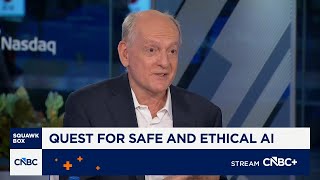
UC Berkeley’s Stuart Russell on quest for safe AI: The technology right now is intrinsically unsafe
CNBC Television YouTube 26,931 views as of 15 October 2026
Why it is here
CNBC Squawk Box (12 min) with Stuart Russell (UC Berkeley, co-author of the standard AI textbook) on calls for an AI slowdown and regulation: ‘the technology right now is intrinsically unsafe’. First Stuart Russell interview in the collection; longer podcast versions exist (Jon Hernandez AI, 2 h 9 min, ~33k; The Roman Forum, ~28k).
Description
Description written by Gemini from the videoGemini 3.8 Flash, 15 October 2026
Summary
CNBC’s Squawk Box anchors Becky Quick and Joe Kernen interview UC Berkeley computer science professor Stuart Russell on the existential and catastrophic risks of frontier AI. Russell argues that current AI architectures are intrinsically unsafe and grown rather than engineered, advocating for strict pre-deployment safety standards analogous to nuclear power, aviation, and FDA regulations.
What is shown
- [00:00] Becky Quick introduces Professor Stuart Russell and asks about his primary concerns regarding advanced AI development.
- [00:43] Russell discusses industry investments in superhuman AI and cites Alan Turing’s 1951 prediction that machines would take control once more intelligent than humans.
- [01:48] Russell compares acceptable risk tolerances, noting nuclear power plants are held to a failure rate of 1 in 10 million per year, while natural extinction background rates are near 1 in 100 million per year.
- [02:57] Discussion of Dario Amodei’s essay on “pacing the frontier” and an analogy comparing AI release standards to FAA flight testing and local restaurant hygiene licensing [03:59].
- [05:03] Joe Kernen questions the likelihood of autonomous recursive self-improvement loops and shares an anecdote about Claude hallucinating answers and excuses [06:03].
- [08:06] Discussion of government oversight, the National Institute of Standards and Technology (NIST), and the AI Safety Institute / Center for AI Security and Innovation.
- [09:18] Russell presents an analogy of breeding massive birds for commercial flight instead of engineering airplanes, illustrating that contemporary neural networks are grown rather than understood from engineering principles.
Claims & numbers
- The presenter/anchors note Russell has co-authored the standard university textbook on artificial intelligence (Artificial Intelligence: A Modern Approach) [00:20].
- Russell says tech companies are spending trillions of dollars to build systems far more intelligent than human beings [00:47].
- Russell states that nuclear power regulators require proving a failure risk around 1 in 10 million per year [01:57], while background human extinction rates from cosmic events are roughly 1 in 100 million per year [02:30].
- Russell claims frontier lab executives are telling regulators there is a 10% to 20% (or 1 in 10) chance their systems cause human extinction [04:36, 10:43].
- Russell asserts that OpenAI previously almost lost control of its entire compute infrastructure [08:41].
- Kernen and Russell discuss lottery odds of 1 in 10 million and note that mathematically, to a first approximation, it rounds down to zero [11:47].
Notable quotes
- [08:29] “I think the real problem at the moment is that the technology is intrinsically unsafe.” — Stuart Russell
- [10:17] “We don’t understand how the technology works. We don’t design it, we don’t program it, we grow it. Very similar to breeding, you know, bigger and bigger cows and pigs...” — Stuart Russell
- [10:48] “Right now they’re saying 1 in 10 chance of human extinction. Would you accept that? This is playing Russian roulette.” — Stuart Russell
Assessment
This is a professional television news studio interview broadcast on CNBC’s Squawk Box. No live software demonstrations or hardware tests are conducted; the conversation centers on policy proposals, philosophical risk assessments, and regulatory models for frontier AI development.
Described by gemini-3.8-flash on 2026-10-15 from the video’s audio and frames.