I Had Opus 5.5 Make the Same Music Video at Every Effort
DevarfYouTube30,701 views as of 12 October 2026
Why it is here
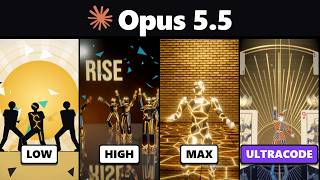
One rap song, six music videos from the same prompt at effort levels low to max and ‘ultracode’, with time, tokens and price compared; ~31k views.
Description
Description written by Gemini from the videoGemini 3.8 Flash, 12 October 2026
Summary
This video is a demonstration and technical breakdown by creator Devarf testing Anthropic’s Claude Opus 5.5 via Claude Code (v2.1.287) in the terminal. The creator gives the model a single identical prompt with a folder of local development tools and audio metadata to programmatically generate an entire 79-second motion-graphics music video for the song “Mirror Mirror” by Anno Domini Beats across five effort tiers (Low to Max) and a multi-agent “Ultracode” run.
What is shown
- Intro & Premise [00:00–00:46]: The presenter outlines the experiment: testing whether Claude Opus 5.5 running in Claude Code can create full motion graphics music videos using programmatic rendering tools instead of video generation models (like Higgsfield) or After Effects.
- The Six Rendered Music Videos [00:46–09:08]:
- Low [00:46]: A 2D stylized vector animation featuring a cartoon man in a yellow shirt dancing, confronting a mirror counterpart, walking on a tightrope, and dodging falling chess kings.
- Medium [02:10]: A 3D render using a dark, low-poly mannequin character with glowing seams dancing against dark backgrounds, chess pieces, and cages.
- High [03:35]: A polished 3D animation featuring chrome and gold mannequins performing synchronized hip-hop choreography in front of glowing mirror portals.
- xhigh (Extra High) [05:00]: A 3D wooden ball-jointed artist mannequin wearing a visor and gold chain, featuring detailed shadow-play, shattering chess pieces, and fluid dancing.
- Max [06:24]: A golden faceted low-poly figure dancing in reflective rooms with dynamic neon seams, falling coins, breaking mirrors, and kaleidoscopic group formations.
- Max + Ultracode [07:49]: A hybrid 2D/3D art-deco theatre concept featuring an animated 2D playing-card marionette Jack/Jester performing complex choreography on a floating 3D playing-card stage with floating cards and mirrors.
- Methodology & Pipeline [09:08–10:17]: Shows the local file environment provided to Claude Code, including audio analysis data (
song-map.json, beats, stem envelopes, lyrics) because the LLM cannot listen directly, alongside rendering engines (three.js, HTML5 2D Canvas, SVG,anime.js, Blender, FFmpeg). - Benchmark Metrics & Ultracode Analysis [10:17–13:14]: Token counts, runtime benchmarks, API cost estimates, and an architectural breakdown of why the multi-agent Ultracode session ballooned to over 2.5 million tokens due to separate agent caches and recursive reviews.
Claims & numbers
- Song: “Mirror Mirror” by Anno Domini Beats from the YouTube Audio Library; duration used is exactly 79.172 seconds (2,375 frames at 30 fps, 1080p H.264) [09:20, 10:12].
- Low Effort run:
- Working time: 41 min 58 s (includes 26 min 38 s rendering time) [00:43, 11:08].
- Output tokens: 78,196 [00:43].
- Estimated API cost: $3.28 [00:43].
- Medium Effort run (default):
- Working time: 54 min 32 s [02:08].
- Output tokens: 150,844 [02:08].
- Estimated API cost: $6.75 [02:08].
- High Effort run:
- Working time: 1 h 48 min 00 s [03:32].
- Output tokens: 319,152 [03:32].
- Estimated API cost: $22.68 [03:32].
- xhigh (Extra High) Effort run:
- Working time: 2 h 30 min 27 s [04:56].
- Output tokens: At least 436,227 [04:56].
- Estimated API cost: At least $34.77 [04:56].
- Max Effort run:
- Working time: 2 h 54 min 54 s [06:21].
- Output tokens: 625,106 [06:21].
- Estimated API cost: $48.78 [06:21].
- Max + Ultracode run:
- Working time to deliver video: 3 h 56 min 37 s [07:46].
- Tokens to delivered video: At least 2,305,435 output tokens ($280.28) [07:46].
- Total run before manual cancellation: At least 2,583,239 tokens, costing an estimated $348.34+ [12:04, 12:18].
- The presenter notes it triggered 42 agent sessions across 5 teams, hit the 5-hour subscriber rate limit nearly three times, and restarted unfinished agents from scratch rather than sharing KV cache [12:28–12:47].
- Pricing basis: Evaluated against Anthropic’s listed API prices for Claude Opus 5.5 ($4 input, $20 output per million tokens, plus cache read/write rates) [11:27].
Notable quotes
- “If you have Opus 5.5 or can use it, I don’t think you need video generation like Higgsfield or big tools like After Effects to make a motion graphics video.” [00:00]
- “I didn’t tell it how the video should look. I just told it to make a music video.” [00:27]
- “Don’t use Ultracode. The risk is what you just saw. If you still want to try it, try it at low effort first, in the terminal.” [13:01]
Assessment
This is a technical demonstration and workflow review benchmarking the code generation capabilities of Claude Opus 5.5 in Claude Code. The presented pipeline is authentic, demonstrating reproducible terminal agent execution that drives programmatic animation rendering libraries without human intervention beyond providing parsed audio stems and tool runtimes.
Lyrics & themes
The background track is the rap song “Mirror Mirror” by Anno Domini Beats.
- Intro & Chorus: Focuses on introspection, pride, and facing internal flaws in the mirror:
- “Mirror, mirror on the wall / Tell me who gon’ rise and fall / I’ve been running from my flaws / Still I’m standing ten feet tall” [00:47, 02:11].
- Verse 1: Explores material success, isolation, parental warnings against selling out, and loneliness:
- “Dancing with my shadow in a room full of gold / Tryna count on my regrets like the stories I told / Mama said, boy, don’t sell your soul for applause / But the silence louder now than a million applause” [01:00, 03:48].
- Verse 2 & Bridge: Metaphors of kings falling, selling out for six figures, tightropes, cages, and media editing:
- “I seen kings fall quick for a hit on a reel / Seen queens trade crowns for a six-figure deal” [01:12, 04:01].
- “We are one mistake from the cage or the graveyard / Living like a movie, but the credits never roll / They gon’ crop you out the frame if you ever lose control” [01:21, 04:11].
Lore & references
- Claude Code (v2.1.287): Anthropic’s official terminal-based agent tool for software engineering and task execution [00:17].
- Effort Levels: Anthropic’s reasoning and compute budgeting setting ranging from Low to Max, dictating token expansion and self-reflection loops [00:23, 11:05].
- Ultracode: Anthropic’s multi-agent swarm orchestration mode in Claude Code, designed to spawn specialized subordinate agent teams for review and debugging [00:25, 11:40].
- Audio-Blindness Accommodation: The agent’s lack of native audio listening requires a bespoke JSON map of frequency envelopes, beat drops, and lyric timing to enable synchronized video timing [09:30].
- Chess & Playing Cards: Common visual motifs across the runs representing hierarchy, greed, and falling from grace (kings falling, trading crowns, puppet jacks) directly drawn from the lyrics [01:12, 05:25, 07:49].
Visual style & craft
- Visual Medium: The videos are entirely code-rendered programmatic animations generated via web/canvas scripts and 3D packages (WebGL with
three.js, SVG, 2D Canvas, and Blender via Python scripting), subsequently stitched via FFmpeg [10:05–10:13]. None of the videos use neural diffusion video generation models. - Progression of Detail:
- Low: Flat 2D vector shapes, basic easing functions, clean silhouette typography.
- Medium/High: 3D scene lighting, reflective floor shaders, procedural skeletal rigs, and multi-light stage setups.
- xhigh/Max: Physically based materials, faceted geometric models, dynamic camera movements, particle confetti, and kaleidoscope transform matrices.
- Max + Ultracode: Elaborate hybrid combining illustrated 2D playing card characters rigged like shadow puppets set inside a full 3D card-house environment with volumetric stage lighting.
- Author vs. AI Contribution: The overarching video presentation (voiceover, grid layout, token charts) is human-edited by Devarf; however, all six embedded music videos were generated autonomously by Claude Opus 5.5 from a single master prompt [10:18].
Described by gemini-3.8-flash on 2026-10-12 from the video’s audio and frames.
Made by AI
- Made with
- Claude Opus 5.5
- How we know
- YouTube description: ‘All six were made by Claude Code with Opus 5.5 from the same prompt’
- Human role
- Wrote one prompt, ran it at six effort settings and compared the results.
- Pipeline
- Same prompt → Claude Code (Opus 5.5) at low / medium / high / xhigh / max / ultracode → six code-rendered videos
- Series
- Claude Pop