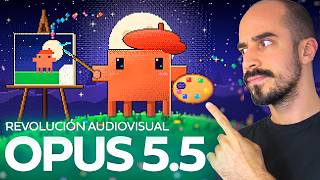
CLAUDE OPUS 5.5 es TODA UNA REVOLUCIÓN AUDIOVISUAL (...sorry Astra)
Dot CSV Lab YouTube 448,621 views as of 17 October 2026
Why it is here
Carlos Santana’s (DotCSV) 28-minute Spanish-language test of Claude Opus 5.5 for animation, motion graphics and 3D, on his second channel Dot CSV Lab. Chapters cover code-made animations, pixel-art animations and dioramas (the source of his viral X clips, one of which is in the dataset as dotcsv-opus-5-5-pixel-art-neural-network-x), game design, how DotCSV’s own animations are made, Opus 5.5 in professional tools, and a home-made “GTA Gran Canaria”. About 449k views; found on 2026-10-17 while looking for YouTube copies of claudevideo.org backlog posts.
Description
Description written by Gemini from the videoGemini 3.8 Flash, 17 October 2026
Summary
Carlos Santana (Dot CSV Lab) reviews the recent wave of frontier AI model releases, focusing on OpenAI’s GPT-6 Sol and GPT-6 Luna alongside Anthropic’s Claude Opus 5.5. He argues that AI progress has entered a rapid exponential phase in audiovisual creation, demonstrating how Claude Opus 5.5 dramatically outperforms competing models like GPT-6 Astra in procedural animation, pixel art, motion graphics, and game design.
What is shown
- [00:00 - 01:29] Introduction to the newly released models: GPT-6 Sol and Luna from OpenAI (discontinuing the Terra line), and Claude Opus 5.5 from Anthropic.
- [02:00 - 02:59] Presentation of OpenAI’s pricing table and the Agent’s Last Exam benchmark comparison between GPT-6 Astra, GPT-6 Sol, GPT-6 Luna, and Claude Opus/Fable models.
- [03:24 - 05:05] Explanation of S-curves (sigmoids) of capability growth across domains: written language (saturating after 2024), code/programming (2024–2026), and audiovisual design (steep exponential rise in mid-2026).
- [06:36 - 08:02] Demonstrating code-driven procedural animation: a fruit fly lifecycle animated entirely via JavaScript and HTML5 Canvas.
- [08:02 - 08:30] A motion graphics explainer animation featuring a character and microscope generated by Claude Opus 5.5.
- [09:30 - 11:44] Carlos prompts Opus 5.5 to build an animated pixel-art neural network training on MNIST; the model writes self-contained code that actually trains an MLP in the browser to accurately visualize the forward and backward passes.
- [11:44 - 12:15] Demos of 3D CNNs and diffusion model pixel-art animations with synchronized chiptune sound design.
- [12:15 - 13:13] Generation of a 40-second 1080p standalone procedural animation video titled “The Age of Discovery” about AI and science.
- [13:30 - 16:09] Head-to-head comparison of pixel art game creation: GPT-6 Astra generates a basic Pangolin surfing game using pre-rendered image assets, while Claude Opus 5.5 builds “Pango Surf”, a fully playable HTML5 Canvas pixel art game with authentic mechanics, dynamic sound, and combos.
- [16:10 - 19:15] Diorama comparison: GPT-6 Astra creates a static multi-layered image (“The Night Shift”), whereas Opus 5.5 builds an animated, interactive pixel art scene (“Calle de los Laboratorios”) filled with AI memes and dynamic events.
- [19:24 - 22:20] Motion graphics benchmark: generating explanatory animations for Carlos’s video on the JEV decision model. Astra creates static-style slide transitions, while Opus 5.5 creates motion graphics tightly synchronized with the spoken audio transcript.
- [22:22 - 23:16] Demonstrating Claude Opus 5.5 generating automation scripts to build 3D neural net animations directly inside Adobe After Effects.
- [23:47 - 26:55] Demonstrating GPT-6 Astra’s strengths in agentic cartography: building a browser-based 3D open-world driving simulator replicating the city of Las Palmas de Gran Canaria.
Claims & numbers
- Model releases & pricing: The presenter shows that GPT-6 Sol is priced at $2.00 input / $10.00 output per 1M tokens, while GPT-6 Luna is priced at $0.10 input / $0.50 output per 1M tokens (a 50% price reduction over previous GPT-5.6 tiers).
- Capability shift: The presenter claims text modeling and code generation are approaching marginal gains on their respective sigmoids, while audiovisual creation has entered an exponential jump in the past two months.
- Real-time ML execution: In the MNIST animation test, the presenter notes Claude Opus 5.5 didn’t merely illustrate a simulation, but wrote code embedding a real 784-16-16-10 MLP achieving 95.5% test accuracy on MNIST in the HTML artifact.
- Agentic 3D reconstruction: The presenter states GPT-6 Astra autonomously fetched geospatial, elevation, and street mapping data to model Las Palmas de Gran Canaria across 10 iterative prompts.
Notable quotes
- [00:00] “Esta semana hemos tenido no dos, ni tres, sino tres modelos nuevos por parte de Anthropic y OpenAI.”
- [10:35] “Para mí esto es mi momento Lee Sedol en lo que respecta a hacer animaciones.”
- [13:53] “Dicho esto, en materia audiovisual no hay comparación.”
Assessment
A hands-on comparative review by an experienced creator testing real outputs from Claude Opus 5.5 and OpenAI’s GPT-6 models. All demonstrated projects (HTML5 Canvas games, web animations, code generation, and After Effects scripts) are functional interactive artifacts built live or iterated on-screen.
Described by gemini-3.8-flash on 2026-10-17 from the video’s audio and frames.