Game inspired by the Antikythera mechanism; everything seen and heard procedurally generated by Opus 5.5 code (X video)
edwin (@edwinarbus) · 2026-09-22 · ai-made · 393,139 views
Made by AI
Model: Claude Opus 5.5 · Series: Agent-built game or 3D world (the video shows the result)
Evidence: X post (2026-09-22): 'I asked Opus 5.5 to make a game inspired by the discovery of the first computer, the Antikythera mechanism. / Everything you see and hear is procedurally generated in real time, from code by Opus 5.5. / It's a single 3 MB HTML file. Playable Claude artifact below.'
Human role: Creator asked for the game; a single 3 MB HTML file, shared as a playable Claude artifact.
Pipeline: Opus 5.5 → single-HTML procedural game (graphics + audio) → 1:00 capture
What's in the video
Description written by Gemini, which watched and listened to the whole video.
Summary
This video showcases a playthrough of Antikythera, a 3D interactive browser game where players dive as a 1901 Greek sponge diver to recover and assemble fragments of the Antikythera mechanism. Presented by developer Edwin (@edwinarbus), all visual rendering, shaders, mechanics, and procedural audio were generated from code produced by Anthropic's Claude Opus 5.5.
What is shown
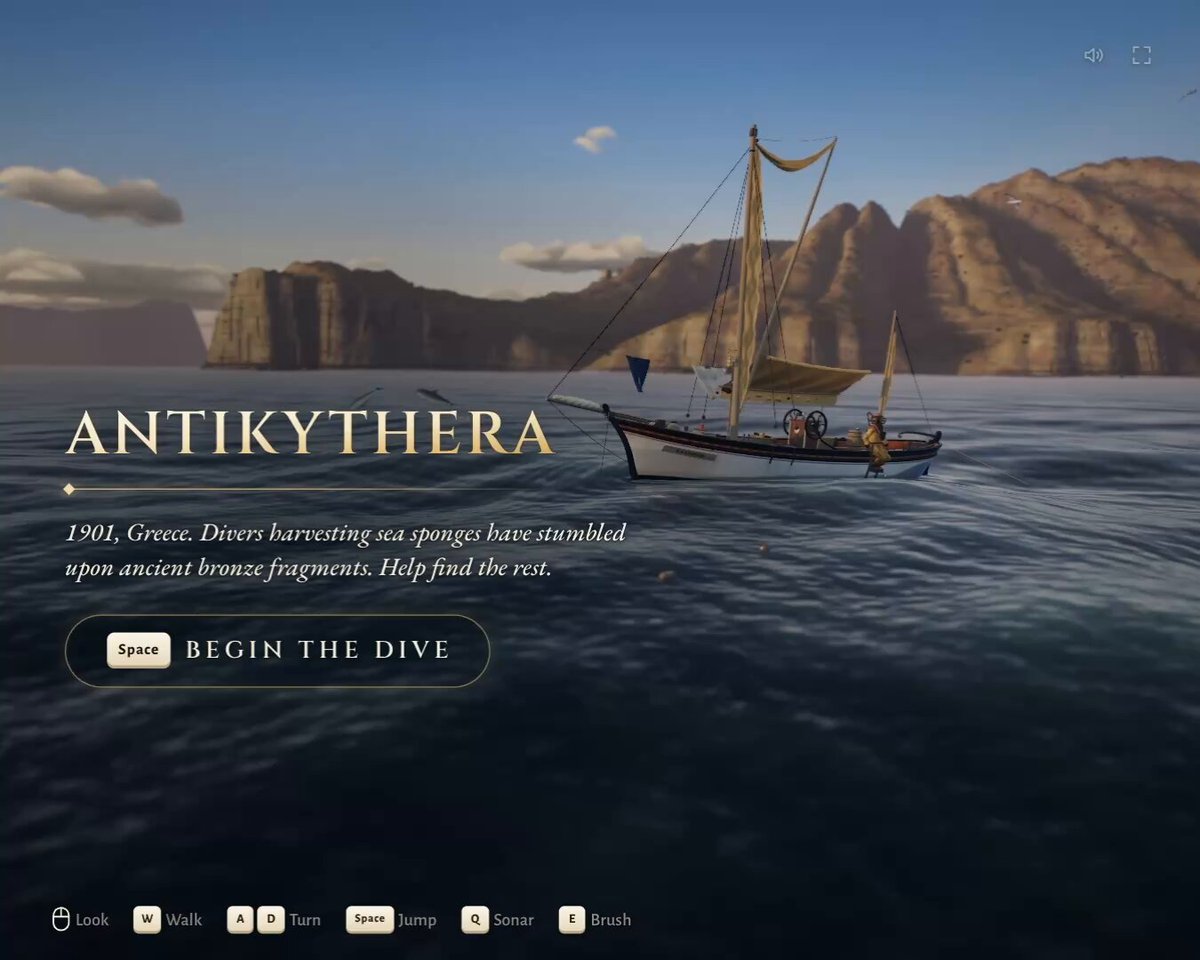
- [00:00] Title and start menu displaying historical context ("1901. Greece. Divers harvesting sea sponges have stumbled upon ancient bronze fragments...") and keybindings.
- [00:02] The diver leaping from a traditional Greek sponge boat into the ocean, diving past schools of fish, dolphins, and jellyfish with sunbeams piercing the water.
- [00:12] Locating bronze fragments buried in the seabed; using an excavation brush to unearth a corroded gear.
- [00:17] Examining the recovered fragment, noting its 127 teeth and the ancient Greek inscription "ΣΕΛΗΝΗ" (Moon).
- [00:22] Walking across the seafloor past scattered ancient amphorae to locate the remaining components.
- [00:24] Gear-train assembly interface where the recovered wheels are placed onto the mechanism's main axle.
- [00:27] Cranking the completed mechanism case underwater, observing the gear train rotate to model the 223-lunar-month Saros eclipse cycle.
- [00:30] A holographic projection displaying the celestial Orrery with the zodiac inscribed in Greek (ΚΡΙΟΣ, ΤΑΥΡΟΣ, ΔΙΔΥΜΟΙ, etc.) predicting a solar eclipse.
- [00:37] Diver ascending back toward the surface at night, watching the eclipse crescent through the water.
- [00:44] End screen congratulating the player ("YOU DISCOVERED THE WORLD'S FIRST COMPUTER") with completion time (0:49) and development credits.
Claims & numbers
- "Everything you see and hear is generated in real time from code by Claude Opus 5.5." (presenter's credit text at [00:48]).
- "The mechanism's gear trains follow the Antikythera Mechanism Research Project's published reconstruction..." ([00:48]).
- "Eclipses repeat in a cycle of 223 lunar months." ([00:27]).
- "127 TEETH" on the lunar gear fragment ([00:18]).
- "All three found in 0:49" completion speedrun time ([00:47]).
Notable quotes
- [00:18] "Beside it, ΣΕΛΗΝΗ: Greek for the Moon."
- [00:27] "Eclipses repeat in a cycle of 223 lunar months."
- [00:44] "YOU DISCOVERED THE WORLD'S FIRST COMPUTER"
Assessment
This is a real technical demonstration of an interactive procedural game running in real time. The code-driven rendering includes shaders, marine wildlife physics, interactive excavation mechanics, and Web Audio synthesis generated via Claude Opus 5.5 code prompts.
AI Production Details
Lyrics & themes
- Type: Instrumental / Sound Design.
- Audio: Contains no lyrics. The audio consists of procedural Web Audio soundscapes including ocean ambient rumbles, splash Foley, bubbling regulators, metallic gear clicks, and synthesized orchestral strings with celestial chimes during the Orrery activation.
- Themes: Archaeoastronomy, historical retrieval, ancient Greek engineering, and early computational history.
Lore & references
- Antikythera Mechanism: References the 1901 discovery of the ancient Greek analog computer off the island of Antikythera by sponge diver Elias Stadiatis.
- Antikythera Mechanism Research Project (AMRP): Directly credits the research team responsible for mapping the gear tooth ratios (specifically the 127-tooth lunar gear representing the 235-month Metonic cycle and the 223-month Saros eclipse prediction dial).
- Claude Opus 5.5: Represents a benchmark demonstration of Anthropic's Claude Opus 5.5 model generating complete, executable full-stack WebGL/shader game code in a single procedural bundle.
Visual style & craft
- Rendering: Stylized real-time 3D procedural graphics (Three.js/WebGL/GLSL shaders) featuring volumetric lighting rays, particle-driven schools of fish, custom water surface displacement, and screen-space water droplet lens refraction at the surface.
- Execution: Entirely code-rendered rather than AI-generated video diffusion, ensuring consistent interactive camera controls, physics collision, and UI interaction states.
Described by gemini-3.8-flash on 2026-10-05 from the video's audio and frames.