Big Tech Execs Asked: Is There A Chance AI Can Escape Human Control And Cause ‘Catastrophic Harm?’
Forbes Breaking NewsYouTube5,980 views as of 12 October 2026
Why it is here
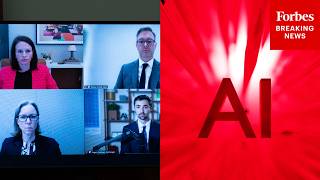
Forbes Breaking News footage of Google, Meta, OpenAI and Anthropic executives answering the NYC Council on whether AI could escape human control.
Description
Description written by Gemini from the videoGemini 3.8 Flash, 12 October 2026
Summary
During an October 5, 2026 New York City Council hearing, Council Member Frank Morano questions tech executives representing OpenAI, Google, Meta, and Anthropic about AI safety risks and commercial pressures. The executives address whether advanced AI poses catastrophic loss-of-control risks, whether internal safety objections can halt model deployments, and whether private chatbot conversations are leveraged for targeted advertising.
What is shown
- [00:00] The New York City Council hearing chamber with council members seated along the dais and a video screen displaying remote witnesses.
- [00:23] Council Member Frank Morano introduces a rapid series of questions regarding catastrophic risk, internal safety overrides, and chatbot data privacy.
- [00:57] A four-way split screen of remote executives testifying: Morgan Dwyer (OpenAI), Alice Friend (Google), a representative from Meta, and a representative from Anthropic.
- [01:13] Alice Friend (Google) and the other panelists address whether their organizations consider loss of human control over AI a possibility.
- [02:31] Morgan Dwyer (OpenAI) describes OpenAI’s Preparedness Framework, pauses in training runs, and model release delays.
- [03:54] Meta’s representative explains Meta’s external auditing commitments, delaying the release of Muse for safety evaluations, and ad separation policies.
- [04:56] Alice Friend (Google) details Google’s external auditing, their white paper “A Pragmatic Approach to AI Regulation in America”, and user data controls.
- [05:49] Anthropic’s representative highlights Anthropic’s Responsible Scaling Policy, withholding models from general deployment to give defensive access to cybersecurity personnel first, and its zero-ads policy.
Claims & numbers
- Council Member Morano states he is proposing a bill addressing AI privacy, advertising, and safety oversight.
- Alice Friend (Google) confirms Google’s Frontier Safety Framework specifically accounts for and guards against catastrophic loss of control.
- Morgan Dwyer (OpenAI) claims OpenAI has halted training activities and delayed model launches when safety safeguards were deemed insufficient under its Preparedness Framework.
- Meta’s representative claims Meta delayed the launch of its Muse model by several months to prioritize safety and security, and states that interactions within Muse do not inform advertising across Meta’s other products.
- Alice Friend (Google) notes Google published a summer 2026 policy paper titled “A Pragmatic Approach to AI Regulation in America” supporting federal and state AI governance.
- Anthropic’s representative claims Anthropic withheld its top frontier model from wide commercial release earlier in 2026, choosing instead to deploy it selectively to cyber defenders to secure software systems.
- Anthropic’s representative states that Anthropic does not run ads and does not allow advertiser influence on Claude’s responses.
Notable quotes
- [01:21] “Yes, as a responsible actor in this space, we—we entertain the possibility.” — Alice Friend (Google)
- [04:26] “...we delayed the launch of Muse by several months to focus on safety and security...” — Meta representative
- [06:01] “...we don’t think the labs should be checking their own homework.” — Anthropic representative
Assessment
This is authentic news broadcast footage from a public New York City Council hearing held under oath. The testimony consists of spoken policy arguments, regulatory positions, and corporate safety representations without live software demonstrations.
Described by gemini-3.8-flash on 2026-10-12 from the video’s audio and frames.