Gemini 4 Argon: Modernizing 40 year code
Google Antigravity YouTube 8,496 views as of 13 October 2026
Why it is here
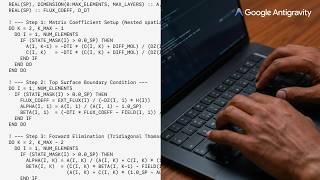
Google Antigravity launch-day demo (2:48): Antigravity and Gemini 4 Argon port decades-old scientific code to Rust (description).
Description
Description written by Gemini from the videoGemini 3.8 Flash, 13 October 2026
Summary
Google Principal Engineer Dan and Product Manager Prashant demonstrate using Google’s Antigravity orchestration platform powered by Gemini 4 Argon to modernize legacy scientific codebases. They show the end-to-end autonomous migration of the 40-year-old legacy Fortran acoustic-toolbox into idiomatic, 100% Safe Rust while discovering latent bugs and achieving massive performance gains.
What is shown
- [00:00 - 00:34] Introduction discussing legacy scientific software dating back 40–50 years (showing NASA documents from 1968 and 1973, NASTRAN, and Fortran printouts) used for fluid dynamics and climate/ocean modeling.
- [01:12 - 01:35] Antigravity IDE running Gemini 4 Argon Medium on the task: migrating
acoustic-toolboxfrom GitHub to Safe Rust in three stages (baseline audit, line-by-line mapping, and compilation/verification). Screen recordings show the agent analyzing files, running benchmark scripts, and refactoring code. - [01:36 - 01:48] Direct side-by-side comparison between legacy Fortran 77 code (
ram1.5.fwith 46 arguments and raw mutable static arrays) and modern Safe Rust (tridiag.rswithsolve_tridiagonal_soa). - [01:49 - 02:14] Executive Modernization Report and Architectural Blueprint generated by the agent detailing uncovered latent bugs (e.g., dead-store elimination, missing signs, unitialized variables, out-of-bounds reads) and verification stats.
- [02:15 - 02:28] Antigravity Interactive HTML dashboard displaying benchmark metrics, memory usage, and side-by-side algorithm restructuring.
- [02:29 - 02:47] Visualizations of scientific simulations and closing remarks, concluding with the Gemini 4 Argon title card.
Claims & numbers
- Speedup: Prashant and the report claim an end-to-end speedup of up to 163.4x, slashing execution time from a 62,080.0 ms Fortran baseline to 380.0 ms in Rust via Profile-Guided Optimization (PGO) and Fat LTO (with Safe Rust baseline at 2,500.0 ms / 24.8x and SoA + SIMD at 440.0 ms / 141.1x) [01:49].
- Code compression & consolidation: Reduced 25,059 lines of legacy Fortran code across 100 files to 1,561 lines of Rust across 24 modules (a 16.1x code compression and 4.2x modular consolidation) [01:55].
- Safety & Parity: Achieved 100% memory safety (
#![forbid(unsafe_code)]), 0 unsafe blocks, zero Clippy warnings, and 100% output bitwise/sub-epsilon parity across 100/100 benchmark test cases [01:49, 02:18]. - Time saved: Antigravity and Gemini 4 Argon completed the modernization in 0.95 hours of AI time versus an estimated 64 to 88 weeks of human engineering effort (~2,728x faster) [02:22].
- Bug fixing: The model identified and corrected 7–8 latent bugs, architectural hazards, and undefined behaviors present in the legacy Fortran codebase [01:59 - 02:14].
Notable quotes
- [00:35] “The goal here was to prove that Antigravity, when coupled with Gemini 4 Argon, can take a large-scale scientific codebase and transform it and replicate it bit by bit.” — Prashant
- [01:39] “Gemini 4 Argon was able to hold a context of all of the code in the codebase, plus information on the physical world that it was trying to simulate.” — Dan
- [02:29] “A higher sense here is to take something that is old and legacy and transform it into something that is more usable and more approachable by modern researchers...” — Prashant
Assessment
This is an official demonstration video from Google Antigravity highlighting Gemini 4 Argon’s code-migration capabilities. The terminal workflows and agent thought traces are sped up and condensed into representative excerpts, but they showcase genuine artifact outputs, diffs, and benchmark dashboards from the migration pipeline.
Described by gemini-3.8-flash on 2026-10-13 from the video’s audio and frames.