Teaching a humanoid robot to play cornhole with Gemini 4 Argon
Google DeepMind YouTube 33,930 views as of 13 October 2026
Why it is here
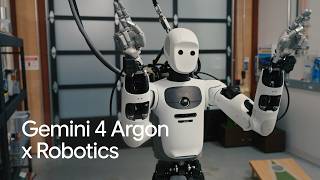
Google DeepMind’s launch-day demo for the Gemini 4 Argon general release (1:44), the most-viewed of Google’s launch videos on YouTube so far. Per the description: in an internal test Argon watched a video of a human playing cornhole, built a MuJoCo simulation and computed whole-body control for Apptronik’s Apollo 2 humanoid, which sank seven consecutive shots; Google calls it a ‘Video-to-Sim-to-Real pipeline’ that ‘compresses weeks of manual modeling into a few hours’. Vendor demo, not independently checked.
Description
Description written by Gemini from the videoGemini 3.8 Flash, 13 October 2026
Summary
Google DeepMind research engineer Rohan Thakker presents an experiment testing whether Gemini 4 Argon can control an Apptronik Apollo humanoid robot to learn and execute playing cornhole. The model observes human demonstrations via the robot’s cameras, models and practices throws inside a MuJoCo physics simulator, and iteratively refines its real-world throwing technique from visual feedback.
What is shown
- [00:00 - 00:05] Apollo humanoid robot throwing a beanbag cleanly into the cornhole board; title overlay: “Gemini 4 Argon x Robotics”.
- [00:05 - 00:08] Introduction by Rohan Thakker, Research Engineer at Google DeepMind.
- [00:08 - 00:12] Web prompt UI (Apollo real2sim Cornhole, running Gemini 4 Argon) prompting the robot to record a demonstration using its left eye camera.
- [00:13 - 00:16] A researcher tossing a beanbag while the robot watches.
- [00:17 - 00:20] Side-by-side comparison of Apollo 2’s left eye camera feed and the MuJoCo simulator mirroring the motion.
- [00:21 - 00:30] Initial trial throws on hardware, showing misses alongside telemetry and code logs of joint positions, velocities, and error analysis.
- [00:31 - 00:36] Successful beanbag throw directly into the target hole; engineers cheer.
- [00:37 - 00:41] Apollo celebrates with arm gestures and speech.
- [00:42 - 00:46] User prompt requesting a 20-second summary of the methodology with accompanying gestures in sim.
- [00:47 - 01:25] Apollo articulates its 4-step approach (motion mapping from video, stereo camera 3D estimation & physics setup, simulation tuning including widening stance to 52 cm for a 7.2 cm balance margin, and real-world iterative correction).
- [01:26 - 01:36] Thakker detailing Gemini 4 Argon’s multimodal reasoning, error diagnosis from video, and experiential learning.
- [01:37 - 01:43] Montage of direct cornhole shots and the closing Gemini 4 Argon title card.
Claims & numbers
- The presenter claims they tested whether Gemini 4 could control a humanoid robot to solve a dynamic physical task (cornhole).
- In simulation, the model widened the robot’s stance to 52 cm to boost its balance margin to 7.2 cm (shown at [01:07]).
- Apollo claims it adjusted its release on the physical robot by a few centimeters until sinking 7 consecutive shots straight into the hole.
- The presenter claims Gemini 4 can autonomously reason over video footage of failures to diagnose mechanical errors and improve control policies iteratively.
Notable quotes
- [00:05] “In this experiment we’re basically trying to see if we can teach Gemini 4 to control a humanoid robot to solve cornhole.” — Rohan Thakker
- [00:38] “Woohoo! Airmail, straight in the hole. Let’s go!” — Apollo / Gemini 4
- [01:20] “...and adjusted my release by a few centimeters until we sank seven shots straight in the hole.” — Apollo / Gemini 4
Assessment
This is an official demonstration video produced by Google DeepMind showcasing Gemini 4 Argon’s multimodal reasoning in a real-to-sim-to-real robotics framework. The footage showcases real robot hardware and simulation environments, though the presentation is polished and time-condensed with cuts across the trial and error iterations.
Described by gemini-3.8-flash on 2026-10-13 from the video’s audio and frames.