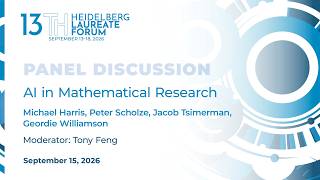
Panel Discussion: AI in Mathematical Research | September 15
Heidelberg Laureate ForumYouTube45,063 views as of 11 October 2026
Why it is here
93-minute HLF 2026 panel on what AI that solves non-trivial research problems means for the mathematical profession and workflows; ~45k views.
Description
Description written by Gemini from the videoGemini 3.8 Flash, 11 October 2026
Summary This video features a panel discussion on “AI in Mathematical Research” recorded on September 15, 2026, at the 13th Heidelberg Laureate Forum. Introduced by Jessica Fintzen and moderated by Tony Feng (with audience Q&A facilitated by Lola Thompson), the panel includes mathematicians Michael Harris, Peter Scholze, Geordie Williamson, and Jacob Tsimerman discussing their personal usage of AI, the implications of automated theorem proving, ethical concerns, and the future of human mathematical understanding.
What is shown
- [00:26] Jessica Fintzen introduces the panel and moderator Tony Feng.
- [02:30] Tony Feng queries the panelists on how many hours they spent interacting with AI during the previous week.
- [02:56] Michael Harris states he spent zero hours and discusses his newsletter Silicon Reckoner, citing Ted Chiang’s critique of commercial LLMs as unethical technologies rooted in intellectual property theft, and references Lewis Hyde’s The Gift [12:30].
- [05:07] Peter Scholze displays his non-smartphone flip phone [10:14], explains why he avoids LLMs, and discusses the Leiden Declaration on AI and Mathematics, arguing that treating mathematics as PR benchmarks harms community norms.
- [07:11] Geordie Williamson details his work using neural networks and coding agents for exploratory math (including murmuration phenomena in number theory), while cautioning against superficial LLM prompting.
- [09:06] Jacob Tsimerman explains his transition toward AI safety at OpenAI, detailing how coding agents generate and test mathematical arguments in game theory.
- [18:07] Panel discussion regarding the Navier–Stokes existence and smoothness problem and recent AI claims/announcements by labs, referencing Tristan Buckmaster and Demis Hassabis.
- [29:30] Career advice for graduate students in the AI era, including the founding of the Association for Human Mathematics [37:44] and the establishment of the journal Mathematical Discourse [45:43].
- [61:42] Q&A session moderated by Lola Thompson addressing public funding of mathematics, disparities in compute access, and audience inquiries [71:10, 84:40, 91:35].
Claims & numbers
- Michael Harris notes Paragraph 259 of the German Criminal Code (Strafgesetzbuch) prescribes imprisonment of up to 5 years for receiving stolen goods (Hehlerei) [12:05].
- Geordie Williamson reports spending approximately 3 to 4 hours per day working alongside AI coding agents [06:45].
- Jacob Tsimerman estimates spending 30 minutes to an hour per day using AI [08:45].
- Peter Scholze notes Demis Hassabis predicted in a January 2025 Die Zeit interview that DeepMind would solve a Millennium Prize problem within 1.5 years [23:00].
- Geordie Williamson mentions finding an explicit construction of a Hadamard matrix of order 668 [25:28].
- Jacob Tsimerman predicts that AI will be able to explain mathematics better than human mathematicians “by April” [74:05], and that superhuman mathematicians will emerge within a few years [42:07, 81:30].
Notable quotes
- [10:11] Peter Scholze: “I’m a Luddite dinosaur. I, as you see, my technology level is this big—it’s this type of phone.”
- [43:35] Geordie Williamson: “Mathematics has been bottlenecked by our brains for, you know, a long time now. That we’re really at max capacity as mathematical researchers.”
- [74:03] Jacob Tsimerman: “I think there’s every reason to believe AI will very soon—like, I’m talking April—be able to explain mathematics better than any mathematician can explain it.”
Assessment This is official recording of a live, unscripted academic panel discussion at the 13th Heidelberg Laureate Forum. No pre-recorded software demos or benchmark runs are presented onstage; the content consists entirely of personal experiences, debate, and philosophical arguments delivered by active mathematical researchers.
Described by gemini-3.8-flash on 2026-10-11 from the video’s audio and frames.