AI’s Riemann result has a ceiling. A human just found it.
HexaValuation YouTube 22,421 views as of 15 October 2026
Why it is here
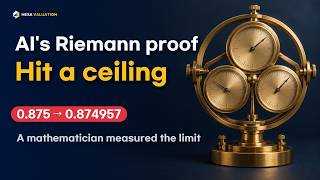
On Baiying Liu’s improvement of OpenAI’s quasi-Riemann bound (7/8 to 0.874957), which also shows the method has a ceiling, plus the week’s withdrawn papers and repairs. About 22,421 views on 2026-10-15.
Description
Description written by Gemini from the videoGemini 3.8 Flash, 15 October 2026
Summary
Presented by HexaValuation, this video analyzes the aftermath of OpenAI’s October 6, 2026 release of 722 AI-generated math manuscripts, focusing on the claimed quasi-Riemann hypothesis proof and its subsequent human improvement. The presenter explains Purdue mathematician Baiying Liu’s preprint that sharpened the zero-free bound from $7/8$ ($0.875$) to $0.874957$, demonstrated a theoretical ceiling for this proof method, and contextualizes the broader mathematical community’s reaction, retraction updates, and debates over AI-generated research releases.
What is shown
- [00:08] Side-by-side infographic comparing the AI bound ($7/8 = 0.875$) with Baiying Liu’s follow-up bound ($0.874957$, an improvement of about $0.00004$).
- [00:48] Visual timeline and complex plane diagrams depicting the Riemann zeta function, the critical line at $\text{Re}(s) = 1/2$, and the zero-free region past $7/8$.
- [01:54] Manuscript tracking graphics: OpenAI posted 722 manuscripts on October 6, dropped to 719 on October 7 after withdrawing three papers on the Hodge conjecture due to a sign error.
- [02:17] Summary slide showing 14 papers repaired and 42% (300 of 719) top-line results Lean-checked.
- [02:57] Lean 4 code excerpt (
theorem riemannZeta_ne_zero_of_seven_eighths_lt_re) comparing code declarations to the written paper text regarding pole handling at $s=1$ and constants. - [04:05] Curated mathematician reactions from the Proofs and Prompts blog, including quotes from Ben Green, Tim Santens, Jakob Glas, Hector Pasten, and Alvaro Lozano-Robledo.
- [05:17] Baiying Liu’s arXiv preprint listing (
arXiv:2610.12234) and diagrams showing how adjusting parameters ($b$, cutoff $t$, moment $\kappa$) reached the optimal ceiling of $0.874957$. - [06:27] The preprint’s acknowledgments showing OpenAI Codex searched for bounds, Anthropic Claude audited the work, and the result was formalized in Lean 4.
- [07:13] Overview of the 9-mathematician advisory group hosted at the Institute for Advanced Study and coverage from TechCrunch, showing that only 10 of 719 manuscripts included the model’s chain-of-thought, alongside critiques from Melanie Wood and Terence Tao.
Claims & numbers
- The presenter says Purdue mathematician Baiying Liu improved OpenAI’s quasi-Riemann bound from $7/8 = 0.875$ to $0.874957$, a difference of about $0.00004$ (published October 8, 2026,
arXiv:2610.12234). - The presenter states OpenAI posted 722 manuscripts on October 6, 2026, which decreased to 719 on October 7 after 3 papers were withdrawn due to a sign error in a trace-cancellation argument regarding the Hodge conjecture.
- The presenter claims 14 additional OpenAI manuscripts were repaired with proof and statement corrections, and 42% (300/719) of top-line results are Lean-checked.
- The presenter claims the 199-page quasi-Riemann proof has not been withdrawn or found to contain errors, but has not completed formal peer review.
- The presenter notes that only 10 out of OpenAI’s 719 manuscripts were released with the model’s chain-of-thought.
- The presenter states that an advisory group of 9 mathematicians hosted at the Institute for Advanced Study urged AI companies to stop testing problems on proprietary closed models, take responsibility for ensuring human understanding, and help fund expert checking time.
Notable quotes
- “A Lean verification does not show the written proof is correct.” — Kimball Martin [03:46]
- “Quasi-RH is huge! But it is not RH.” — Alvaro Lozano-Robledo [04:54]
- “There is not human understanding of them at the point of release, and now the work begins.” — Melanie Wood [07:51]
Assessment
This is an analytical explainer and commentary video relying on clean motion graphics, code excerpts, paper screenshots, and sourced quotes rather than live on-screen demonstrations. The presentation accurately summarizes community preprints and verified historical reporting regarding OpenAI’s October 2026 mathematics release and Baiying Liu’s follow-up work.
Described by gemini-3.8-flash on 2026-10-15 from the video’s audio and frames.