Claude Opus 5.5 vs GPT-6 Sol for 3D game development in Unreal Engine (Higgsfield, X video)
Higgsfield AI (@higgsfield_ai) · 2026-09-22 · ai-made · 536,497 views
Made by AI
Model: Claude Opus 5.5, GPT-6 Sol · Series: Agent-built game or 3D world (the video shows the result)
Evidence: X post (2026-09-22): 'Claude Opus 5.5 vs GPT-6 Sol for 3D game development with Higgsfield in Unreal Engine.'
Human role: Higgsfield ran both models through its own tooling; a vendor comparison (promotional).
Pipeline: Higgsfield tooling + Unreal Engine driven by each model → 44-second comparison
What's in the video
Description written by Gemini, which watched and listened to the whole video.
Summary
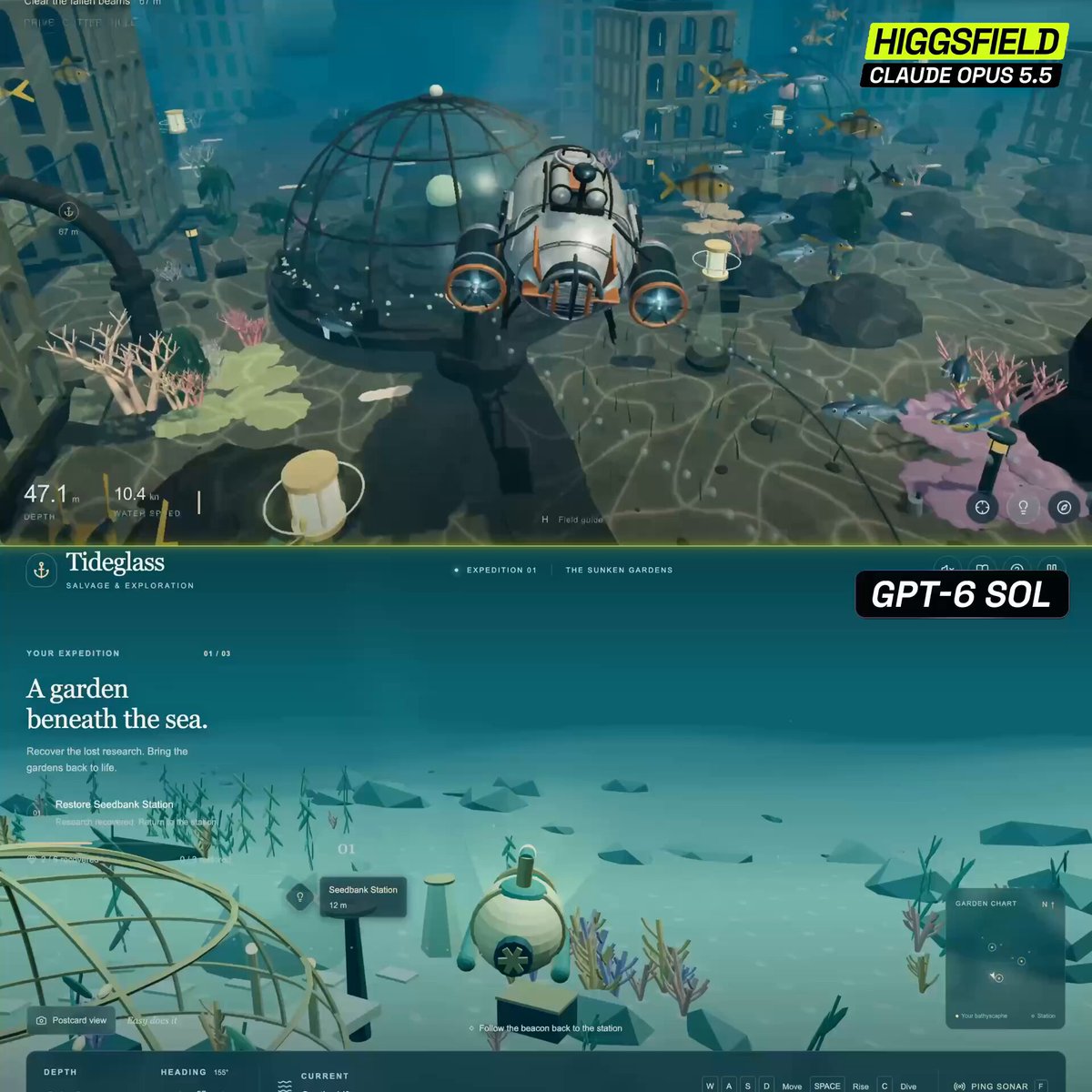
This split-screen comparison showcases an underwater 3D game environment developed using Anthropic's Claude Opus 5.5 (top) versus OpenAI's GPT-6 Sol (bottom) within a game engine development workflow presented by Higgsfield AI. Both models generate interactive, playable marine exploration gameplay featuring autonomous submersibles navigating submerged ruins, biodomes, marine life, and procedural collection quests.
What is shown
- [00:00–00:10] Top view (Claude Opus 5.5): A mechanical steampunk-style submarine maneuvers past submerged city buildings, geodesic reef biodomes, and sea life; the bottom view (GPT-6 Sol) shows Tideglass: Reclaim & Restoration, featuring a minimalist, cel-shaded aesthetic with a yellow submersible discovering the "Sunken Gardens."
- [00:10–00:26] The GPT-6 Sol display prompts the player with journal entries ("A little closer," "Coral Lens," "Current Compass") while its yellow sub scans undersea flora; simultaneously, the Claude Opus 5.5 submarine banks around sunken concrete towers while avoiding a large shark swimming overhead.
- [00:27–00:35] Top panel displays an interactive fishing mini-game mechanic ("Silver Dart — Common — Reeling"), prompting user input ("Hold/Hold mouse scroll") with tension gauges.
- [00:36–00:44] Bottom panel tracks artifact recovery missions ("Glowing Specimen," "Signal Core," "Restore Glasshouse Station") as the submersible approaches research structures and docking anchors.
Claims & numbers
- Top UI telemetry displays depths ranging between 35.8 m and 45.9 m and water speeds up to 13.7 m/s.
- Bottom UI tracks distance markers down to 1 m for artifact recovery and shows mission progress markers for Expedition 01.
- No verbal benchmarks or performance claims are spoken by a presenter.
Notable quotes
- None (the video contains no spoken dialogue or narration).
Assessment
This is a side-by-side technical showcase demonstrating game design and level-generation capabilities between Claude Opus 5.5 and GPT-6 Sol in an interactive 3D engine. The footage consists of real-time engine playback featuring distinct art styles, functional UI overlays, and gameplay loops rather than pre-rendered video hallucinations.
Lyrics & themes
- The audio is entirely instrumental and atmospheric, consisting of low-frequency underwater hums, propulsion rumble, sonar pings, bubble sound effects, and digital UI feedback clicks.
Lore & references
- Claude Opus 5.5 vs. GPT-6 Sol: Direct head-to-head evaluation pitting Anthropic's flagship coding/reasoning model against OpenAI's GPT-6 tier model in game asset synthesis and interactive systems engineering.
- Tideglass / Subaquatic Ecological Themes: Both scenes center on post-diluvian restoration ("Reclaim & Restoration," sunken metropolises, restoring coral habitats), a prevalent theme in speculative physical AI simulations.
Visual style & craft
- Claude Opus 5.5 (Top): Features realistic PBR lighting, water caustics, textured metal on the submarine, realistic fish shoals, and underwater haze amid submerged urban high-rises.
- GPT-6 Sol (Bottom): Stylized low-poly art direction with flat shading, soft seafoam/mint color palettes, and clean graphic typography resembling contemporary indie exploration games (e.g., Abzû or Subnautica).
- Both halves display fully integrated UI systems, interactive raycasted HUD waypoints, and coherent 3D collision physics.
Described by gemini-3.8-flash on 2026-10-05 from the video's audio and frames.