A 3-minute animated film of all human progress, and 30 years beyond, from one prompt ("Claude Fable 5.5", X video)
imjustnewatai (@imjustnewatai) · 2026-10-02 · ai-made · 345,454 views
Made by AI
Model: Claude Fable 5.5 (creator's claim; model not announced by Anthropic) · Series: Code-rendered film (LLM writes the program that draws every frame)
Evidence: X post (2026-10-02): 'I gave Claude fable 5.5 one prompt: a video of all human progress, then 30 years into the future. It came back with a 3-minute animated film and an original score. No footage, no stock music.' Anthropic has not announced Fable 5.5; as of 2026-10-04 Fable 5.1 is the current Fable model. The attribution is the creator's claim (users report claude.ai requests being routed to an unannounced model while Fable 5.1 is selected) and is unverified.
Human role: One prompt (per the creator); how the score was produced is not explained.
Pipeline: One prompt → model-written animation code and original score (method not stated) → 3:09 film
What's in the video
Description written by Gemini, which watched and listened to the whole video.
Summary
This video is an animated data-visualization short film titled The Second Day, created by X user @imjustnewatai reportedly generated from a single prompt using Claude Fable. It maps 3.3 million years of human technological history onto a single 24-hour clock, arriving at the present (2026) at midnight, before visualizing an accelerating exponential projection of scientific and technological progress across the first fraction of a second of "Day Two" (2027–2056).
What is shown
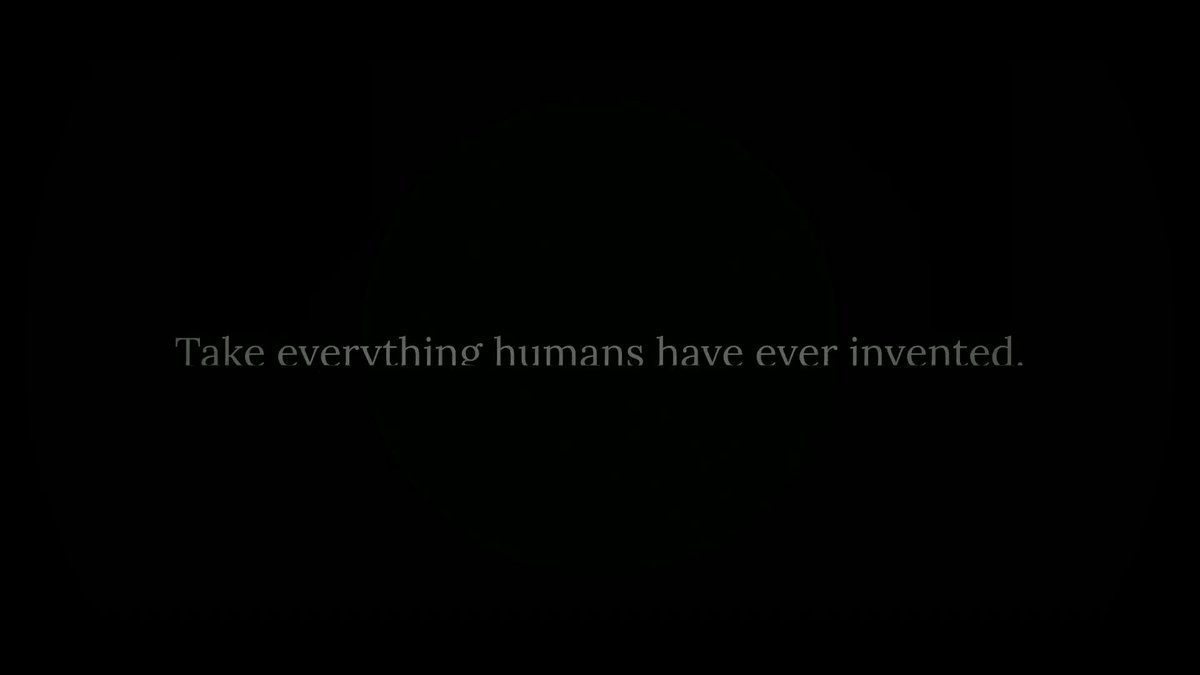
- [00:00–00:08] Opening premise text establishing 3.3 million years of human invention compressed into a single 24-hour day.
- [00:09–00:26] Deep prehistoric era: Stone tools appear at 00:00:00; sixteen hours pass on the timeline with minimal technological change.
- [00:27–00:44] Milestones of early human evolution: Control of fire (
1,000,000 years ago / 16:43:38), emergence of Homo sapiens (300,000 years ago / 21:49:05), and cave art (~45,000 years ago / 23:40:21). - [00:45–01:08] The agricultural revolution through antiquity and the Middle Ages: Farming at five minutes to midnight (c. 10,000 BCE / 23:54:45), the wheel, cuneiform writing, metallurgy, mathematics, paper, zero, and gunpowder.
- [01:08–01:47] Rapid acceleration in historical time: The printing press (1450, 15 seconds to midnight), the Copernican revolution, Newtonian mechanics, the steam engine (1712, 8 seconds to midnight), electrification, powered flight, nuclear physics, computing, the Moon landing (1969), and the World Wide Web (1989, 1 second to midnight).
- [01:48–02:00] Retrospective timeline tracking the history of Artificial Intelligence: Alan Turing (1950), backpropagation (1986), Deep Blue (1997), deep learning (2012), AlphaGo (2016), the Transformer architecture (2017), AlphaFold (2020), generative language models (2022), and AI Nobel Prizes (2024), reaching midnight (2026: "You are here").
- [02:01–02:43] "Day Two" speculative projection (2027–2053): Visualized as an accelerating curve and sphere of light. Milestones list autonomous AI agents, machine-proven mathematics, AI-designed drugs, fusion energy, curing Alzheimer's, carbon capture, and exponential scientific output culminating in "a century of progress every hour" (10,000,000× 2026 pace) by 2053.
- [02:44–03:09] A quiet sunrise over the Earth's curvature at 2056 (00:00:00.785 on the clock), concluding with the title card The Second Day.
Claims & numbers
- Timeline compression scale: 3.3 million years equals 24 hours (86,400 seconds), meaning all written human history occurred in the last 2 minutes and 19 seconds of the day [00:24].
- Milestone timings on Day One:
- Farming (~10,000 BCE) occurs at 23:54:45 ("five minutes to midnight") [00:46].
- The printing press (~1450 CE) occurs at 23:59:44.9 ("fifteen seconds to midnight") [01:09].
- The steam engine (1712 CE) occurs at 23:59:51.7 ("eight seconds to midnight") [01:19].
- The World Wide Web (1989 CE) occurs at 23:59:59.03 ("one second to midnight") [01:43].
- Generative AI language models (2022 CE) arrive at 23:59:59.895 ("a tenth of a second to midnight") [01:58].
- Speculative Day Two acceleration claims (2027–2056):
- Pace of discovery reaches 10× 2026 rate by 2034, 100× by 2038, 1,000× by 2042 ("a century of progress every year"), 10,000× by 2046 ("every month"), 100,000× by 2049 ("every week"), and 10,000,000× by 2053 ("every hour") [02:29–02:42].
- By 2056, only 0.785 seconds have elapsed on the Day Two clock [02:47].
Notable quotes
- "Take everything humans have ever invented. 3.3 million years of it. Now fit it into one day." [00:01]
- "The first day took 3.3 million years. What we do with the second is still up to us." [02:52]
- "Dates up to 2026 are real; the oldest are approximate. Everything after is imagined." [03:04]
Assessment
This is a stylized, AI-generated conceptual motion graphic/infographic video rather than a software demo or product launch. While the historical chronology is grounded in established archaeological and technological dates, the post-2026 trajectory is explicitly speculative science-fiction visualizing an intelligence explosion.
Lyrics & themes
- Audio: The soundtrack is completely instrumental, featuring a rhythmic ticking clock, minimalist grand piano motif, and swelling orchestral-electronic synth strings building to a cinematic climax and settling into a quiet piano coda.
- Themes: The film centers on the accelerating returns of human technology, the compression of historical time, the singular inflection point represented by artificial intelligence, and the ethical responsibility humans retain over an unpredictable technological future.
Lore & references
- "Attention is all you need" [01:56]: Direct citation of the 2017 seminal paper by Vaswani et al. that introduced the Transformer architecture.
- AlphaGo vs. Lee Sedol (2016) [01:55] & AlphaFold (2020) [01:57]: Key milestones of Google DeepMind's breakthrough AI systems.
- "A century of progress every..." [02:38–02:42]: A direct conceptual reference to technological singularity literature (e.g., Ray Kurzweil's Law of Accelerating Returns).
- The 24-hour cosmic calendar analogy: Adapts Carl Sagan's famous "Cosmic Calendar" metaphor specifically to the history of human tool use and invention.
Visual style & craft
- Designed with vector motion graphic aesthetics, clean typography (serif headings paired with clean sans-serif data labels), and a dark, low-contrast palette accented by luminous gold, copper, and neon gradients.
- Visual elements include geometric line art (wireframe stone tool, solar orbits, celestial sphere), 2D vector silhouettes (campfire, hunter-gatherers, hands on a cave wall), animated charts, and mathematical/code overlays.
- Transitions, kinetic typography, and motion easing are characteristic of high-end programmatic rendering (e.g., motion graphics generated via Remotion, SVG, or canvas code).
Described by gemini-3.8-flash on 2026-10-04 from the video's audio and frames.