Demis Hassabis: How AI Solves Impossible Problems
Intelligence Squared YouTube 152,667 views as of 19 October 2026
Why it is here
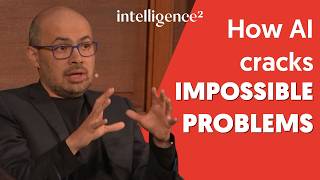
Google DeepMind CEO and Nobel laureate Demis Hassabis in conversation with Sebastian Mallaby, author of The Infinity Machine (a book about Hassabis and DeepMind), at Intelligence Squared (13:54 excerpt; the full talk is on Intelligence Squared+). Topics per the description: why Google held back its chatbot before ChatGPT, how AI cracks problems too vast for brute force, and whether AGI can be built safely. About 153k views in four days. The upload date is Oct 15, 2026, but the recording date is not stated: the panel (moderated by Bloomberg TV’s Tom Mackenzie, per the Gemini description) mentions nothing later than Gemini 3.0 in late 2025, so it may be an earlier talk around the book’s launch. No timeline entry is linked.
Description
Description written by Gemini from the videoGemini 3.8 Flash, 19 October 2026
Summary
In an Intelligence Squared panel discussion, Google DeepMind co-founder Demis Hassabis sits down with author Sebastian Mallaby and Bloomberg TV anchor Tom Mackenzie. The panel discusses the evolution of large language models, the organizational merger of Google Brain and DeepMind, the conceptual framework of AI as a search engine across vast combinatorial spaces (“The Infinity Machine”), and the balance between intense commercial competition and safety governance in the pursuit of AGI.
What is shown
- [00:00 - 03:16] Demis Hassabis describes the early reluctance at Google to release early language models like LaMDA due to hallucination risks clashing with Google’s search brand reputation, contrasting this with OpenAI’s startup approach in launching ChatGPT.
- [03:17 - 05:33] Tom Mackenzie and Sebastian Mallaby review the merger of Google Brain and DeepMind across an eight-hour time difference and internal rivalry over compute resources, highlighting Gemini’s leaderboard trajectory.
- [05:34 - 08:58] Hassabis defines the concept behind “The Infinity Machine”: framing scientific challenges (such as protein folding and the game of Go) as navigating astronomical combinatorial search spaces using learned neural models and directed search rather than brute force.
- [08:59 - 13:54] The discussion turns to the duel-use nature of AGI, from warfare and cyber risks to transformative potential in disease eradication, clean energy, and foundational physics, alongside the need for international safety standards and coordination.
Claims & numbers
- Hassabis states early LLMs would deliver incorrect information roughly 20% of the time, posing a severe reputational risk to Google Search.
- Mallaby states that Google Brain in Mountain View and DeepMind in London operated across an 8-hour time zone difference while competing for compute resources before merging.
- Mallaby claims that by late 2025, DeepMind’s Gemini 3.0 model beat its ChatGPT rival on independent evaluation leaderboards.
- Hassabis notes that the number of possible board positions in Go exceeds the number of atoms in the observable universe.
- Hassabis states an average-sized protein possesses approximately $10^{300}$ possible conformational shapes.
- Hassabis notes DeepMind has maintained an internal “AI for Science” group for nearly 10 years, which yielded breakthroughs such as AlphaFold.
Notable quotes
- [01:40] “It’s like go for it, you know, you only live once, YOLO it. And it’s fine.” — Demis Hassabis
- [06:33] “In Go, there are more possible board positions than there are atoms in the universe.” — Demis Hassabis
- [09:32] “I believe it’s the ultimate tool for science, and broadly construed, so science and medicine.” — Demis Hassabis
Assessment
This is a live, unedited stage panel interview hosted by Intelligence Squared. The conversation consists of executive commentary, retrospective analysis, and high-level conceptual descriptions rather than live software demonstrations or staged product benchmarks.
Described by gemini-3.8-flash on 2026-10-19 from the video’s audio and frames.