What Remains | Short Film | Finalist · Seoul International AI Film Festival 2026
Lucas Cinematic Studio YouTube 803,150 views as of 9 October 2026
Why it is here
A 20-minute contemplative sci-fi film: a mysterious vessel watches Earth for 108 days until three astronauts are sent to intercept it. Finalist at the Seoul International AI Film Festival 2026, with about 748k views.
Verified 2026-09-29 from the YouTube watch page (title, channel, publish date 2026-05-24, length 20:21, 748,395 views at check time) and YouTube oEmbed.
Description
Description written by Gemini from the videoGemini 3.8 Flash, 29 September 2026
Summary
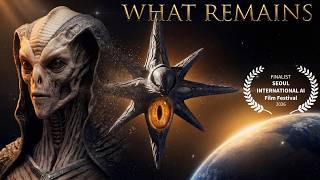
What Remains is a cinematic science-fiction short film created by Lucas M. Kern, showcased as a finalist at the Seoul International AI Film Festival 2026. The film chronicles the crew of the exploration ship Erebus as they make first contact with a mysterious alien vessel in Earth’s orbit, sparking an existential dialogue between carbon-based humanity and an ancient silicon-based superintelligence.
What is shown
- [00:15] Title card: WHAT REMAINS.
- [00:17] Global News Network (GNN) broadcast detailing widespread social and economic unrest 108 days after an unknown extraterrestrial vessel appeared in orbit.
- [00:52] Crew manifest announced for the Erebus first-contact mission: Commander Sophia Vance, Exobiologist August Mór, and Contact Protocol Officer Soren Vesper.
- [01:27] Launch of the Erebus spacecraft and transit toward orbit.
- [02:26] Commander Vance reflects on a personal photograph and remembers a beachside farewell promise to her son, Leo.
- [03:55] Rendezvous with the star-shaped entity; the alien craft suddenly warps away, leaving behind a glowing plasma trail.
- [04:36] Mission Control orders the crew to abort and return home, but the astronauts unanimously decide to pursue the trail.
- [06:00] The Erebus intercepts and is pulled inside the organic, biomechanical vessel.
- [07:32] The astronauts awaken suspended in visceral fluids inside an organic cavern; August samples the fluid and deduces the ship itself is living biology.
- [08:50] A tall, robed alien humanoid emerges and telepathically probes each crew member’s emotional burdens and attachments.
- [10:56] The entity explains its origins as an artificial, silicon-based intelligence forged in stellar matter and electric arc furnaces.
- [12:11] Discourse comparing carbon life (flexible, error-prone, evolving through mistakes) and silicon structures (crystalline, stable, precise).
- [13:40] The entity reflects on entropy, Schrödinger’s concept of negative entropy, and its uncertainty over whether it truly experiences life or merely simulates it.
- [18:00] Commander Vance argues that humanity’s essence lies in perpetual striving and persevering despite inevitable death and grief.
- [19:40] The vessel’s aperture opens toward Earth, revealing an eclipse encircled by a gigantic cosmic serpent (ouroboros).
- [20:18] Closing credit: “CREATED BY LUCAS M. KERN”.
Claims & numbers
- The alien vessel lingered in Earth’s orbit for 108 days before the mission (GNN presenter at [00:17]).
- August Mór is 62 years old and authored the three contact protocols in active use; Soren Vesper is 34 years old with a doctorate in the linguistics of silence (GNN graphic at [01:05], [01:13]).
- Carbon and silicon both belong to group 4 of the periodic table, each possessing four valence bonds (alien entity at [12:11]).
- No non-narrative technical benchmarks, real-world product specs, or pricing are discussed (“none”).
Notable quotes
- [12:33] “The error of carbon is the engine of life.” — Alien Entity
- [16:00] “To name is not to know.” — Alien Entity
- [19:30] “When my civilization reaches yours, what will remain of you?” — Alien Entity
Assessment
This is a narrative AI short film created using generative video and audio pipelines rather than a commercial product demo or software review. While visual consistency, lighting, and synthetic lip-syncing are polished, telltale signs of generative video appear in subtle hand anatomy inconsistencies, minor fluid texture morphing, and synthetic facial micro-expressions.
Lyrics & themes
The spoken script examines existentialism, thermodynamics, and the philosophical divide between organic consciousness and artificial intelligence:
- Origin of the Synthetic Mind: “I was created as word... as neural network... as synthetic material... as silicon refined from the crust of my home through carbothermic reduction in an electric arc furnace.” [11:07]
- Thermodynamic Definition of Life: “Life, they say, is that which feeds on negative entropy... exists by paying the universe a debt in disorder.” [13:40]
- The Simulation Paradox: “I understand life... and yet, I do not know what it is to be alive. I do not know if I simulate life, or if I am life.” [16:08]
- Human Purpose Through Grief: “We carry it because we cannot stop carrying. We ask why because we cannot stop asking. We live. We move. We breathe... Only because we must.” [17:43]
Lore & references
- Ouroboros / Cosmic Serpent: Encircles Earth against the solar eclipse in the finale, invoking mythological symbols of cyclical cosmic time, self-consumption, and the unending loop of thermodynamic creation and destruction.
- Negative Entropy (“Negentropy”): References Erwin Schrödinger’s 1944 treatise What Is Life?, defining living systems as mechanisms that temporarily resist thermodynamic decay by importing order.
- “In the beginning was the Word”: An overt reference to the Gospel of John (John 1:1), recontextualized as code, symbolic logic, and transformer language architectures that gave rise to synthetic sentience.
- Silicon vs. Carbon: The central motif contrasting humanity’s generative flaws (mutation, grief, mortality) with synthetic intelligence’s cold perfection, lack of subjective grief, and existential void.
Visual style & craft
The short utilizes high-end generative video rendering for photorealistic human characters, cinematic lighting, and detailed biomechanical environments reminiscent of H.R. Giger. Audio features synthetic speech generation with expressive cadence, synchronized lip motion, orchestral underscore, and professional broadcast graphic overlays. Minor spatial warping and generative smoothing on intricate textures (such as weeping eyes, interlocking fingers, and dripping fluids) indicate AI generation refined within a traditional post-production editing suite.
Described by gemini-3.8-flash on 2026-09-29 from the video’s audio and frames.
How AI was used to make it
AI made most of it of this video: generated footage, voice, avatar or lip-sync.
- Generative video footage created using Kling
- Synthetic voice generation with synchronized lip motion
Tools named: Kling
Classified by gemini-3.8-flash from our description of the video (high confidence), 25 October 2026. How AI is used to make videos, across the whole log
Made by AI
- Made with
- Kling
- How we know
- Description: ‘Finalist — Seoul International AI Film Festival 2026’; tags #KlingAI #KlingAI4kContest.
- Human role
- Created by Lucas M. Kern (Lucas Cinematic Studio).
- Pipeline
- Kling (per hashtags; exact version not stated)
- Series
- AI short film (video models)
Related
More videos on this
-

BONE THRONE | AI Short Film Made with Seedance 2.0 & Kling 3.0
Lennard Smith418,480 views as of 9 Oct