OpenAI Just Broke Matrix Multiplication. Why 2.25 Matters
Mathify - Animate math by chatting with AIYouTube21,406 views as of 12 October 2026
Why it is here
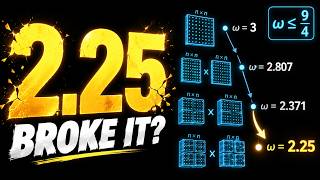
Explainer of the release’s claimed bound ω ≤ 9/4 on the matrix multiplication exponent (previous best ~2.371).
Description
Description written by Gemini from the videoGemini 3.8 Flash, 12 October 2026
Summary — An animated explainer by the channel Mathify breaks down OpenAI’s October 2026 theoretical paper establishing that the matrix multiplication exponent $\omega$ over the complex numbers is at most $9/4 = 2.25$. Narrated with synthetic voiceovers, the video traces the history of fast matrix multiplication algorithms since Strassen, explains the mathematical mechanisms of the new proof (tensor characters, polynomial convolution profile functions, shared-leg Fourier separation, and Lean 4 formalization), and clarifies that this is an asymptotic complexity result rather than an immediate practical performance boost for libraries like PyTorch.
What is shown
- [00:00] Overview of OpenAI’s claimed exponent bound of $9/4 = 2.25$.
- [00:36] Diagram of naive matrix multiplication requiring $n^3$ operations ($n^2$ output cells, each requiring $n$ multiplications).
- [01:30] Volker Strassen’s 1969 algorithm multiplying $2 \times 2$ matrices with 7 multiplications instead of 8, yielding $\omega \approx 2.807$.
- [02:16] Formal definition of $\omega$ as the infimum of exponents $\tau$ such that $n \times n$ matrix multiplication runs in $O(n^{\tau+\epsilon})$.
- [03:10] Historical timeline plot of upper bounds on $\omega$ (1969 Strassen to Coppersmith–Winograd in 1987 at $\approx 2.376$, through Duan–Wu–Zhou in 2024 and AlphaEvolve in August 2026 at $\approx 2.371177$).
- [04:49] Number line comparison showing previous decimal increments ($\sim 0.0016$ and $\sim 0.00012$) versus OpenAI’s claimed drop of $0.121177$.
- [05:51] “Did PyTorch just become much faster?” section addressing misconceptions about practical hardware vs. asymptotic bounds.
- [07:05] Comparison between the traditional laser method and OpenAI’s character-theoretic framework comparing matrix multiplication tensors against polynomial multiplication tensors $C(a,b)$.
- [12:16] Properties of the profile function $P(a,b)$ (symmetry, boundary condition, interpolation upper bound).
- [13:54] Diagram of the shared-leg separation technique via finite Fourier projection over a cyclic group $\mathbb{Z}/N\mathbb{Z}$.
- [15:40] Structural inequalities: discrete concavity and shifted tripling, proving the diagonal lower bound $P(a,a) \ge a^{4/3}$.
- [19:18] Squeezing upper and lower bounds to deduce $t \le 3/4$ and $\omega \le 3t \le 9/4 = 2.25$.
- [21:44] Discussion of the companion Lean 4 proof script and automated verification.
- [23:03] Analysis of the field dependence (roots of unity over $\mathbb{C}$) and subsequent follow-ups extending the result to arbitrary fields.
- [25:40] Discussion of the theoretical frontier $\omega = 2$ and the role of AI in discovery and formal proof.
Claims & numbers
- The presenter says naive matrix multiplication takes roughly $n^3$ scalar operations ($n^2$ entries $\times n$ multiplications and $n-1$ additions).
- The presenter states multiplying two $2,000 \times 2,000$ matrices naively takes $\sim 10^9$ operations, and $10,000 \times 10,000$ takes $\sim 10^{12}$ operations.
- The presenter notes Strassen (1969) proved $2 \times 2$ multiplication with 7 multiplications, giving $\log_2 7 \approx 2.807$.
- The presenter says Coppersmith and Winograd reached $\approx 2.376$ in 1987, after which the bound barely moved for 25 years.
- The presenter states recent human progress (2012–2024) pushed the bound down to $\approx 2.371339$, and an AlphaEvolve-assisted refinement in August 2026 lowered it to $\approx 2.371177$.
- The presenter notes OpenAI’s October 2026 result claims $\omega(\mathbb{C}) \le 9/4 = 2.25$, a decrease of $0.121177$ (over $100\times$ larger than typical recent improvements).
- The presenter claims the proof bounds $\omega \le 3t$ with $t \le 3/4$ derived from profile inequalities.
- The presenter states OpenAI released a Lean 4 formalization verified without unresolved
sorryplaceholders in the solution module.
Notable quotes
- [05:56] “Did PyTorch just become much faster? No, absolutely not. At least not from this theorem alone.”
- [06:50] “This is a foundational result about the limits of computation, not a software patch.”
- [28:34] “The number left on the board is 2. The race continues.”
Assessment This is an educational mathematics review and explainer analyzing OpenAI’s theoretical paper and its Lean verification. It clearly separates theoretical complexity results from practical wall-clock computing, accurately illustrating the underlying algebraic and character-theoretic mechanisms.
Described by gemini-3.8-flash on 2026-10-12 from the video’s audio and frames.