OpenAI solved aperiodic Minecraft tilings
Myren EarioYouTube15,660 views as of 10 October 2026
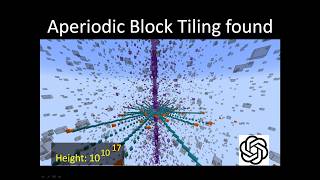
Why it is here
Explains the OpenAI release’s ‘translational tile with no fully periodic tiling in dimension three’ preprint using Minecraft builds; ~16k views.
Description
Description written by Gemini from the videoGemini 3.8 Flash, 10 October 2026
Summary
Presenter Myren Eario explains an open mathematical problem formulated in Minecraft terms: whether a 3D block configuration can tile infinite space exclusively through translation in a strictly non-periodic (aperiodic) manner. He covers OpenAI’s paper “A translational tile with no fully periodic tiling in dimension three” (dated September 23, 2026), presenting visual models and size estimates of the tile derived with Claude Sonnet 5.5.
What is shown
- [00:00 - 01:17] Minecraft gameplay showing block constructions (iron, diamond, gold, emerald, stained glass) demonstrating periodic and non-periodic tiling patterns in 3D space.
- [01:18 - 01:53] A browser window showing the preprint repository and paper PDF titled “A translational tile with no fully periodic tiling in dimension three” by OpenAI (dated September 23, 2026).
- [01:54 - 03:21] Presentation slides detailing the mathematical formulation of a Minecraft block configuration as a finite subset of $\mathbb{Z}^3$ and defining translational tiling and periodicity.
- [03:22 - 04:31] Slides reviewing the 2D case proved by Rachel Greenfeld and Terence Tao (2021) showing no aperiodic translational tiles exist in $\mathbb{Z}^2$, contrasted against OpenAI’s 3D result in $\mathbb{Z}^3$.
- [04:32 - 07:15] Slide deck diagrams illustrating the physical appearance and structure of the OpenAI tile, based on Claude Sonnet 5.5 estimates: the central vertical “needle,” radial “star” rays, and sparse “dust.”
- [07:16 - 08:24] Browsing the 26-page paper PDF, highlighting the introduction, theorem statements, and Sudoku-style constraints across sections.
Claims & numbers
- The presenter states that OpenAI published roughly 300 solutions to unsolved math problems generated by their internal models [01:30].
- The presenter notes Greenfeld and Tao proved in 2021 that aperiodic translational tiles do not exist in $\mathbb{Z}^2$ [03:42].
- Citing Claude Sonnet 5.5’s reading of the paper, the presenter reports the constructed tile’s dimensions and characteristics:
- Width and length: approximately $10^{2300}$ blocks [04:42].
- Height: roughly $10^{10^{17}}$ blocks, with a noted reduction to $10^{10^6}$ blocks [05:04, 05:31].
- Density: approximately $0.1^{10^8}$ (fewer than one block per $10^{10^8}$ cells in the bounding box) [05:08, 06:45].
- Rays: roughly 44,000 activation-tile rays radiating along multiples of $(1, -i)$ [06:33].
- Total length of the paper: 26 pages [08:14].
Notable quotes
- [01:15] “And this challenge has been solved today by OpenAI.”
- [04:08] “In three dimensions, you have aperiodic tiles which consist really out of blocks, out of integer blocks, like out of Minecraft blocks.”
- [05:46] “This is not part of the paper, this like I asked Claude AI to read the paper and then give me estimates how high and long it is.”
Assessment
This is an independent educational explainer and review of an OpenAI research paper using Minecraft analogies and Claude Sonnet 5.5 prompts. The visual representations of the tile are explicitly noted as artistic approximations generated with Claude rather than official figures from the preprint.
Described by gemini-3.8-flash on 2026-10-10 from the video’s audio and frames.