OpenAI’s AI Wrote 700 Math Papers. Engineers Still Won’t Trust AI With Their Code.
AI News & Strategy Daily | Nate B Jones YouTube 30,012 views as of 15 October 2026
Why it is here
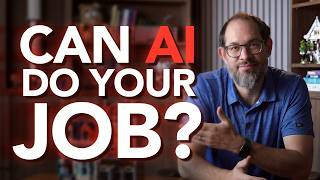
Nate B Jones (20:35) calls OpenAI’s math release ‘narrow superintelligence’ and asks why engineers still keep coding agents away from production.
Description
Description written by Gemini from the videoGemini 3.8 Flash, 15 October 2026
Summary
Nate B. Jones analyzes OpenAI’s release of over 700 mathematics research manuscripts and contrasts this achievement with the software industry’s persistent skepticism toward autonomous coding agents. He argues that current artificial intelligence represents “narrow superintelligence,” where superhuman capability in formally verifiable fields like mathematics does not automatically transfer to system architecture, engineering judgment, or business intuition.
What is shown
- [00:01] Graphic overview citing OpenAI’s October 6, 2026 release of 719 manuscripts across 372 result families.
- [00:49] Slide comparing “Math” (checkable, superhuman) versus “Code” (checkable, still guardrailed).
- [02:21] Graphic on theoretical matrix multiplication bounds ($\omega \le 9/4$ over complex numbers) from OpenAI Lean scope note 107.
- [02:32] Diagram illustrating an inverse problem in smooth isotropic elasticity (“Surface measurements $\to$ Interior uniquely determined”).
- [03:52] Framework diagram tracing advancement: Theory $\to$ Engineering $\to$ Products.
- [04:30] Graphic detailing OpenAI’s reported metric of approximately 3 hours of average thinking compute per result.
- [08:04] – [08:35] Scenario diagrams outlining an enterprise search feature, illustrating how edge cases (revoked permissions and conflicting documents) require human architectural judgment.
- [10:58] Transferability diagram contrasting Math (superhuman), Code (useful, guardrailed), and Business (further still).
- [15:58] Skill strategy map: “Experience + passion” $\to$ “Area of impact” $\to$ “AI as the tool.”
- [19:18] Citation of Alexandr Wang’s essay “Why I’m Building Muse” (September 2026 via Daring Fireball).
Claims & numbers
- The presenter says OpenAI released more than 700 math research papers (719 manuscripts across 372 families) on October 6, 2026.
- The presenter cites a Decrypt report where an OpenAI spokesperson stated that almost every result came from a single prompt using an unreleased internal model.
- The presenter notes that OpenAI reported the model used an average of approximately 3 hours of thinking compute per result.
- The presenter claims existing mathematical evaluation benchmarks had saturated, prompting labs to test models against unsolved research problems.
- The presenter asserts that despite superhuman math outputs, senior engineers maintain zero-trust policies and guardrails around AI coding agents in production.
Notable quotes
- [04:40] “The model did something in three hours with some of these problems that mathematicians can’t do their whole lives. That’s superintelligence.”
- [14:08] “Not every problem is a function of intelligence.”
- [15:45] “The IQ points don’t spend that way.”
Assessment
This is an analytical commentary and review video, not a live product demonstration or primary benchmark run. The presenter talks directly to the camera with supporting conceptual slides and graphics referencing publicly reported lab announcements without showing live model interactions.
Described by gemini-3.8-flash on 2026-10-15 from the video’s audio and frames.