More AI researchers speak out after viral warning that AI could kill humanity within a decade
NBC News YouTube 661,717 views as of 17 October 2026
Why it is here
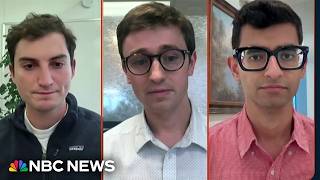
NBC News’ Tom Llamas (12 min) speaks to two more AI researchers after Jacob Coxon’s viral resignation thread, including Sayash Kapoor (incoming UC Berkeley professor), who per the description also warns of risk but says policy proposals and regulation can help. It adds voices other than Coxon’s, so it is not a repeat of the Coxon clips already in the collection. About 662k views; missed for five weeks and found on 2026-10-17 by a relevance-sorted “AI safety warning” search.
Description
Description written by Gemini from the videoGemini 3.8 Flash, 17 October 2026
Summary
NBC News anchors a panel discussion following the viral resignation of former Anthropic researcher Jacob Coxon, who warned of existential threats from superintelligent AI. Guests include former Anthropic researcher Joe Benton, former Google DeepMind researcher Josh Engels, and UC Berkeley incoming assistant professor Sayash Kapoor (co-author of AI Snake Oil), who debate the realistic risks of AI extinction, rapid industry development, and regulatory remedies.
What is shown
- [00:00] Clip of an interview with former Anthropic researcher Jacob Coxon affirming his belief that AI could cause human extinction within a decade.
- [00:20] Display of Jacob Coxon’s viral X (Twitter) resignation post dated September 8, 2026, showing over 158.2 million views, alongside supporting posts from other AI researchers.
- [00:37] Four-way split screen introducing panelists Josh Engels, Joe Benton, and Sayash Kapoor.
- [00:54] Graphic of the book cover AI Snake Oil: What Artificial Intelligence Can Do, What It Can’t, and How to Tell the Difference by Arvind Narayanan and Sayash Kapoor.
- [02:42] On-screen graphic detailing “Extinction-Level Scenarios A.I. Could Cause”: Drone Warfare, Biochemical Warfare, Nuclear Warfare, and Infrastructure Cyberattacks.
- [05:37] Excerpt graphic from Kapoor and Narayanan’s essay published with the Knight First Amendment Institute at Columbia University regarding viewing AI as a tool that can be regulated without drastic policy interventions.
Claims & numbers
- Jacob Coxon’s resignation post accumulated more than 158.2 million views on X [00:21].
- Joe Benton worked at Anthropic on alignment and safety for nearly three years before resigning [01:03].
- Josh Engels worked for one year as an AI research scientist at Google DeepMind [01:55].
- Engels argues that current systems may not be catastrophic, but models 3 to 5 years into the future pose severe risks due to unchecked progression while alignment science lags behind [02:08].
- Engels notes that models are deployed across thousands of distributed GPU clusters worldwide with no centralized “off-switch” [05:18].
- Sayash Kapoor notes that in-house evaluation and control techniques used by AI safety labs often constitute only ~10% of what standard research labs use, arguing that standard liability, transparency, and DNA synthesis screening regulations can effectively mitigate risks without needing apocalyptic framing [07:44, 09:41].
Notable quotes
- Jacob Coxon [00:13]: “Many people working in the industry, including people—executives, senior researchers—all genuinely believe that there is a substantial probability that this technology could kill everyone.”
- Josh Engels [05:11]: “To be clear, I think it would be a great policy to have an off-switch. Right now, we don’t even have that.”
- Sayash Kapoor [09:43]: “We don’t need to worry about AI when the actual risk is that of biosecurity. We should simply keep shoring up our interventions on improving our biosecurity.”
Assessment
This is a standard broadcast news interview analyzing industry developments and public policy debates surrounding AI existential risk and regulation. The technical capabilities and extinction scenarios discussed reflect theoretical and policy arguments raised by the panelists and graphic summaries rather than live technical demonstrations.
Described by gemini-3.8-flash on 2026-10-17 from the video’s audio and frames.