What now for Mathematics (with 3Blue1Brown) - Numberphile
NumberphileYouTube340,122 views as of 12 October 2026
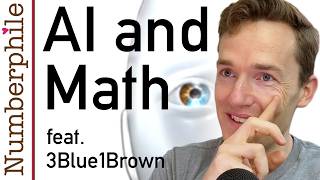
Why it is here
Highlight clips from Numberphile’s interview with Grant Sanderson (3Blue1Brown) on what AI means for mathematics; the full podcast is filed as numberphile-podcast-glimmer-in-our-eye-grant-sanderson.
Description
Description written by Gemini from the videoGemini 3.8 Flash, 12 October 2026
Summary
This video is an excerpt from a Numberphile interview conducted by Brady Haran with Grant Sanderson (creator of 3Blue1Brown). They discuss the future of mathematics in the era of artificial intelligence, examining the value of mathematical exposition over raw proofs, the potential loss of human “hero stories” when machines solve major conjectures, and the idea of “meta-mathematics” emerging from large-scale automated proof generation.
What is shown
- [00:00] Grant Sanderson discusses re-evaluating mathematical contributions by incentivizing clarity and exposition, proposing Millennium Prize-style challenges for open exposition problems.
- [01:02] Sanderson explains his personal motivation in math as the feeling of deep conceptual understanding rather than the race to prove new theorems.
- [01:57] Brady Haran raises concerns that mathematics and science depend on human hero figures (like Andrew Wiles or Terence Tao) to inspire future generations, and questions what happens when computers solve the benchmark problems.
- [03:05] Sanderson suggests that to preserve human competition and heroism, contest mathematics (such as the International Mathematical Olympiad) could extend into adulthood as a professional spectator sport, comparable to chess or Go.
- [04:27] Sanderson speculates on “meta-mathematics”: analyzing tens of thousands of machine-generated proofs to identify emergent macro-level phenomena and new conceptual frameworks.
- [04:58] Outro slate and preview clips directing viewers to the full-length conversation on Numberphile2 and the Numberphile Podcast.
Claims & numbers
- Grant Sanderson suggests the mathematical community should establish dedicated prizes and tenure criteria for solving “open exposition problems” to match the prestige given to novel proofs [00:26].
- Brady Haran notes that public engagement and recruitment into math rely heavily on individual hero stories (such as Fields medalists, Nobel laureates, Andrew Wiles, or Terence Tao) [02:00].
- Grant Sanderson proposes expanding competitive mathematics into a televised or spectated adult circuit modeled after professional chess and Go if human heroism needs to be preserved [03:36].
- Grant Sanderson hypothesizes that AI generating tens of thousands of automated proofs could enable a new discipline of “meta-mathematics” focused on macroscopic structural trends across proof corpora [04:28].
Notable quotes
- “What would it look like to have Millennium Prize problems for open exposition problems?” — Grant Sanderson [00:26]
- “And I worry we’re going to run out of chances for people to be heroes, for people to be Andrew Wiles... And when you run out of heroes, do you... will that affect people’s motivation to become mathematicians?” — Brady Haran [02:05]
- “What does it look like when you have an abundance of proof writing? Is there some sort of meta-mathematics... that can only come about by observing what happens when you have a machine go and create whole swaths of tens of thousands of proofs in a certain field?” — Grant Sanderson [04:28]
Assessment
This is a discussion and philosophical interview clip exploring the cultural and intellectual implications of AI in mathematics; no live software tools, benchmarks, or models are demonstrated on screen.
Described by gemini-3.8-flash on 2026-10-12 from the video’s audio and frames.