The Quasi-Riemann Hypothesis, explained
PerplexityYouTube11,861 views as of 12 October 2026
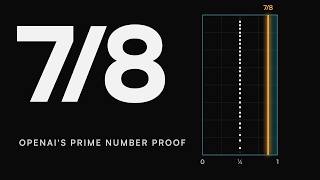
Why it is here
Perplexity’s official channel: ‘Perplexity Computer turned every one of [OpenAI’s 722 papers] into an animated explainer in a single run’ (all at 722.video), then went deep on the quasi-Riemann claim, including how much has been checked; ~10k views.
Description
Description written by Gemini from the videoGemini 3.8 Flash, 11 October 2026
Summary
This video, produced by Perplexity Computer, explains OpenAI’s October 6, 2026 preprint claiming a proof of the quasi-Riemann hypothesis alongside 721 other mathematical manuscripts. It outlines what the quasi-Riemann hypothesis entails, how zeros of the Riemann zeta function relate to prime distributions, the historical background of zero-free regions, and the status of independent verification across Lean formalization, computational re-runs, and human peer review.
What is shown
- [00:00 - 00:19] Title card showing the 199-page preprint The Quasi-Riemann Hypothesis dated Sept 30, 2026, alongside an X/Twitter post by mathematician Alex Kontorovich praising the magnitude of the claim.
- [00:20 - 00:36] Excerpts from page 4 of OpenAI’s preprint noting that Theorem 1.1 establishes a zero-free half-plane for $\text{Re}(s) > 7/8$, while emphasizing the full Riemann hypothesis remains open.
- [00:37 - 01:05] View of the
openai/mathGitHub repository (722 manuscripts initially, 3 withdrawn leaving 719 live), followed by Perplexity Computer’s automated video series and Dave Goldblatt’s independent Lean re-run report. - [01:06 - 02:44] Animated number line of primes up to 60 compared against the logarithmic integral $\text{Li}(x)$, visual wave decomposition of the error term corresponding to non-trivial zeta zeros, and historical zero-free regions (Hadamard & de la Vallée Poussin 1896/1899, Vinogradov & Korobov 1958).
- [02:45 - 03:48] Explanation of the $7/8$ vertical boundary, the exclusion of Landau–Siegel zeros via a 9-page companion paper, and downstream consequences (e.g., capping prime count error at roughly $N^{7/8}$, settling Vinogradov’s conjecture on least quadratic non-residues, completing Euler’s list of 65 idoneal numbers).
- [03:49 - 05:23] Breakdown of the “four layers of checking”: Lean kernel verification (486,490 lines of Lean proof across 2,924 modules), independent rerun (63 minutes on one machine with Lean and nanoda kernels), human reading (only 9 pages reviewed, 199 pages unread), and expert peer review (none public yet).
- [05:24 - 05:55] Evaluation table comparing 31 claims from Perplexity Computer’s automated video summaries against the source papers (all 31 matched).
Claims & numbers
- On October 6, 2026, OpenAI published a 199-page proof alongside a 9-page companion paper in a repository of 722 manuscripts (3 later withdrawn on Oct 7, leaving 719) (
openai/math). - The proof establishes that there are no zeros of the Riemann zeta function or Dirichlet L-functions for $\text{Re}(s) > 7/8$, addressing an open problem dating back 127 years (to 1899).
- Over 12.36 trillion zeros ($12,363,153,437,138$) have been numerically computed, all located on the critical line $\text{Re}(s) = 1/2$.
- The accompanying Lean formalization comprises 486,490 lines of proof across 2,924 modules accepted by the Lean kernel.
- An independent re-run by Dave Goldblatt took 63 minutes on a single machine across two verification kernels (Lean default kernel and nanoda).
- Perplexity Computer cross-checked 31 claims from its automated 3-part video breakdown against OpenAI’s manuscripts and verified 31 matches.
Notable quotes
- [00:13] Alex Kontorovich: “If a human did this, it would be an instant Fields Medal, no questions asked.”
- [03:40] Hector Pasten (via Scientific American): “Plenty of applications of the Riemann hypothesis did not need the full Riemann hypothesis. The quasi-Riemann hypothesis is way more than enough for many applications.”
- [05:02] Scientific American: “No one, not even OpenAI researchers themselves, has been able to even read through everything yet.”
Assessment
This is a factual, automated educational explainer video created by Perplexity Computer summarizing OpenAI’s massive mathematical release and its verification status as of October 8, 2026. The presentation clearly differentiates between machine-checked Lean formalization and full human comprehension, maintaining objective skepticism about the unread 199-page paper.
Lyrics & themes
The video is non-musical and driven entirely by spoken voiceover narration structured into five thematic sections:
- The Announcement & Initial Reaction [00:00 - 01:05]: Introduces OpenAI’s paper drop and immediate reception.
- Zeta Zeros and Prime Distribution [01:06 - 02:44]: Explains Riemann’s explicit formula and historical zero-free curves.
- [01:41] “The further right a dot sits, the louder its wave, and the more the primes can drift.”
- The Quasi-RH Breakthrough [02:45 - 03:48]: Defines the fixed $7/8$ boundary and its arithmetic implications.
- [02:37] “It asks for one gap valid at every height, not merely nonvanishing on $\mathfrak{R}s = 1$.”
- Four Layers of Verification [03:49 - 05:23]: Analyzes Lean formal proof versus human read-through limits.
- [04:21] “Lean checked the code, not the 199-page paper, and not the consequences.”
- Automated Extraction & Summary [05:24 - 05:55]: Evaluates Perplexity’s claim-checking pipeline and concludes on the historical milestone.
Lore & references
- OpenAI Math Release (
openai/math): References the October 6, 2026 release of 722 automated math manuscripts by OpenAI. - Lean & Formalization Ecosystem: Mentions the Lean 4 proof assistant and the independent
nanodachecker kernel, highlighting the modern workflow of AI proof verification. - Landau–Siegel Zeros: Acknowledges the longstanding mathematical obstacle of exceptional real zeros near $s=1$.
- “Summer of Soundness Bugs” / Kernel Soundness: Touches on community awareness around relying strictly on formal verification kernels vs. human review.
Visual style & craft
- Aesthetic: Minimalist 3Blue1Brown-inspired dark-mode pedagogical animations using clean 2D vector graphics, interactive number lines, and monospace code blocks.
- Data Visualizations: Clear schematics representing the critical strip, zeta zeros plotted on the complex plane, Fourier-style sine waves mapping individual zero contributions, and color-coded status badges for the verification pipeline.
- AI vs. Human Elements: The visuals and script bear the automated hallmarks of Perplexity Computer (captioned “Made by Perplexity Computer. Some errors may exist”), likely generated via programmatic animation scripts (e.g., Manim/Motion Canvas) rendered autonomously from paper summaries.
Described by gemini-3.8-flash on 2026-10-11 from the video’s audio and frames.
Made by AI
- Made with
- Perplexity Computer
- How we know
- YouTube description: ‘Perplexity Computer turned every one of them into an animated explainer in a single run. Then we picked one result and went deep.’
- Human role
- Perplexity staff picked the paper and published; the degree of human editing on this deep-dive is not stated.
- Pipeline
- Perplexity Computer agent → animated explainers for all 722 OpenAI papers (722.video) → deeper explainer on one result
- Series
- Agent-made explainer