"Sketch-to-simulation with Opus 5.5": pencil-sketch catapult turned into a 3D physics sim (Ben Poole, X video)
Ben Poole (@poolio) · 2026-09-22 · ai-made · 255,375 views
Made by AI
Model: Claude Opus 5.5 · Series: Agent-built game or 3D world (the video shows the result)
Evidence: X post (2026-09-22): 'sketch-to-simulation with Opus 5.5'
Human role: Process not described beyond the caption; quotes Anthropic's launch post.
Pipeline: Sketch → Opus 5.5 → 3D physics simulation (1:20 capture)
What's in the video
Description written by Gemini, which watched and listened to the whole video.
Summary
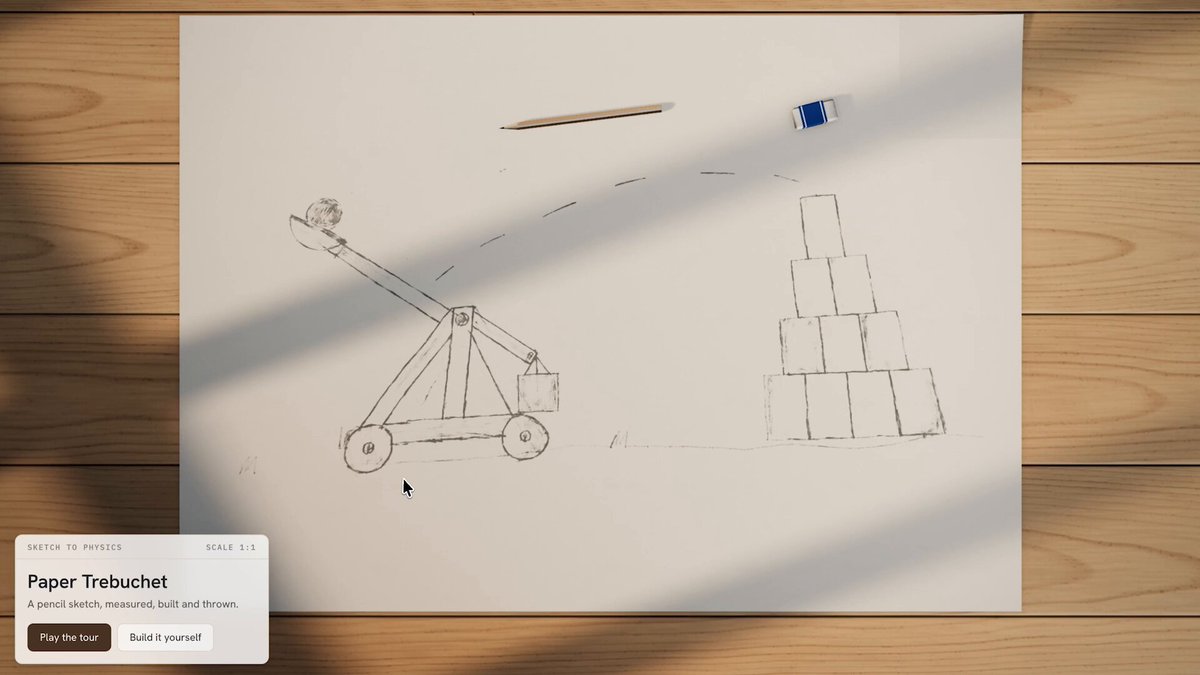
This video presents an interactive WebGL/3D physics application titled Paper Trebuchet: A pencil sketch, measured, built and thrown, shared by AI researcher Ben Poole. It demonstrates a sketch-to-simulation pipeline where a hand-drawn 2D pencil sketch of a trebuchet and a block tower is parsed, converted into physical 3D wooden components, simulated, adjusted, and turned into a playable interactive sandbox.
What is shown
- [00:00 - 00:05]: Title card overlaying a 2D pencil drawing of a trebuchet and block tower on a desk next to an eraser and pencil, prompting either "Play the tour" or "Build it yourself".
- [00:05 - 00:17]: The READ phase: the sketch is automatically annotated with segment labels (
wheels,frame,arm,pivot,weight,cup,ball,tower,ground,path) and precise dimensional measurements (e.g., 155 mm base, 170 mm arm, 243 mm tower height). - [00:18 - 00:25]: The LIFT phase: 2D line art extrudes into paper cutouts before skinning into realistic 3D wooden textures and physics-ready meshes on a tabletop.
- [00:26 - 00:32]: The MISS phase: trebuchet releases a 97 g ball with a 0.48 kg counterweight, landing short of the tower.
- [00:33 - 00:36]: The TWEAK phase: simulated trajectory arcs show calculated flight paths for different counterweight masses (0.48 kg, 0.57 kg, 0.68 kg, 0.95 kg), selecting 0.68 kg.
- [00:37 - 00:44]: The HIT and REPLAY phases: the ball strikes and topples the block tower, followed by a 0.25× slow-motion replay with trajectory telemetry (1.85 m/s release at 32°, 2.35 m/s impact).
- [00:45 - 01:19]: The Build it yourself interactive mode: a user controls parameters in a sidebar UI (counterweight slider, slow-motion toggle, hero/side/top camera angles) and drags/releases the catapult arm to test various launch angles and impact forces against the tower.
Claims & numbers
- Scale: Indicated as "SCALE 1:1" [00:02].
- Annotated sketch dimensions: 155 mm base frame, 46 mm axle offset, 170 mm throwing arm, 33 mm cup/ball diameter, 40 mm block width, 61 mm block height, 243 mm total tower height [00:15–00:16].
- Physical launch metrics: 97 g projectile ball, 0.48 kg default counterweight, upgraded to 0.68 kg for successful hit [00:28, 00:35].
- Kinematics: 1.85 m/s initial velocity at 32° launch angle; 2.35 m/s terminal impact velocity [00:41].
- Interactive telemetry: Shows real-time readouts up to 2.10 m/s release speed, 37° angle, and 535 mm range [01:19].
Notable quotes
- "Paper Trebuchet / A pencil sketch, measured, built and thrown." [00:02]
- "Drag the cup back and let go" [00:48]
- "Ball back in the cup" [00:55]
Assessment
This is a software demonstration video showing an interactive web application that converts a 2D drawing into an interactive 3D physics simulation. The visual transition from pencil drawing to 3D rendering and the subsequent user-controlled interactive sandbox are smoothly executed within a web graphics framework.
Lyrics & themes
- Music style: Instrumental only.
- Themes: The audio consists entirely of a calm, ambient fingerpicked acoustic guitar piece with subtle atmospheric synthesizer pads; there are no spoken words, singing, or lyrics.
Lore & references
- Sketch-to-Code / Sketch-to-3D: Reflects the long-standing frontier AI aspiration of turning rough sketches or natural design documents directly into functional software code, 3D meshes, and physics engines.
- Educational Physics Simulators: Pays homage to classical physics toy simulators (like Phun / Algodoo) reimagined with modern 3D browser graphics and multimodal generative capabilities.
Visual style & craft
- Visual format: Clean real-time 3D browser graphics (WebGL / Three.js style rendering) blended with photorealistic tabletop lighting and soft shadow mapping.
- Transitions: Smooth morphing animation transitioning from a flat pencil drawing on paper to card cutout layers and finally to textured wooden 3D assets.
- UI/UX design: Minimalist modern typography and interface controls, featuring SVG trajectory overlays, interactive drag handles, camera toggle presets (Hero, Side, Top), and live physical telemetry readouts.
Described by gemini-3.8-flash on 2026-10-05 from the video's audio and frames.