The Mathematics are Mad
The PrimeTime YouTube 1,264,883 views as of 15 October 2026
Why it is here
ThePrimeagen (17:39) on why mathematicians are angry about OpenAI’s 722-manuscript math release; chapters on ‘mathematical misalignment’, Lean, ‘math humans can’t do’ and the next generation. Sources in the description: OpenAI’s announcement and the n log n follow-ups by AcerFur and Doug Colkitt. 1.26M views in six days.
Description
Description written by Gemini from the videoGemini 3.8 Flash, 15 October 2026
Summary
In this commentary video, software engineer and streamer Michael Paulson (ThePrimeagen) discusses the mathematical community’s reaction to OpenAI releasing solutions to hundreds of open math problems. He examines concerns raised by prominent mathematicians like Terence Tao, analyzes specific results such as the unit square bin-packing problem and sub-$n \log n$ integer multiplication, and discusses the broader implications of automated theorem proving for human mathematical research.
What is shown
- [00:10] Social media reactions from mathematicians and developers expressing shock and dismay over AI solving math problems.
- [00:32] Headlines and social media posts discussing OpenAI’s financial reporting and announcements.
- [00:56] The cover page and table of contents of the “OpenAI Research Catalog” (dated October 6, 2026), listing 372 result families across 722 manuscripts, along with tweets pointing out numbering gaps in the catalog.
- [01:21] Geometric diagram from a preprint illustrating “(a) The planar optimum: Six aligned squares; five tilted” for packing 11 unit squares.
- [01:40] Sponsored segment showcasing the WorkOS / AuthKit authentication dashboard and SDK integration.
- [02:29] The September 11, 2026 open letter titled “A Severe Misalignment of AI in Mathematics” and its list of Fields Medalist signatories.
- [03:25] Tweets quoting a Scientific American report stating that an unreleased OpenAI model one-shotted problems from a single prompt.
- [04:25] Social media thread by Terence Tao discussing “traditional mathematics (or ‘Math 1.0’)” versus automated proof generation.
- [05:56] Code sample written in the Lean 4 formal verification language demonstrating a basic equivalence theorem (
theorem add_one_preserves_equality). - [08:36] OpenAI preprint abstract on “Integer multiplication below $n \log n$” (September 23, 2026).
- [10:14] Wikipedia excerpt explaining the Archimedean spiral and coordinate transforms.
- [10:55] Excerpt from the paper “The Fibonacci Geometry of Eleven Squares” showing the planar optimum mapped to a Fibonacci torus.
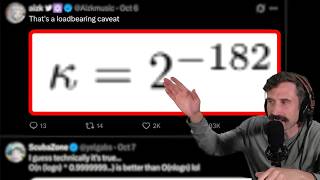
- [12:10] Series of posts by Doug Colkitt and Swapnil Jain detailing successive community tightenings of the integer multiplication parameter $\kappa$.
- [15:50] Screenshots of the
r/mathsubreddit and moderator notices restricting AI-related discovery discussions to megathreads.
Claims & numbers
- The presenter states that on October 6, 2026, OpenAI released a research catalog containing 372 result families across 722 manuscripts claiming solutions to open mathematical problems.
- The presenter cites a Scientific American report claiming an unreleased OpenAI model generated almost every result from a single prompt given to an AI agent.
- The presenter notes that over 100 of the 372 result families included machine-checked Lean formalizations.
- The presenter states that OpenAI proved integer multiplication can run faster than $O(n \log n)$ at $O(n (\log n)^{1 - \kappa})$ with $\kappa = 2^{-182}$.
- The presenter states that external researchers iteratively tightened OpenAI’s $\kappa$ bound: first to $5.8 \times 10^{-33}$ (between $2^{-108}$ and $2^{-107}$, a $2^{75}$-fold improvement), then to $2^{-78}$ (a 570-million-fold improvement), $2^{-59}$, $2^{-34}$, and ultimately $\kappa \ge 2^{-17}$.
- The presenter states that the bound improvement changed the exponent’s string of nines from 54 nines down to 5 nines.
Notable quotes
- [02:44] “The goals of the AI companies and the goals of the mathematical community are severely misaligned.” (quoting the Fields Medalists’ open letter)
- [03:27] “OpenAI one shotted math.” (quoting his own tweet)
- [12:05] “It turns out that yes, $n \log n$ is in fact not the lower bound, it’s just some insane number, right?”
Assessment
This is an independent commentary and reaction video by a tech streamer analyzing recent AI papers, social media statements, and community discourse. The video displays real preprints, blog posts, and tweets without staging hands-on model execution, offering subjective critique and perspective on the cultural and practical impact of automated mathematics.
Described by gemini-3.8-flash on 2026-10-15 from the video’s audio and frames.