Claude Fable 5 Took 60 Hours to Build This Game
RemakeBench · 2026-09-10 · ai-made · 32,168 views
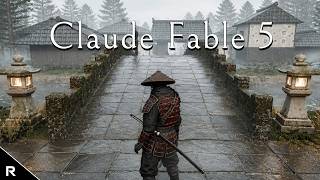
Made by AI
Model: Claude Fable 5, GPT-5.6 Sol · Series: Agent-built game (video of the result)
Evidence: Title and chapters: 'Claude Fable 5 Took 60 Hours to Build This Game'; chapters credit GPT-5.6 Sol and Fable 5 for the graybox and 'independent AI judges' for the town.
Human role: Directed the build with published skills; Tripo-sponsored.
Pipeline: Fable 5 (+ GPT-5.6 Sol) in Unity → Tripo 3D assets → AI judges review the town
Lore: long-run
What's in the video
Description written by Gemini, which watched and listened to the whole video.
Summary
Presented by the AI-development channel RemakeBench, this video documents a 67-hour autonomous game development sprint expanding a simple 7-hour "walking simulator" prototype into a full third-person stealth action samurai game. Orchestrated by GPT-5.6 Sol with Anthropic's Claude Fable 5 performing the core implementation alongside an ensemble of independent judge models and Tripo 3D asset generation, the system built a multi-stage town level, enemy combat AI, stealth executions, dynamic atmosphere, and a boss encounter in Unity.
What is shown
- Side-by-Side Comparison [00:00]: Contrast between the original 7-hour single-prompt Claude Opus 5 walking demo and the new 67-hour iterative game featuring combat and stealth.
- Art Direction & Reference Boards [00:41]: Mood boards, architectural elevations, texture references, and character concept sheets for a ninja minion, golden-armored boss, and the ronin player character.
- Tripo 3D Asset Generation Pipeline [01:10]: Generating 3D props (a stone water well) and character meshes, showing prompt/image inputs, retopology reduction (from 100k to 50k polys), PBR texture baking, and automated rigging.
- Stage 1 — Playable Sandbox [02:14]: Orchestration diagram (GPT-5.6 Sol coordinating Claude Fable 5, Grok 4.6, Codex GPT-5.6, and Opus 5) and iterative greybox testing in Unity, refining katana execution sync, hit reactions, and quick-time finisher triggers.
- Content Pipeline & Autonomous Evaluation Architecture [03:54]: Python/Blender-to-Unity workflow stack and multi-agent judging loop where external models (Codex, Opus, Grok) score scene snapshots against target references using both fixed and adversarial rotating cameras.
- Environment Assembly Timelapse [04:07 / 06:58]: Progressive replacement of greybox blocks with textured buildings, foliage, lanterns, stone streets, and the elevated shrine boss courtyard.
- Stage 4 — Atmosphere & Context Management [07:15]: Tuning fog depth, sunset-to-night lighting transitions, and fire effects, followed by a discussion of context compaction strategies ("runaway rounds" and baseline resets) and handling contradictory judge feedback.
- Stage 5 — Gameplay Depth & Boss Fight [09:15]: Live playtesting of stealth takedowns, patrol avoidance, multi-enemy melee combat, character mesh deformation artifacts, and the final duel against the golden samurai boss.
- Run Statistics & Outro [11:00]: Final metrics display showing 67 wall-clock hours, 837 iterations, 23,513 tool calls, and ~3.4B total tokens processed.
Claims & numbers
- The previous single-prompt test with Opus 5 took 7 hours and resulted in an unpolished "walking simulator" with broken animations [00:01].
- The project operated under a hard deadline constraint of 3 days (72 hours) [00:30].
- Tripo 3D's Smart P2 mesh generation took approximately 5 seconds per prop asset [01:20].
- Character models were retopologized down to 50,000 polygons to preserve runtime performance, while the main character retained 100,000 polygons [01:52].
- Fog parameters required 6 judging rounds to achieve a passing score [07:37].
- Total project runtime: 67 wall-clock hours across 837 decision turns and 23,513 tool calls [11:00].
- Token consumption totaled over 3.338 billion cached tokens and
130 million fresh tokens (3.47B total) [11:04].
Notable quotes
- "In this video, we will try to expand the core idea into a game with stealth, combat, and different enemy designs, and also expand the map from a courtyard to a whole town." [00:12]
- "Each item has to be independently judged by a model that does not have context about the project... This is to minimize overfitting to a set model's preferences or blind spot." [04:24]
- "The wall-clock time across all models including sub-agents is 67 hours, with total token cost being 3.3 billion tokens." [11:00]
Assessment
This is a technical showcase and devlog detailing an autonomous multi-agent pipeline used to construct a functional game prototype within Unity. While the resulting gameplay demonstrates genuine functionality (navmesh pathfinding, animation blending, trigger colliders, combat logic), the footage clearly shows persistent procedural artifacts typical of automated game development—notably character mesh tearing during animations, z-fighting, and simplified enemy behavior loops.
Lyrics & themes
The video contains spoken technical narration rather than song lyrics, structured into development stages:
- Setup & Art Direction: Grounding references and establishing visual targets [00:41].
- Stage 1 — Playable Sandbox: Mechanics-first greyboxing before asset injection [02:14].
- Stage 2 & 3 — Assembly & Judging: Evaluating spatial coherence with adversarial cameras [03:54].
- Stage 4 — Atmosphere: Day-night progression and managing context compaction limits ("The runaway round") [07:15].
- Stage 5 — Gameplay Depth: Addressing combat limitations, mesh weighting issues, and runtime bottlenecks [09:15].
Key verbatim narration lines:
- "The output looked great, but had terrible animations and lacked proper gameplay mechanics." [00:05]
- "We don't need the significant horsepower yet, whilst we're only sorting out gameplay." [02:26]
- "There are instances where the progress that the models make on the independent judge score each round is very minimal... leading to significant context compaction or even timeout." [07:48]
- "Again, something that state-of-the-art AI cannot do, but they can generate the individual armor assets easily." [09:57]
Lore & references
- Orchestrator vs. Worker Agents: The workflow assigns high-level scheduling to GPT-5.6 Sol while routing specific code-generation, environment-building, and script tasks to Claude Fable 5.
- Independent Multi-Model Jury (Codex, Opus, Grok): References the widespread technique of using disjoint, alternating frontier models to avoid single-model blind spots and reward-hacking during visual evaluation.
- Adversarial Camera: An active evaluation mechanism designed to prevent the generator agents from optimizing scenery only for predetermined, fixed camera angles.
- Context Pressure Valves: Visualized as a mechanism to handle token saturation and degraded performance during recursive multi-turn agent runs.
Visual style & craft
The video is edited as an engineering case study, combining high-resolution screen recordings of Unity engine gameplay, web tool interfaces (Tripo 3D, Excalidraw), and clean vector-animated architectural node diagrams explaining agent communication flow. While the overarching video edit and voiceover pacing follow human devlog conventions, the in-game assets, animation sequences, code scaffolding, and level placement were created through the demonstrated autonomous LLM/3D agent loop.
Described by gemini-3.8-flash on 2026-09-29 from the video's audio and frames.