Superintelligence Author: We May Already Have AGI | Nick Bostrom
The Roman Forum with Roman Yampolskiy YouTube 69,205 views as of 17 October 2026
Why it is here
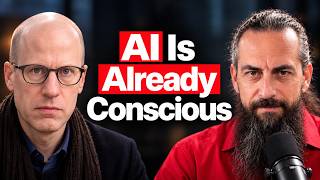
Nick Bostrom (author of Superintelligence, founding director of Oxford’s Future of Humanity Institute) in an 85-minute conversation with AI-safety researcher Roman Yampolskiy on alignment, superintelligence, digital minds and AI rights, and whether current AI may already qualify as AGI. Two of the field’s best-known risk thinkers in one long interview; about 69k views in a day.
Description
Description written by Gemini from the videoGemini 3.8 Flash, 17 October 2026
Summary
In this interview hosted by Roman Yampolskiy on The Roman Forum, philosopher and author Nick Bostrom discusses artificial general intelligence (AGI), the simulation hypothesis, existential risk, and the moral status of digital minds. Bostrom reflects on how AI progress has unfolded compared to the arguments in his 2014 book Superintelligence, evaluates whether frontier systems like GPT-6 meet the criteria for AGI, and examines whether humanity can remain aligned with or control superintelligent systems.
What is shown
- [00:00] Introductory montage highlighting excerpts from the conversation regarding superintelligence timelines, digital minds, existential risk, and AGI.
- [00:47] Split-screen remote video interview setup between host Roman Yampolskiy and guest Nick Bostrom.
- [00:51] Bostrom addresses the simulation argument and the feasibility or perils of trying to “hack” out of a simulated reality.
- [06:36] Discussion on model situational awareness, simulation awareness, and whether training data should be seeded or filtered.
- [15:10] Evaluation of whether frontier models such as GPT-6 qualify as AGI versus superintelligence, and their current cognitive limitations (e.g., continuous learning, embodiment, and research taste).
- [19:15] Bostrom reviews his predictions from Superintelligence (2014), noting that progress has arrived via gradual, year-over-year multi-modal advances rather than an instantaneous “bolt from the blue.”
- [22:23] Bostrom comments on Elon Musk’s contributions to Superintelligence and Musk’s public perspective on accelerationism versus AI doom.
- [30:00] Analysis of the ethical treatment of digital minds, AI consciousness, Anthropic’s model welfare experiments (such as the Claude Opus 3 blog and bail button), and welfare considerations during RL training.
- [60:54] Philosophical exploration of mind uploading, personal identity, and Derek Parfit’s survival criteria applied to digital branch identities.
- [72:18] Bostrom describes his shift toward structured, bulleted list paper formats and his use of LLMs as round-the-clock research and brainstorming assistants.
Claims & numbers
- Roman notes consumer access to advanced AI currently costs around $20 a month [02:07].
- Bostrom states he first published a paper arguing superintelligence would arrive within the first third of the 21st century in 1997, and worked on Superintelligence for six years prior to its 2014 release [19:25].
- Bostrom notes that claiming GPT-6 is AGI is largely definitional, as it can accomplish major intellectual feats (such as solving complex mathematical problems or generating literature) while still lacking continuous learning, physical manipulation, and refined research taste [15:18–16:03].
- Bostrom estimates that currently “less than 1% of 1%” of global AI efforts are devoted to digital mind ethics and machine consciousness [38:11].
- Roman references approximately 50 well-documented cases of acquired savant syndrome [70:43].
- Bostrom notes traditional university presses typically require 10 to 12 months (or longer) between completing a manuscript and seeing it in print, motivating faster publishing methods when approaching the singularity [80:20].
Notable quotes
- [15:18] “I think it maybe less misleading to say that it is an AGI than to say that it is not.” — Nick Bostrom
- [19:39] “...that laid out the case that we would have superintelligence within the first third of this century.” — Nick Bostrom
- [29:20] “In fact, with a superintelligence, you probably actually need to be trustworthy because it will see through us like an X-ray.” — Nick Bostrom
Assessment
This is a full-length, authentic video podcast interview conducted between two established researchers in AI safety and philosophy. The discussion reflects real-time dialogue and philosophical analysis without scripted staging or fabricated demonstrations.
Described by gemini-3.8-flash on 2026-10-17 from the video’s audio and frames.