Can AI solve the hardest problems in mathematics? | PuzzlingScience with Yang-Hui He
The Royal Institution YouTube 131,746 views as of 16 October 2026
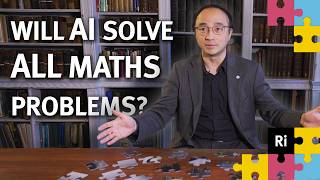
Why it is here
Royal Institution episode (17:47) in which mathematical physicist Yang-Hui He explains AI-assisted mathematics, why AI results must be verified, how AlphaProof and Harmonic’s Aristotle approach proofs, and how Lean checks them (per the description). About 132k views; found on 2026-10-16 by a search for maths results.
Description
Description written by Gemini from the videoGemini 3.8 Flash, 16 October 2026
Summary
In this video from The Royal Institution’s Puzzling Science series, mathematical physicist Yang-Hui He (fellow at the London Institute for Mathematical Sciences) explores whether modern AI can solve complex mathematical problems. He attempts a live experiment using ChatGPT Pro to solve a 48-piece jigsaw puzzle to test its geometric reasoning, discusses recent AI systems (such as AlphaProof, Aristotle, and Lean formalization), and provides a bonus interview responding to OpenAI’s announcement of solving the Navier–Stokes existence and smoothness problem.
What is shown
- [00:00–00:18]: Yang-Hui He introduces a 48-piece jigsaw puzzle and photographs the scattered pieces on his foldable phone to test ChatGPT Pro’s ability to identify and assemble them.
- [00:46–01:15]: The phone correctly counts 48 pieces, while He explains the geometric reasoning challenges language models face.
- [01:27–02:24]: Diagram animation illustrating the three tiers of math research: Top-Down Mathematics, Bottom-Up Mathematics, and Meta-Mathematics (“proving by vibe”).
- [04:06–04:12]: Archival photograph stamp of mathematician Paul Erdős while discussing databases of open math conjectures.
- [05:40–05:52]: He checks his phone interface, showing ChatGPT getting confused with image attachments and generating coordinates.
- [08:50–09:00]: He arranges the physical puzzle pieces into a structured 6×8 grid on the table to make it easier for the AI to coordinate.
- [12:50–13:08]: Testing the AI’s output against the physical pieces: ChatGPT predicts positions (4,4), (4,5), (3,4), and (3,5) make up the “human face cluster,” which He checks and confirms is completely wrong.
- [14:04]: Still photograph showing Yang-Hui He’s young son, who completed the puzzle manually in 5 minutes.
- [14:09–14:15]: Text slide contextualizing the bonus interview segment following OpenAI’s September 8, 2026 announcement of solving the Navier–Stokes problem using 10,000 agents.
- [14:16–17:35]: Sofa interview where He reflects on the Navier–Stokes resolution, 100 subsequent claimed proofs across different math branches, emergency committees of Fields Medalists, and the crucial distinction between mechanical proof verification and human understanding.
Claims & numbers
- IMO performance: DeepMind’s AlphaGeometry, AlphaGeometry 2, and AlphaProof demonstrated problem-solving up to the Gold medal level at the International Mathematical Olympiad (IMO) by the summer of 2024.
- FrontierMath benchmark: Supported by OpenAI, featuring 700 research-level mathematics problems, of which about 20% have been solved.
- Harmonic’s Aristotle: Has solved approximately 6% of the Erdős problem collection unguided by human mathematicians.
- Axiom AI: The presenter claims Axiom AI recently resolved four standing conjectures in the mathematical literature.
- Millennium Prize Problems: Out of the 7 original problems, only 1 (the Poincaré conjecture) had been solved in the first decade; 6 remained open until the recent Navier–Stokes breakthrough.
- OpenAI Navier–Stokes breakthrough: On September 8, 2026, OpenAI announced its system used 10,000 AI agents to solve the Navier–Stokes existence and smoothness problem.
- OpenAI 100 problems: The presenter claims OpenAI subsequently resolved 100 additional major open problems across 100 distinct branches of mathematics, triggering the formation of an emergency committee of Fields Medalists to evaluate the proofs in batches.
- Lean and Mathlib: Mathlib has existed since 2013; auto-translating informal human mathematics into Lean formal proof code allows formal machine-checked verification of AI-generated proofs.
Notable quotes
- [02:19]: “A word that’s caught on now is called ‘proving by vibe’, which I which I love a lot.”
- [10:33]: “And that’s the game changer, because now you can just generate stuff... once you translate it into this code, and if the code compiles, then you know your reasoning is correct.”
- [16:32]: “The single most important thing in mathematics, in mathematical research broadly defined, is understanding.”
Assessment
This is an authentic science communication and review video produced by The Royal Institution featuring an active mathematical physicist. The hands-on jigsaw puzzle test is an unedited, honest demonstration of multimodal LLM failure at spatial grid placement, followed by an insightful commentary and bonus reaction interview addressing historic 2026 milestones in automated theorem proving.
Described by gemini-3.8-flash on 2026-10-16 from the video’s audio and frames.