FULL: Elon Musk, Jensen Huang, Tom Brown Discuss the AI Revolution & What's Next - 09/29/26
Right Side Broadcasting Network · 2026-09-29 · interview · 600,316 views
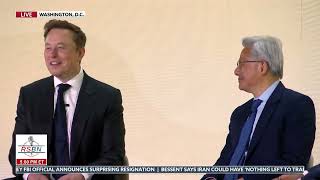
What's in the video
Description written by Gemini, which watched and listened to the whole video.
Summary
At a panel discussion in Washington, D.C., hosted following a White House summit on superintelligence, Elon Musk (Tesla, SpaceX, xAI), Jensen Huang (NVIDIA), and Tom Brown (Anthropic co-founder) discuss the scaling requirements of AI. Moderated by an interviewer, the panel explores the exponential demand for power, orbital data centers via Starship, agent safety architectures, economic revitalization through data center construction, and their recent White House commitments.
What is shown
- [00:00] Elon Musk and Jensen Huang take the stage for a panel discussion under "The Golden Age of AI".
- [00:54] Jensen Huang details how generative AI reinvents the computing stack from hardware to software and why power generation is the baseline bottleneck.
- [03:07] Elon Musk discusses energy scaling challenges, software competition, domestic semiconductor capacity, and comparisons with China's electric grid.
- [05:35] Musk and Huang calculate the math linking gigawatts of AI compute to economic output and national GDP.
- [06:31] Musk outlines SpaceX’s vision for space-based orbital compute and space-based solar arrays.
- [08:30] Huang describes data centers as "SI factories" (Super Intelligence factories) generating tangible economic output and creating blue-collar and white-collar jobs.
- [10:30] Musk details the local economic impacts of xAI's Colossus cluster in Memphis, including tax revenues, local jobs, and a $250M water recycling plant.
- [12:35] Discussion turns to Starship's orbital progress and NVIDIA’s newly announced Open Agent Safety Platform (OpenShell and BlueField runtime monitoring).
- [16:24] Musk reviews Starship's orbital launch, deploying Starlink V3 satellites.
- [17:00] Tom Brown arrives and joins the panel onstage.
- [18:38] Tom Brown explains the capabilities of Claude Opus 5.5, long-horizon autonomous task delegation, and AI writing massive volumes of software.
- [20:15] Huang describes his daily workflow using Claude to conduct research, synthesize papers, and output formatted reports.
- [21:38] Musk talks about consumer AI utility, including clinical second opinions and life organization.
- [23:07] Huang discusses the balance between agent containment, judgment, and safety.
- [24:49] Musk and Huang review their White House meeting with President Donald Trump and their signing of a joint declaration on Super Intelligence safety.
Claims & numbers
- Jensen Huang states that computing has shifted fundamentally from retrieval-based computing to generative computing across every layer of the computing stack.
- Elon Musk states that average US power consumption is approximately 500 GW; thus, every 5 GW of steady-state power added represents a 1% increase in power usage, which he estimates will yield approximately a 1% increase in GDP due to increasing intelligence-per-watt efficiency.
- Huang and Musk calculate that 1 GW of compute generates approximately $50B to $60B in annual economic output.
- Musk asserts China produces roughly three times the electricity of the United States.
- The moderator notes SpaceX has discussed bringing 10 GW of generation online, which would represent roughly 25% of all new power added in the US.
- Musk says solar panels deployed in space deliver nameplate power continuously without weather interruptions or night cycles, yielding 5x to 8x the energy density of terrestrial solar without needing massive battery storage.
- Musk states SpaceX and Tesla aim to produce 200 GW of solar generation capacity per year, targeting hundreds of gigawatts of orbital compute annually, eventually scaling to terawatts.
- Musk notes Starship deployed Starlink V3 satellites with wingspans matching a Boeing 737, marking the largest payload delivered to orbit since Skylab, and expects weekly to twice-weekly Starship flights next year.
- Huang states that building out 10 to 20 GW of SI infrastructure annually in the US creates approximately 1 million jobs across trades (construction, pipefitting, cooling, electrical).
- Musk mentions building a $250M water recycling facility and subsidizing Starlink service for the community surrounding Colossus.
- Tom Brown states Claude Opus 5.5 continues the trend of gaining IQ points per release, specifically excelling at long-horizon task delegation and engineering software development.
- Huang explains NVIDIA's Open Agent Safety Platform: OpenShell provides containerization analogous to a web browser sandbox for agents, while BlueField DPU chips monitor agent network and runtime activity out-of-band in real time.
- Musk and Huang confirm they signed a voluntary joint declaration at the White House with President Trump pledging rigorous safety standards, mutual auditing, and incident notification for frontier superintelligence models.
Notable quotes
- Elon Musk [04:45]: "I think actually will materialize to be approximately 1% increase in GDP... because the intelligence per watt keeps increasing."
- Jensen Huang [08:37]: "These are really SI factories—super intelligence factories. And the reason why it's a factory is because you're producing something of economic value; you're not just storing it."
- Elon Musk [25:10]: "We agreed to a number of things that include joint monitoring, board special committees, and just generally grading each other's homework."
Assessment
This is a live news broadcast recording of an official panel discussion featuring technology executives and AI lab leaders following a White House summit. The video consists of unscripted spoken discussion, projections, and policy reflections rather than live benchmark demonstrations or pre-rendered marketing clips.
Described by gemini-3.8-flash on 2026-10-07 from the video's audio and frames.
People
Donald Trump Elon Musk Jensen Huang Tom Brown