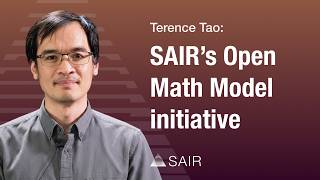
Terence Tao: SAIR’s Open Math Model Initiative
SAIRYouTube137,478 views as of 11 October 2026
Why it is here
Terence Tao’s keynote at the Science x AI Summit at Caltech (Sept 11, 2026) previewing SAIR’s Open Math Model; introduces ‘proof indigestion’ and links the 25 Fields Medalists’ declaration ‘A Severe Misalignment of AI in Mathematics’ (mathandai.org); ~137k views.
Description
Description written by Gemini from the videoGemini 3.8 Flash, 11 October 2026
Summary
Mathematician Terence Tao gives a presentation at the SAIR Science x AI Summit 2026 outlining the disruption of mathematical workflows by AI systems and introducing SAIR’s benchmark challenges and Open Math Model initiative. He illustrates how AI has created a severe bottleneck in proof verification and exposition (“proof indigestion”) and presents results from SAIR’s distillation and Inverse Galois Problem (IGP24) competitions. The presentation concludes with an extended audience Q&A discussing scientific values, research automation, and the risks of data pollution.
What is shown
- [00:06] Title slide: “Mathematics competitions at SAIR” by Terence Tao, UCLA.
- [00:58] Flowchart diagram mapping the traditional mathematical discovery pipeline: open problems $\to$ unverified solutions $\to$ verified solutions $\to$ definitive solutions $\to$ accepted solutions $\to$ well-written solutions.
- [04:49] Diagram updated with thick blue arrows illustrating the current AI surge in proof generation and verification, creating a bottleneck before proof exposition and canonicalization.
- [05:44] Metaphorical illustration of traffic congestion (horse-drawn carriages alongside early automobiles) generated by ChatGPT.
- [06:14] Conceptual illustration of high-speed segregated lanes alongside pedestrian greenways for AI-friendly mathematical infrastructure.
- [06:46] Dystopian AI-congestion render depicting unchecked industrial AI dominance.
- [07:34] Slide detailing SAIR’s programs: event sponsorships, podcasts, research prizes, and the planned open-source math foundation model initiative.
- [08:49] Overview of active SAIR challenges: Distillation, Inverse Galois Problem 24 (IGP24), Modular Arithmetic, Andrews-Curtis (launched that day), and the Lean Kernel challenge.
- [10:37] Overview of the Equational Theories Distillation Challenge dataset covering 22 million universal algebra problems formalised in Lean.
- [12:27] Example slide showing a distilled text “cheat sheet” prompt developed to improve open-source model accuracy.
- [13:58] Slide explaining the Inverse Galois Problem 24 (IGP24) competition covering 165,836 target Galois group signatures for degree-24 polynomials.
- [14:27] Progress graph showing located polynomial signatures increasing from 0.37% before the competition to 98.9% at the end of Stage 1.
- [16:21] Live audience Q&A session covering competition scoring, aligning frontier lab incentives, LLM differences from symbolic automated theorem provers, and training on synthetic mathematical data.
Claims & numbers
- The presenter notes that 24 fellow Fields Medalists released an open declaration on mathematics and AI at
math-and-ai.orgon the morning of the talk [00:35]. - The presenter states that frontier AI models (such as Gemini 3 Deep Think) solve approximately 99% of universal algebra binary operation problems, while standard open-source models perform near random chance (50/50) without prompting assistance [11:26, 11:51].
- In Stage 1 of the Distillation Challenge, competitors compressed universal algebra theory into a 10 KB prompt (“cheat sheet”) that improved open-source model accuracy by 30% to 40% [12:25, 12:35].
- In Stage 2 of the Distillation Challenge, despite allowing calls to open-source LLMs within Python code, the winning contestants used almost no LLM calls [13:09, 13:48].
- For degree-24 polynomials over $\mathbb{Q}$, there are 165,836 possible Galois group signatures across 25,000 transitive groups; prior to SAIR’s IGP24 challenge, only about 600 (0.37%) were documented [14:27, 14:38].
- Following Stage 1 of IGP24, competitors located polynomials for 98.9% of the target signatures [14:27, 15:10].
- The winning team in Stage 1 of the IGP24 competition consisted of two domain experts using traditional symbolic computation rather than AI tools [16:04].
Notable quotes
- [05:19] “We are now getting this very unprecedented traffic jam, or what I call proof indigestion, where we are suddenly creating all these proofs... but no one understands them.”
- [18:20] “I think the academic community has more soft power than it realizes... we have a lot of cachet, and one of the reasons why these companies are chasing these goals is because they’re trying to borrow our prestige.”
- [22:47] “It comes from the slow, deliberate process, the serendipity of sort of just noticing things while you’re working slowly on something, and this is what’s being destroyed.”
Assessment
This is a recording of an in-person keynote address and Q&A given by Terence Tao at the SAIR Science x AI Summit 2026. Tao’s slides display real competition benchmark data, Lean project references, and illustrative AI-generated concept images without misleading claims or undisclosed staging.
Described by gemini-3.8-flash on 2026-10-11 from the video’s audio and frames.