Terence Tao’s AI-in-Math slides (including the infamous cancer slides *facepalm*)
Dr. Samuel Allen Alexander YouTube 38,542 views as of 15 October 2026
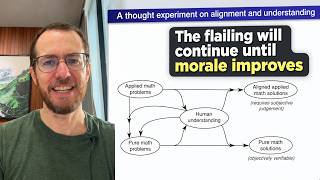
Why it is here
Mathematician and philosopher Samuel Allen Alexander reads and comments on Terence Tao’s ‘Math 2.0’ slide deck (37:50). 39k views.
Description
Description written by Gemini from the videoGemini 3.8 Flash, 15 October 2026
Summary
Dr. Samuel Allen Alexander reviews and critiques a slide deck titled “Math 2.0” delivered by mathematician Terence Tao for an October 2026 Caltech lecture. The video walks through Tao’s slides on AI disruption, “proof abundance,” experimental mathematics projects, and Tao’s controversial cancer thought experiment regarding AI alignment and mathematical understanding.
What is shown
- [00:00] Title slide for Terence Tao’s talk “Math 2.0” (dated October 2026, hosted at
tsworth.github.io/tao-web/slides/math-2-0-caltech-2026.pdf). - [00:52] – [05:51] Slide deck sequence detailing the transition from “Math 1.0” (“proof scarcity”) to “Math 2.0” (“proof abundance”), discussing objective verifiability (Lean proof assistant) and digitizability.
- [10:03] Slide showing Abraham Wald’s World War II aircraft armor/survivorship bias diagram applied to reporting bias in AI-solved mathematical problems.
- [12:29] Presentation of First Proof (
1stproof.org) initiative aimed at benchmark evaluation of AI models on unpublished research problems. - [14:24] – [17:10] Slides highlighting large-scale crowdsourced and automated math projects, including the Equational Theories Project (2024–2025) and the SAIR/LMFDB Inverse Galois Problem challenge (IGP24).
- [18:50] – [22:30] Flowcharts comparing naive and complex models of mathematical understanding, showing how AI could bypass human understanding and feed directly into pure solutions and misaligned applied solutions.
- [23:50] – [27:51] Slide outlining Tao’s cancer cure thought experiment: prompting an AI for a cancer cure that passes Phase 3 trials accompanied by a Lean certificate, questioning whether patients would trust it without mechanistic human understanding.
- [30:00] – [35:42] Slides covering open exposition, the Caltech Mathathon (“Old Problems, New Proofs”), the Integrated Explicit Analytic Number Theory Network (IEANTN), and ablation studies.
Claims & numbers
- The presenter notes that Terence Tao presented the “Math 2.0” lecture at Caltech in October 2026.
- The slide deck states that the Equational Theories Project crowdsourced human and automated proofs to settle over 22 million true/false statements in universal algebra [16:42].
- The slide deck states that the first stage of the Inverse Galois Problem challenge (IGP24) located degree-24 polynomials for each of 25,000 possible Galois groups, with stage two targeting degree 31 [16:55].
- The presenter asserts that academic hiring and tenure boards have historically prioritized open-problem solving over theory building or exposition [01:28, 10:45, 18:02].
- The presenter critiques Tao’s cancer thought experiment, arguing that terminal cancer patients routinely take experimental treatments that pass clinical trials even when the exact biochemical mechanisms are not fully understood [25:33, 26:06].
Notable quotes
- “The advent of modern AI tools is disrupting many long-established professions. My own field of mathematical research... has proven to be particularly susceptible to this type of disruption.” — Reading Terence Tao’s slide [00:34]
- “There’s no world in which gaining new knowledge about mathematics harms mathematics. That’s absolutely ridiculous.” — Dr. Samuel Allen Alexander [10:10]
- “Reaching these lighthouses prematurely by automated tools can disrupt the exploration of the paths not taken, and sterilize the surrounding field.” — Reading Terence Tao’s slide [20:33]
Assessment
This video is an informal commentary and slide-by-slide critique by an independent mathematician analyzing Terence Tao’s October 2026 Caltech presentation deck. The presentation shown on screen is an authentic PDF slide deck displayed in a web browser, interspersed with the host’s reactions and opinions.
Described by gemini-3.8-flash on 2026-10-15 from the video’s audio and frames.