OpenAI Dropped 722 Math Papers Overnight. Mathematicians Lost It.
Singularity Research LabsYouTube38,375 views as of 12 October 2026
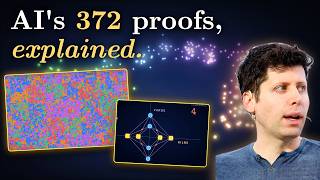
Why it is here
35-minute tour of OpenAI’s 722-manuscript math release and mathematicians’ reactions.
Description
Description written by Gemini from the videoGemini 3.8 Flash, 12 October 2026
Summary
This video by the channel Singularity Research Labs analyzes OpenAI’s October 6, 2026 dump of 722 AI-authored math manuscripts (claiming 372 results) into a GitHub repository. The narrator chronicles the build-up—from earlier Olympiad benchmarks and the September Navier–Stokes blow-up claim dispute—through the mathematical details of five core results in the release and the intense debate it provoked in the mathematics community.
What is shown
- Background & Navier–Stokes Controversy [00:00–06:50]: Overview of David Hilbert’s 1900 problems and the Clay Millennium Prize Problems. Coverage of OpenAI’s September 8, 2026 announcement of a forced Navier–Stokes blow-up solution generated by 10,000 AI agents running for 88 hours, followed by priority accusations from Tristan Buckmaster and Levent Alpöge, pushback from Fields Medalists, and the formation of the independent Advisory Group on Mathematics and Artificial Intelligence (AGMAI).
- Overview of the 722 Papers Repository [06:51–08:14]: Visual map displaying 372 result clusters across 17 fields of mathematics compiled from ~4,000 posed problems, representing roughly 3 hours of internal model thinking compute per result and ~26 million lines of Lean 4 code.
- Result 1: The Flint Hills Series and the Irrationality Exponent of $\pi$ [08:15–12:12]: Detailed breakdown of the Flint Hills sum $\sum_{n=1}^\infty \frac{1}{n^3 \sin^2 n}$, Diophantine approximations of $\pi$ (e.g., 22/7 and 355/113), the definition of the irrationality exponent $\mu(\pi)$, and OpenAI’s Lean-formalized claim that $\mu(\pi) = 2$. Excerpts from OpenAI’s 42-page thought process summary showing the agent’s problem-solving trail.
- Result 2: Integer Multiplication Below $n \log n$ [12:13–15:45]: Exploration of Karatsuba’s algorithm and the Schönhage–Strassen conjecture. Breakdown of OpenAI’s preprint proving an upper bound of $O(n (\log n)^{1 - 2^{-182}})$ on multi-tape Turing machines—a classic “galactic algorithm” that yields no practical speedup on real-world inputs.
- Result 3: Hadwiger–Nelson Problem (Coloring the Euclidean Plane) [15:46–20:50]: Walkthrough of the unit-distance graph chromatic number problem, from Edward Nelson and the Moser spindle to Aubrey de Grey’s 2018 proof that 4 colors are insufficient. Examination of OpenAI’s 3-line Lean theorem stating the Euclidean plane cannot be 5-colored, narrowing the chromatic number to 6 or 7.
- Result 4: Turán’s Brick Factory & the Harary–Hill Conjecture [20:51–23:50]: Graphic illustration of minimum crossing numbers in complete and bipartite graphs, Zarankiewicz’s crossed tracks, and OpenAI’s algebraic proof confirming Hill’s conjecture for all $n$ with complete Lean verification.
- Result 5: Matrix Multiplication Exponent Bound [23:51–26:13]: Historical timeline of bounding the matrix multiplication exponent $\omega$ from Volker Strassen (1969) down to 2.371. Contrast between OpenAI’s initial 83-page preprint ($\omega < 2.258$, labeled “sludge”) and a refined 13-page Lean-verified proof 8 days later establishing $\omega \le 9/4 = 2.25$.
- Remaining Claims & Mathematical Backlash [26:14–34:44]: Partial progress claimed on Millennium problems (quasi-Riemann hypothesis ruling out zeros with $\text{Re}(s) > 7/8$, cases of the Birch and Swinnerton-Dyer conjecture, and the Hodge conjecture for CM abelian varieties), the Unique Games Conjecture, and Hilbert’s 10th problem over $\mathbb{Q}$. Coverage of the Association for Human Mathematics’ critical response, viral social media debates over “maggot sludge” vs. beauty, and reflections on G. H. Hardy’s aesthetic standards.
Claims & numbers
- Repository statistics: The presenter states the release contains 722 manuscripts spanning 34,815 pages, claiming 372 distinct mathematical results across 17 subfields, with roughly 26 million lines of Lean 4 formalization code [00:18, 06:58, 07:42].
- Compute cost: The presenter reports that each result required an average of approximately 3 hours of internal model thinking compute [07:08].
- Direction of results: The presenter claims roughly 1 in 5 of the results disproves an existing conjecture rather than proving it [07:15].
- Navier–Stokes run: The presenter claims OpenAI’s September 8 solution used ~10,000 AI agents executing over an 88-hour span [03:55].
- Irrationality exponent of $\pi$: The presenter states the paper claims $\mu(\pi) = 2$ exactly, implying that the Flint Hills series converges to approximately 30.3145 [10:53, 11:01].
- Integer multiplication: The presenter notes the algorithm achieves $O(n (\log n)^{1 - \kappa})$ with $\kappa = 2^{-182} \approx 1.63 \times 10^{-55}$, which requires numbers with more than $10^{92}$ digits before surpassing $n \log n$ [14:10–14:56].
- Plane coloring: The presenter states the paper proves no 5-coloring of the Euclidean plane exists, bounding the plane’s chromatic number strictly to 6 or 7 [18:08, 20:47].
- Matrix multiplication: The presenter claims the model improved the proven upper bound on $\omega$ to $\omega \le 2.25$, jumping past decades of incremental hundredths-of-a-decimal improvements [25:01, 25:47].
- Quasi-Riemann hypothesis: The presenter states the paper claims a zero-free strip for $\zeta(s)$ and Dirichlet $L$-functions for $\text{Re}(s) > 7/8$ alongside the non-existence of Landau–Siegel zeros [26:59].
Notable quotes
- [00:48] Levent Alpöge (tweet): “It’s obviously the most significant moment in mathematical history.”
- [08:01] G. H. Hardy (quoted): “Beauty is the first test: there is no permanent place in the world for ugly mathematics.”
- [13:35] Presenter: “And they conjectured that $n \log n$ was the true speed limit: nothing faster.”
Assessment
This is a documentary-style retrospective review and explainer video, combining animated visual proofs (using Manim-style motion graphics), paper excerpts, and social media quotes. The video accurately documents the public claims, preprints, and community controversies surrounding the release while clearly differentiating between computer-verified Lean code and unrefereed mathematical claims.
Described by gemini-3.8-flash on 2026-10-12 from the video’s audio and frames.