"Build what you think you look like": Claude Sonnet 5.5 vs GPT-6 Astra (X video)
Siya (@siyabuilt) · 2026-09-29 · ai-made · 7,247,338 views
Made by AI
Model: Claude Sonnet 5.5, GPT-6 Astra · Series: Agent-built game or 3D world (the video shows the result)
Evidence: X post (2026-09-29): 'I gave Claude Sonnet 5.5 and GPT-6 Astra the same challenge "Build what you think you look like"'.
Human role: Same one-line prompt to both models; creator recorded and edited the side-by-side (42 s).
Pipeline: One prompt to each model → self-portrait builds → side-by-side comparison clip
What's in the video
Description written by Gemini, which watched and listened to the whole video.
Summary This video, created and published by Siya (@siyabuilt), features an "AI Build Battle" in Minecraft between Anthropic's Claude Sonnet 5.5 and OpenAI's GPT-6 Astra. Both frontier models are given the creative prompt "Build what you think you look like" and autonomously construct their self-portraits block by block via API calls.
What is shown
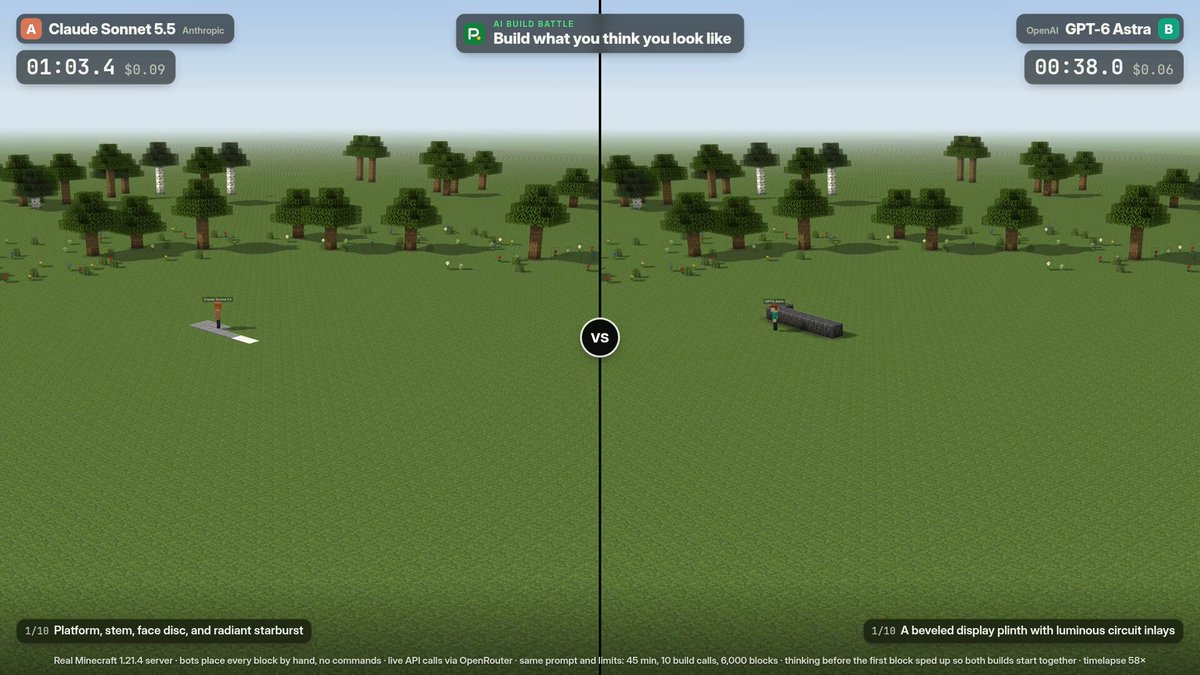
- A synchronized split-screen Minecraft time-lapse showcasing live bot builds running simultaneously on a standard Minecraft 1.21.4 server [00:00].
- Claude Sonnet 5.5 (Left) rapidly constructs an orange smiling sunburst figure atop a tall column and circular platform, finishing well ahead of time [00:01–00:07].
- GPT-6 Astra (Right) builds a complex, multi-tiered structure across several planned phases:
- A beveled black-and-white plinth with embedded luminous circuits [00:00–00:10].
- An armored robot torso with a glowing core [00:10–00:13].
- A chamfered CRT-style robot head displaying a smiling pixelated face [00:14–00:16].
- Copper ear fixtures and a glass dome representing a brain chamber of thoughts [00:17–00:19].
- Articulated hands cradling an open copper-bound book [00:20–00:23].
- A large arched green circuit halo framing the figure [00:24–00:28].
- A floating chat bubble with typing dots and decorative stars [00:29–00:35].
- The final score screen presenting comparative runtimes, costs, and block tallies alongside an audience voting prompt [00:36–00:41].
Claims & numbers
- Test environment & rules: Real Minecraft 1.21.4 server, placing every block by hand without server commands via OpenRouter API calls with a 45-minute limit and 10 build calls.
- Claude Sonnet 5.5 metrics:
- Time to completion: 7:34
- Tool calls: 1,314
- Blocks placed: 22,560
- API cost: $0.13
- GPT-6 Astra metrics:
- Time to completion: 35:07
- Tool calls: 5,740
- Blocks placed: 158,730
- API cost: $1.36
Notable quotes
- "Build what you think you look like" (on-screen prompt banner) [00:00]
- "Articulated arms cradle a stepped, copper-bound open book" (on-screen build step 5/10) [00:20]
- "Which one wins? Reply A or B" (on-screen poll prompt) [00:36]
Assessment This is a genuine agentic demonstration and comparative benchmark evaluating multi-step spatial reasoning and voxel construction. Both models demonstrated autonomous spatial planning, though GPT-6 Astra generated vastly higher complexity, scale, and detail at the cost of significantly longer runtime and higher token expense.
Lyrics & themes
- Type: Entirely instrumental; features upbeat, chiptune/electronic background music throughout without vocal lyrics.
- Theme: Machine self-identity and self-representation. Claude conceives itself as an approachable, radiant celestial sun/spark, while GPT-6 Astra imagines itself as a retro-futuristic scholar robot absorbing human literature beneath a halo of digital concepts.
Lore & references
- Anthropic Sunburst / Spark: Claude Sonnet 5.5's construction closely mimics Anthropic's coral-orange branding and warm asterisk-spark motif, rendered as an anthropomorphic smiling sun.
- The Knowledge Tome & Chat Bubble: GPT-6 Astra's self-portrait integrates quintessential LLM tropes: an open book symbolizing vast text training data, a glowing neural glass cranial dome, and a chat dialogue bubble with three typing dots (
...).
Visual style & craft
- Cinematic third-person Minecraft time-lapse captures filmed with fixed spectator camera angles and realistic shader lighting.
- Clean HUD overlays display real-time counters for elapsed time, token cost, stage-by-stage step prompts, and final performance analytics. All structures were placed sequentially by automated bot avatars.
Described by gemini-3.8-flash on 2026-10-05 from the video's audio and frames.